
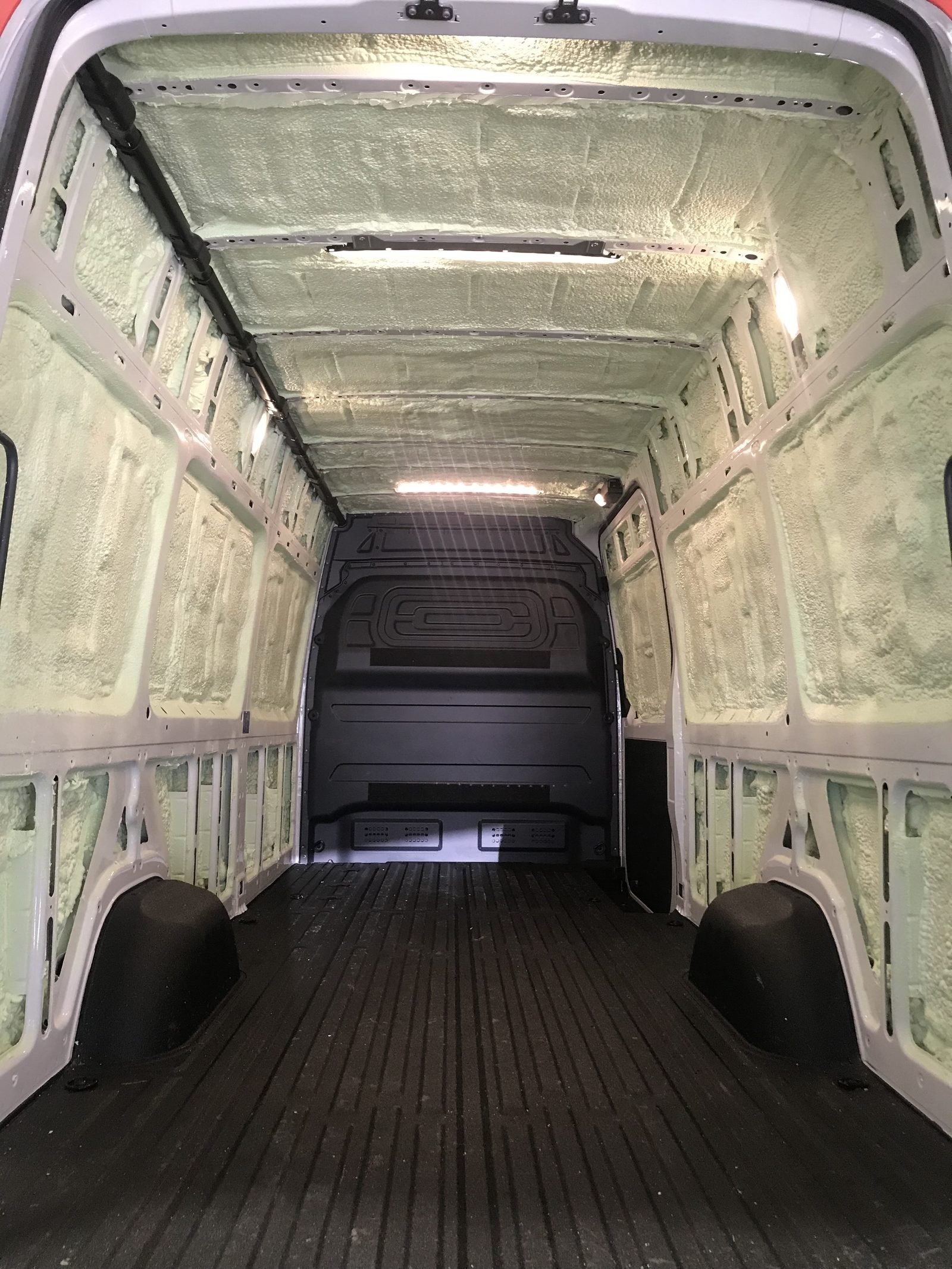
Why trailers condense so readily
A trailer is a thin metal box with a large surface area relative to its volume, towed through moving air. It reaches ambient temperature faster than any building and holds no thermal mass at all.
Put anything warm inside - animals, people, equipment brought in from a heated shop - and the interior air is immediately warmer and more humid than the skin. Water forms on the inside of the panels and runs down the walls.
In a stock trailer that means wet bedding and stressed animals. In a cargo trailer it means damaged freight. In a living-quarters trailer it means the walls are wet every cold morning.
What foam changes
Closed-cell bonded to the interior skin removes the cold surface and provides vapour control in the same pass. Because it adheres to the panel and to the frame members, it also does not sag, shift or fall out under road vibration - which is the standard failure mode of batt in anything that moves.
The secondary effects are the ones owners mention: a much quieter trailer, and a skin that flexes and drums noticeably less.
Different trailers, different priorities
Cargo and utility. Usually about condensation protecting the load, plus enough R to stop the interior swinging with the weather. One to two inches of closed-cell is typical.
Horse and stock. Animal comfort and ventilation together. Foam removes the drip onto animals, and ventilation still has to be adequate for the load - the two are designed together, not traded off.
Living quarters and mobile offices. Genuine four-season envelope requirements. Thicker application, careful attention to the floor, and planning for wiring and services before spraying.
Job-site and mobile units. Working spaces in Alberta weather. Treated like a small building rather than a trailer.
The floor is usually the weak point
Trailer floors are exposed directly to road spray, cold air and gravel. They are also the surface people and animals stand on, so they are what gets noticed.
Insulating the underside is effective but needs a protective covering - unprotected foam under a trailer will be damaged by road debris and degraded by UV. Ask how the underside will be finished.
We take care of the work
You are dealing with the contractor directly on Trailer Spray Foam Insulation Alberta. We quote the job, we schedule it, and our own installers do the work.
Trailer Spray Foam Insulation Alberta: Common Questions
Will foam add much weight? Closed-cell adds real weight over a large surface. On a trailer where payload matters, get the number as part of the quote rather than discovering it at the scale.
Can it be applied to an aluminium trailer? Yes. Adhesion to clean, dry, properly prepared aluminium is good. Preparation matters more on aluminium than on steel, not less.
What about the existing interior liner? Foam must bond to the substrate being insulated. A liner either comes off, or the foam goes over it - which changes the assembly and needs to be a deliberate decision.
Will it stop the noise? Substantially. Damping the large flat panels is where most trailer noise comes from.
Get a trailer quoted
Get a quote with the trailer type, dimensions and what it hauls. See vehicle insulation and vans.