
The container sweats, badly
Corten steel walls with nothing behind them go straight to outdoor temperature. Any moisture in the interior air condenses on them - and containers generate their own moisture, because the plywood floor and anything stored inside give off vapour as temperature swings.
The result is well known to anyone who has used one: water running down the inside walls, pooling on the floor, and everything in the container damp. Container users call it container rain, and it is purely a dew-point problem.
Interior or exterior application
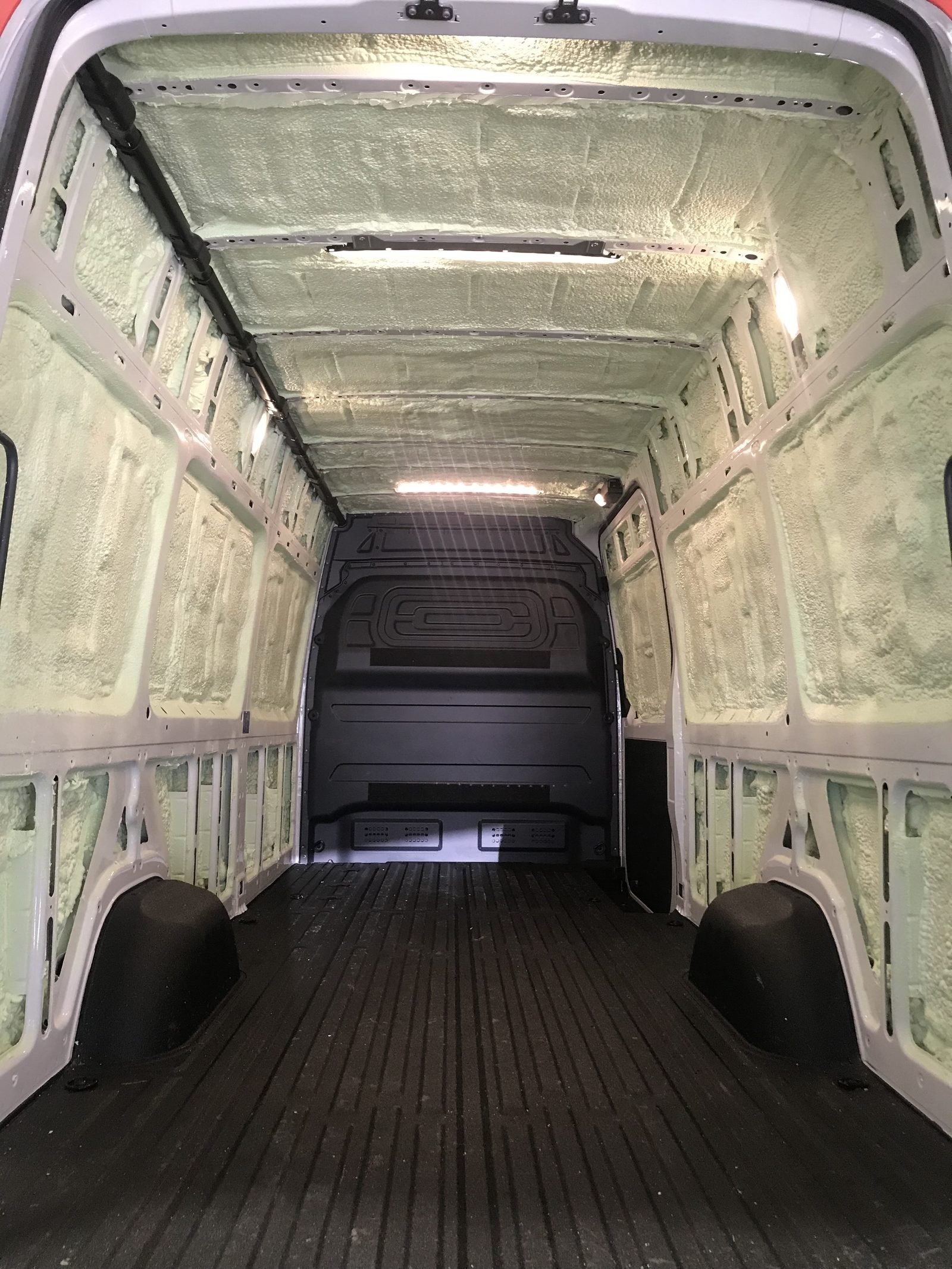
Interior is the common choice. Closed-cell sprayed to the inside of the walls and ceiling removes the condensing surface entirely and fills the corrugations, giving a flat surface to finish against.
The cost is interior space. A container is only about 2.3 metres wide inside, and two inches off each wall is noticeable. It is usually accepted because the alternative does not work.
Exterior preserves the interior dimension and keeps the steel warm, but it needs a protective and UV-resistant coating and a cladding plan. It is the better technical answer for a permanent building and the more expensive one.
Why closed-cell and not batt
Framing out the inside and batting it is a common DIY approach and it fails the same way every time. The framing creates a cavity between the insulation and the steel, humid air reaches the cold wall through and around the batt, and it condenses in the cavity where it cannot dry.
Closed-cell bonded directly to the steel leaves no cavity and no path. It is the only approach that removes the mechanism rather than hiding it.
Corrugations, and why foam suits them
The corrugated profile has no flat surface to fasten to and no parallel-sided cavity. Foam sprayed onto it fills the profile completely, bonds along the whole surface, and gives you a flat plane to strap and finish against.
It also stiffens the panels and cuts the drumming noise that makes a bare container so loud in rain and hail.
Who you are dealing with
We take care of Shipping Container Spray Foam Insulation Alberta end to end -- the assessment, the quote, the scheduling and the spraying. Our crews do the work.
Shipping Container Spray Foam Insulation Alberta: Common Questions
How thick for an Alberta container? Typically two inches of closed-cell for a tempered space and three or more where the container is heated and occupied through winter. Set against use and available interior width.
Does the foam need to be covered? If the container is an occupied building, thermal-barrier requirements under the building code apply. If it is unheated storage, requirements differ. We confirm what applies to your use.
What about the floor? Container floors are treated plywood over steel cross-members and they are a real thermal weak point. Insulating underneath needs a protective covering; insulating over the top costs headroom. Both are done - it depends on the build.
Can I spray it myself with a kit? Kits exist. What they do not give you is controlled thickness, correct substrate temperature, or adequate ventilation and PPE inside a sealed steel box. That last one is the reason to think hard about it.
Get a container quoted
Get a quote with the container size, how it will be used and whether it will be heated. See metal buildings and self storage.
Where We Cover Shipping Container Spray Foam Insulation Alberta
- Shipping Container Spray Foam Insulation Acheson
- Shipping Container Spray Foam Insulation Airdrie
- Shipping Container Spray Foam Insulation Athabasca
- Shipping Container Spray Foam Insulation Banff
- Shipping Container Spray Foam Insulation Barrhead
- Shipping Container Spray Foam Insulation Beaumont
- Shipping Container Spray Foam Insulation Blackfalds
- Shipping Container Spray Foam Insulation Bonnyville
- Shipping Container Spray Foam Insulation Bow Island
- Shipping Container Spray Foam Insulation Brooks
- Shipping Container Spray Foam Insulation Calgary
- Shipping Container Spray Foam Insulation Camrose
- Shipping Container Spray Foam Insulation Canmore
- Shipping Container Spray Foam Insulation Cardston
- Shipping Container Spray Foam Insulation Carstairs
- Shipping Container Spray Foam Insulation Chestermere
- Shipping Container Spray Foam Insulation Clairmont
- Shipping Container Spray Foam Insulation Claresholm
- Shipping Container Spray Foam Insulation Coaldale
- Shipping Container Spray Foam Insulation Cochrane
- Shipping Container Spray Foam Insulation Cold Lake
- Shipping Container Spray Foam Insulation Crossfield
- Shipping Container Spray Foam Insulation Devon
- Shipping Container Spray Foam Insulation Diamond Valley
- Shipping Container Spray Foam Insulation Didsbury
- Shipping Container Spray Foam Insulation Drayton Valley
- Shipping Container Spray Foam Insulation Drumheller
- Shipping Container Spray Foam Insulation Edmonton
- Shipping Container Spray Foam Insulation Edson
- Shipping Container Spray Foam Insulation Fort Macleod
- Shipping Container Spray Foam Insulation Fort McMurray
- Shipping Container Spray Foam Insulation Fort Saskatchewan
- Shipping Container Spray Foam Insulation Fox Creek
- Shipping Container Spray Foam Insulation Grande Cache
- Shipping Container Spray Foam Insulation Grande Prairie
- Shipping Container Spray Foam Insulation High River
- Shipping Container Spray Foam Insulation Hinton
- Shipping Container Spray Foam Insulation Innisfail
- Shipping Container Spray Foam Insulation Lacombe
- Shipping Container Spray Foam Insulation Langdon
- Shipping Container Spray Foam Insulation Leduc
- Shipping Container Spray Foam Insulation Lethbridge
- Shipping Container Spray Foam Insulation Lloydminster
- Shipping Container Spray Foam Insulation Medicine Hat
- Shipping Container Spray Foam Insulation Morinville
- Shipping Container Spray Foam Insulation Nisku
- Shipping Container Spray Foam Insulation Okotoks
- Shipping Container Spray Foam Insulation Olds
- Shipping Container Spray Foam Insulation Peace River
- Shipping Container Spray Foam Insulation Picture Butte
- Shipping Container Spray Foam Insulation Pincher Creek
- Shipping Container Spray Foam Insulation Ponoka
- Shipping Container Spray Foam Insulation Raymond
- Shipping Container Spray Foam Insulation Red Deer
- Shipping Container Spray Foam Insulation Redcliff
- Shipping Container Spray Foam Insulation Rimbey
- Shipping Container Spray Foam Insulation Rocky Mountain House
- Shipping Container Spray Foam Insulation Sherwood Park
- Shipping Container Spray Foam Insulation Slave Lake
- Shipping Container Spray Foam Insulation Spruce Grove
- Shipping Container Spray Foam Insulation St. Albert
- Shipping Container Spray Foam Insulation St. Paul
- Shipping Container Spray Foam Insulation Stettler
- Shipping Container Spray Foam Insulation Stony Plain
- Shipping Container Spray Foam Insulation Strathmore
- Shipping Container Spray Foam Insulation Sundre
- Shipping Container Spray Foam Insulation Sylvan Lake
- Shipping Container Spray Foam Insulation Taber
- Shipping Container Spray Foam Insulation Three Hills
- Shipping Container Spray Foam Insulation Vegreville
- Shipping Container Spray Foam Insulation Vermilion
- Shipping Container Spray Foam Insulation Wainwright
- Shipping Container Spray Foam Insulation Westlock
- Shipping Container Spray Foam Insulation Wetaskiwin
- Shipping Container Spray Foam Insulation Whitecourt