
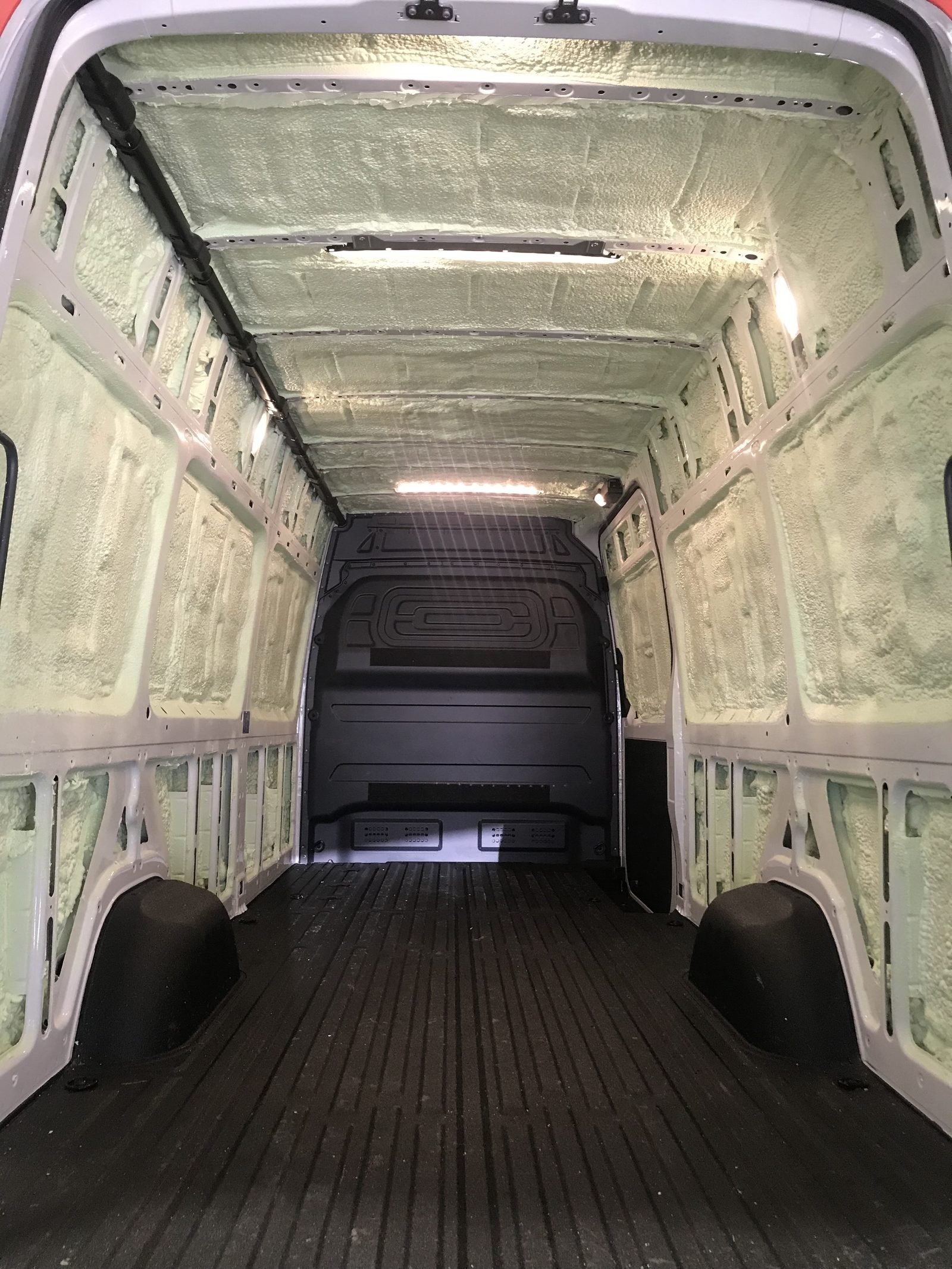
Shipping container spray foam insulation in Cochrane is acreage and yard work. A sea can is the cheapest secure dry-looking storage available, so they sit on properties all around this town holding tack, tools, quads, seasonal equipment and the overflow from a shop, and the one thing every owner eventually discovers is that dry-looking is not the same as dry.
A steel box in the place with the widest swings
A container is a sealed box of thin steel with no insulation and no thermal mass, so its inside surface follows the outside temperature almost exactly. Put that box where Cochrane is, close enough to the foothills to catch every chinook, and it is being driven up and down through freezing repeatedly all winter rather than settling anywhere. Every one of those crossings is a chance for the air inside to give up its moisture onto the steel.
Why the sweat forms and where it lands
Warm air holds moisture, cold steel does not warm it, and the difference goes onto the surface as water. In a container that surface is the ceiling and the upper walls, so the water forms above everything stored and falls onto it. Owners describe it as a leak and go looking for a hole in the roof, and there is no hole. The water was already inside as vapour and the box simply gave it a cold surface to land on.
The material has to be stuck to the skin itself
The fix is a closed cell foam sprayed straight onto the inside of the skin, with no gap and no cavity behind it. That does two things at once: it insulates, and because it adheres continuously it stops air reaching the steel at all, which is what actually ends the condensation. Anything installed with a gap behind it leaves the steel accessible and the water simply forms out of sight, which is worse than leaving it alone, because it is then unseen.
The corrugations, and what will not fit them
The wall of a container is not flat. It is a repeating profile, and any rigid board or batt system crosses those ridges leaving continuous voids behind it, exactly the gap that has to be eliminated. Sprayed foam follows the profile into every corrugation and sticks to all of it. That fit is the technical reason this is the method for a container rather than a preference.
Shipping Container Spray Foam Insulation Cochrane: Common Questions
Water is dripping inside. Where is the leak? Usually there is none. It is condensation forming on the cold ceiling above your contents.
Can we use rigid board instead? Not effectively. The corrugated wall leaves voids behind board, and those voids are where the condensation then happens unseen.
Does it need insulating if it is only storage? That is the main reason to do it here. The point is protecting the contents from condensation, not heating the box.
What is used as the covering? Normally drywall or an approved panel. On a Cochrane container that thermal barrier is part of the fit-out and belongs in the scope from the start.
Size the assembly with the R-value calculator, then get a free Cochrane quote. More on Shipping Container Spray Foam Insulation Alberta.