
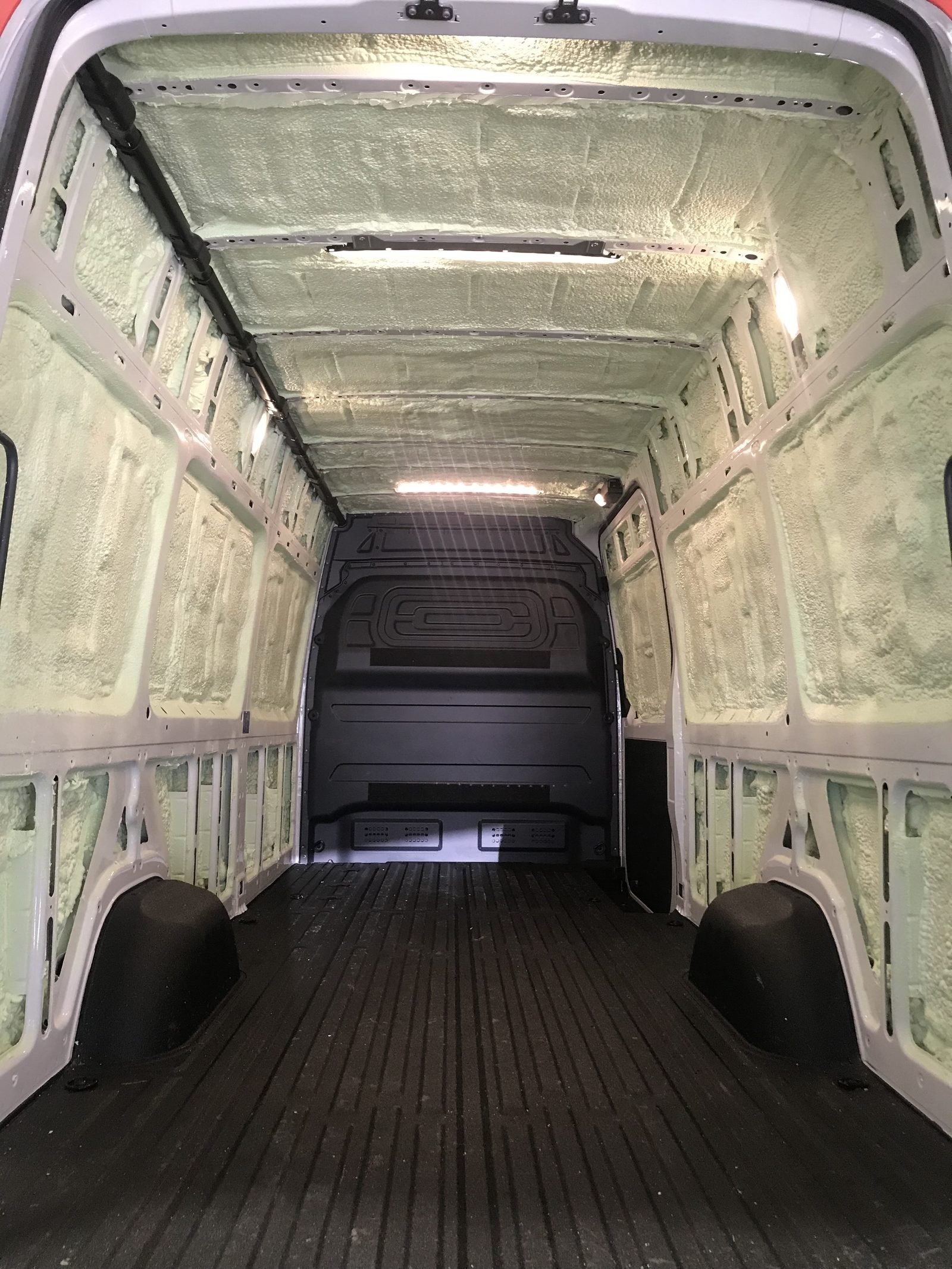
Shipping container spray foam insulation in Chestermere covers two uses that look different and share one problem. There are the containers sitting on acreages holding tools, tack and seasonal equipment, and there are the ones on building sites across a city that has not stopped expanding. Both are steel boxes and both sweat.
Thin steel with nothing behind it to slow anything down
A container is thin steel with no insulation and no thermal mass, so its inner surface follows the outside temperature almost exactly and reaches it within the hour. Air inside holds moisture, that moisture meets a cold ceiling, and it condenses there. Because the coldest surface is overhead, the water forms above everything stored and falls onto it, which is why owners describe a leak and then cannot find a hole. There is no hole. The water was already inside as vapour, and the box simply supplied it a cold surface to land on. Everything stored in the upper half of the container gets it first.
Sun on the steel is the other half of it
The mechanism runs in both directions and the flat open exposure here supplies both. A container in full sun on a Chestermere acreage gets far hotter inside than the air does, and the swing between that and a cold night is what drives the moisture around. Anyone who has opened one on a July afternoon knows the temperature; the part that matters is that the same box is below freezing twelve hours later.
Closed cell sprayed straight to the skin
The method is a closed cell foam applied directly onto the inside of the steel with no gap behind it. It insulates and it stops air reaching the skin, and stopping the air is what actually ends the condensation. Anything installed with a space behind it leaves the steel accessible, so the water still forms and now forms where nobody can see it, which is worse than doing nothing.
The corrugations are why nothing rigid fits
The wall of a container is a repeating profile rather than a flat plane. Rigid board or batt crosses the ridges and leaves a continuous void behind it, which is precisely the gap that has to be eliminated. Sprayed foam follows the profile into every corrugation and adheres to all of it. That fit is the technical reason this is the method rather than a preference.
Shipping Container Spray Foam Insulation Chestermere: Common Questions
Water drips inside but there is no hole. Where is it from? It is condensation on the cold ceiling above your contents, not a leak.
Can we line it with rigid board instead? Not effectively. The corrugated wall leaves voids behind board and the condensation then happens out of sight.
It is only storage. Does it need doing? That is the main reason to do it. The point is protecting what is inside from condensation rather than heating the box.
What counts as occupied? People spending time inside it. Once a Chestermere container becomes an office, a crib or a break space, a thermal barrier over the foam is required.
Size the assembly with the R-value calculator, then get a free Chestermere quote. More on Shipping Container Spray Foam Insulation Alberta.