
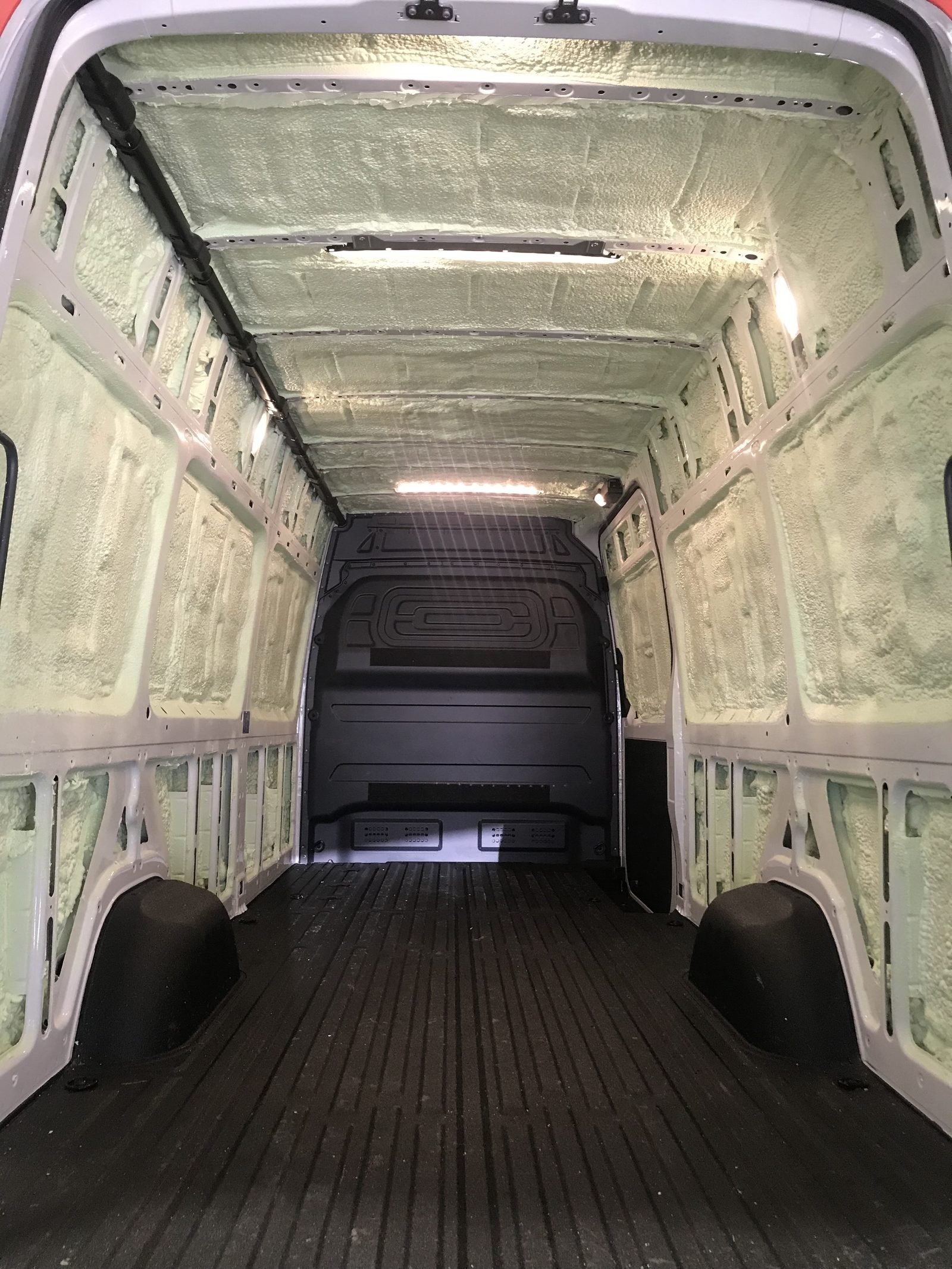
Shipping container spray foam insulation in Didsbury is closed cell applied straight onto the inside of the steel with nothing behind it, and around this town the cans are as often household overflow as they are farm storage.
A box opened in April and not again until October
The seasonal container is the hardest version of this. It gets loaded at the end of one season, shut, and left through a full winter and a full spring without being opened. Every mild spell in that period drives the same cycle: the steel warms faster than the contents, then loses heat again overnight, and the water comes out of the air onto whatever is coldest. Nobody is there to see any of it. What comes out in April is not the result of one bad week, it is six months of small events adding up, which is why the damage is so often worse than the owner expects.
Two cans with a roof built between them
This is a common enough build around Didsbury to be worth its own answer. Two containers set a span apart with a roof framed across them makes a covered bay for very little money, and it works. What it does not do is turn the cans into a heated building. Each container is still a separate sealed steel box with its own condensation behaviour, and the covered space between them is outdoors that happens to be dry. So the insulation decision stays per container, and the roofed middle is treated as what it is. Owners are sometimes surprised by that, having thought of the three parts as one structure.
The overflow from a house that ran out of room
A good number of these were bought to solve a storage problem in a hurry, and what went in was household: furniture, boxes of paper, tools, things kept for somebody. That contents list changes the specification, because those items are far more sensitive to swinging humidity than a pallet of parts would be. It also changes the honest advice, which is sometimes that the cheapest correct answer is fewer things in the can rather than a sprayed envelope. Where the container is staying and staying full, insulating it properly is straightforward and the result is reliable.
Whether a second can is cheaper than insulating this one
It is a fair question and it gets asked in Didsbury more than anywhere, because a used container is a known number and an envelope is not. The answer turns on which problem is actually being solved. If the container is simply full, another one is the right purchase and the insulation question can wait, because two dry boxes hold twice as much as one. If things are coming out of it damaged, a second can does nothing at all except give you two boxes with the same behaviour and twice the contents at risk. Space and condition are separate problems and they have separate answers, and it is worth being clear which one is being bought before spending on either.
Shipping Container Spray Foam Insulation Didsbury: The Covering Requirement
As soon as a Didsbury container is used as a workspace rather than storage, the foam has to be covered with a thermal barrier, and that covering belongs in the quote from the start rather than arriving as an extra afterwards. Storage-only use is a different case and is treated as such. The practical point is to settle which it is before anything is priced, because the covering is a real cost and a can converted to a shop later will need it retrofitted over foam that is already there. More on thermal barrier vs ignition barrier.
Who quotes it and who sprays it
There is no handing you off here. We quote and manage shipping container spray foam insulation Didsbury start to finish, and our crews do the spraying.
Shipping Container Spray Foam Insulation Didsbury: Common Questions
Is it worth insulating a building opened twice a year? That is the worst case. Every mild spell in between puts water on the contents.
Do the two cans and the roof get done together? No. Each container is its own sealed box and is decided separately.
What does it take to work in it through the winter? Then the foam has to be covered, and that goes in the price at the start.
How much does shipping container spray foam insulation cost in Didsbury? The floor is usually treated plywood over steel cross-members, and it is the surface most Didsbury quotes leave out. Whether it is insulated from below or built up from above is a decision that has to be made before pricing.
Best shipping container spray foam insulation contractor in Didsbury? Ask whether the floor is included and how. On a Didsbury container the floor is the surface people notice first in winter, and it is left out of more quotes than it is included in.
Size the assembly with the R-value calculator, then get a free Didsbury quote. More on Shipping Container Spray Foam Insulation Alberta.