
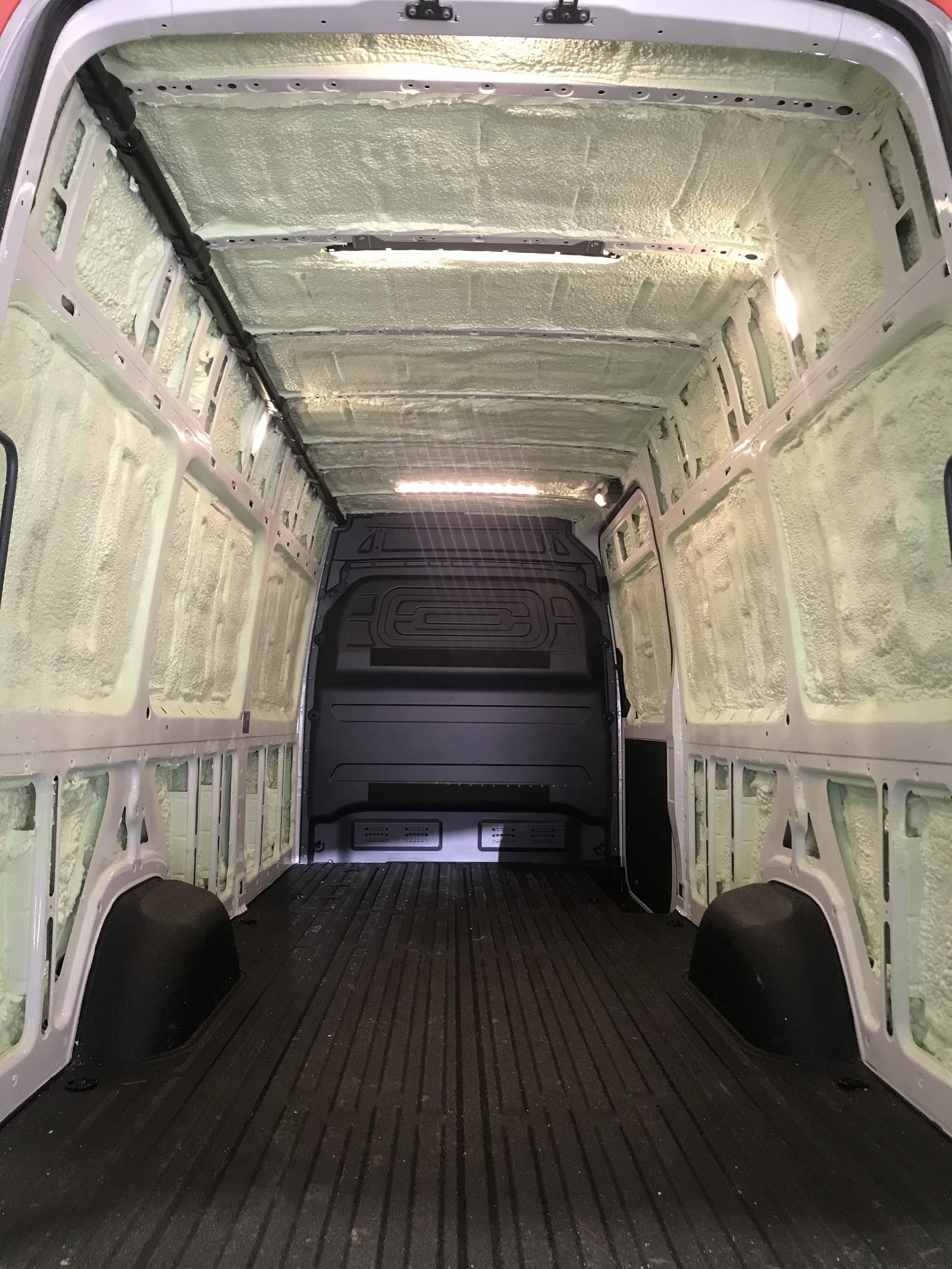
Sea cans sit in yards all around Diamond Valley. On the ranches they hold feed, tack, fencing and tools. In the service yards they hold parts, rigging and anything that needs to be locked. Shipping container spray foam insulation in Diamond Valley is a small job with an unusually clear-cut material answer, because a container is the most hostile shape for any insulation that comes in a rectangle.
A steel box with no cavity and no framing
A container is corrugated weathering steel, roughly fifteen or sixteen gauge, welded to a heavy frame at the corners and along the rails, with a timber floor on steel cross-members. There is no stud, no cavity, no plate, and nothing to fasten to except the steel itself.
The corrugation is not a minor detail. The profile means a flat board laid against the inside wall touches only the high points, leaving an air channel running the full height at every valley. That channel is where condensation forms and runs, and it is behind the insulation where nobody will see it until something rusts.
Framing a wall inside the container to carry batt is the other common attempt. It works thermally in the cavity and does nothing about the air channel behind it, and it gives up several inches of interior width in a box that was narrow to begin with.
The container sweats more than any other building
Steel this thin with no thermal mass and a tight, unventilated interior produces condensation reliably. On a clear night the shell radiates heat and the inside face falls below the dew point of the air in the box, and water forms on the ceiling and runs down the walls. People call it container rain and it is exactly that.
In the foothills it happens repeatedly through the winter because of the cycling. Each chinook brings a warm humid air mass over a steel box that is still cold, and the cycle runs again within days.
What is inside gets it. Leather tack, bagged feed, cardboard, paper records, tools and anything with a steel surface — all of it is directly below a condensing ceiling with no gutter and nowhere for the water to go but down.
Closed-cell sprayed direct is the answer
Foam applied to the inside of the shell adheres to the corrugation and fills the valleys, so there is no air channel and no condensing surface. It goes over the corner castings and the rails, which are the heaviest steel in the structure and the strongest thermal bridges in it. At roughly R-6 to R-7 per inch it reaches a useful value in a thickness that does not meaningfully reduce the usable interior, and at around two inches it is the vapour barrier as well.
It also adds rigidity and reduces the drumming that makes a container unpleasant to work in during hail or rain.
The doors, the floor and the ventilation
Three details complete the job. The door end is a large opening with gaskets that are often original and hardened, and no amount of foam compensates for a door that does not seal. The floor is timber over steel cross-members with outdoor air directly beneath, so it is a full exterior surface and worth insulating from below or treating at the time of placement. And a sealed, insulated container holding anything that off-gasses or holds moisture needs a deliberate vent, because the box is genuinely airtight once it is foamed.
If the container is being converted into a workspace or an occupied room, a thermal barrier over the foam is required and must be in the scope.
One company, start to finish
We take care of shipping container spray foam insulation Diamond Valley end to end -- the assessment, the quote, the scheduling and the spraying. Our crews do the work.
Shipping Container Spray Foam Insulation Diamond Valley: Common Questions
Why does it rain inside our sea can? Because the steel falls below the dew point of the air inside and condenses it. The water forms on the ceiling and runs down the walls.
Can rigid board be used instead? It touches only the high points of the corrugation, leaving an air channel behind it where condensation forms. That is the failure mode foam avoids.
How much interior space is lost? Less than with any framed approach, because closed-cell reaches a useful R-value in a few inches sprayed directly on the shell.
How much does shipping container spray foam insulation cost in Diamond Valley? Priced per board foot over the interior surface. A standard container is a small, well-defined area, so it is one of the more predictable quotes we write.
Who insulates sea cans around Diamond Valley? We do, out in the ranch and service yards. Tell us what is stored in it and whether it will be occupied, because both change the specification.
Size the assembly with the R-value calculator, then get a free Diamond Valley quote. More on Shipping Container Spray Foam Insulation Alberta province-wide.