
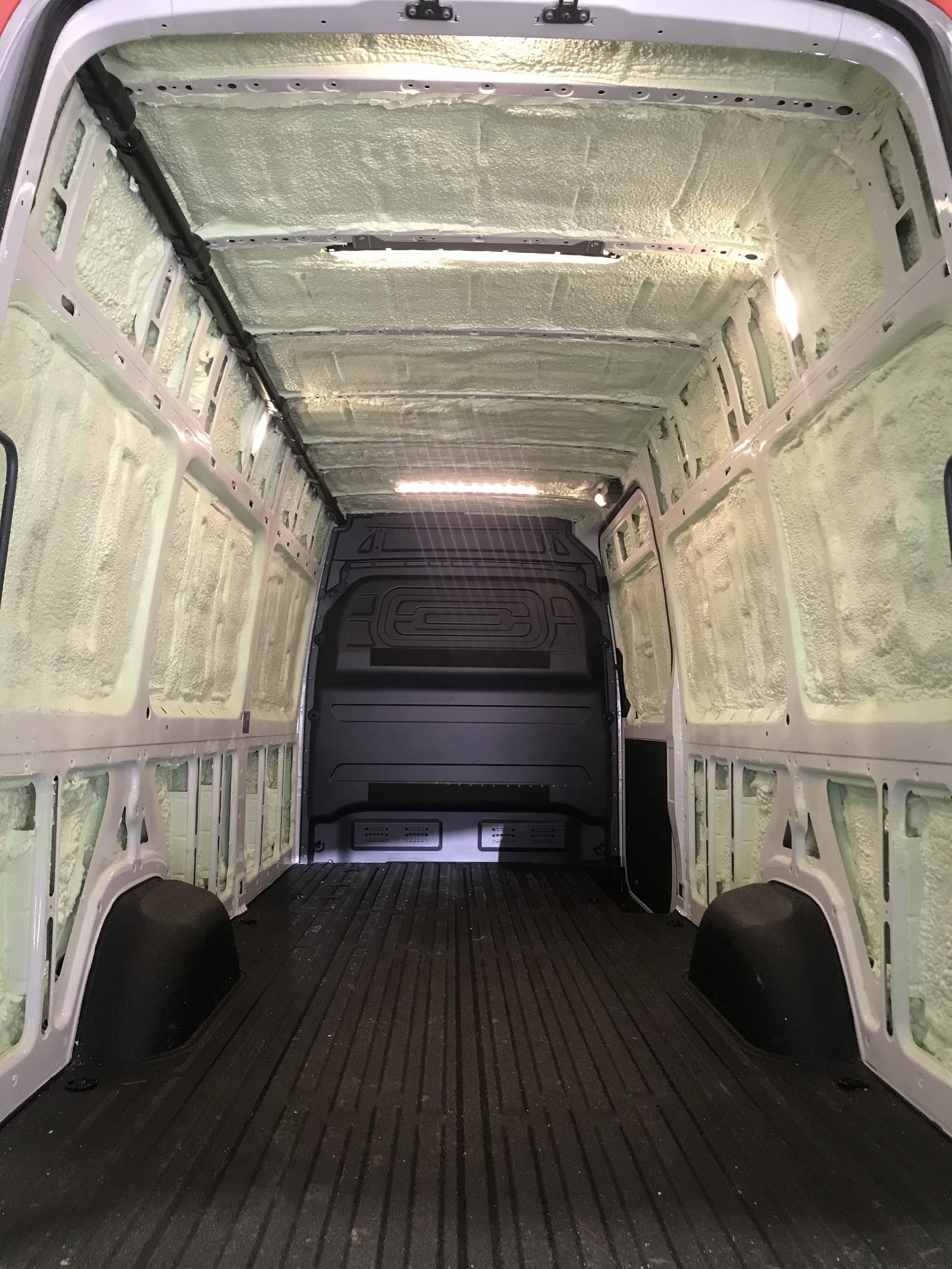
Shipping container spray foam insulation in Rimbey is work on sea cans sitting on farm yards and oilfield service yards around the county, where they serve as secure tool storage, parts stores, site offices and occasionally a small heated workspace. They are an excellent box and a terrible building, and understanding why makes the specification obvious.
A sea can is a single sheet of steel with nothing behind it
There is no cavity, no framing to speak of beyond the corrugation itself, and no thermal break anywhere in the structure. Outdoor temperature arrives at the inside surface essentially undiminished. Combine that with an airtight steel shell and you get a container that is colder inside than outside on a winter morning and hotter inside than outside on a July afternoon, with nothing in the assembly to slow either direction. The box was designed to be stacked on a ship, not to protect anything from weather while standing still for ten years.
The thing that destroys contents is the sweat
Because the shell is almost airtight, any moisture that gets in stays in. It comes in with wet equipment, with snow on boots, from a dirt pad underneath, and in the air itself every time the doors are opened. When the steel cools overnight that moisture condenses on the walls and the ceiling, runs down the corrugations, and drips onto whatever is stored below. People call it container rain and it is exactly that. In a climate that stays cold for weeks, the condensate freezes to the inside of the roof and then releases all at once when the weather turns, which is how a container full of dry goods ends up soaked in March.
Why closed-cell and why on the inside of the corrugation
Sprayed directly to the inside of the steel, closed-cell bonds into every corrugation with no gap behind it, which is the entire point: there is no longer a cold steel surface for interior air to reach. At roughly two inches it is a vapour barrier in its own right and delivers about R-6 to R-7 per inch, so a workable value fits without eating the internal dimensions that make the container useful. Anything that leaves an air space against the steel, including rigid board on a furring frame, reproduces the condensation problem behind the finish where it cannot be seen.
The floor, the doors and the pad it sits on
Container floors are usually treated plywood over steel cross members with open air underneath, and in a parkland winter that underside is exposed to drifted snow and to whatever moisture is coming out of the ground. Insulating the floor from below, or building up from inside if the headroom allows, matters more than people expect. The doors are a weather seal designed for a ship, not a thermal one, and a container used as a workspace needs that boundary thought about separately. And a can set on bare soil rather than on blocking or gravel will keep feeding moisture up into itself regardless of what is sprayed inside it.
Converting one into something people work in
Once a container is heated, even intermittently, it becomes a building and the assembly has to behave like one. That means the full shell including the ceiling, attention to the door opening, and some means of ventilating a very small airtight volume that someone is going to run a heater in. We would rather have that conversation before spraying than after.
The crew on your job
Nobody gets handed your shipping container spray foam insulation Rimbey job. We quote the job, schedule it and stand behind it, and our crews are the ones who show up.
Shipping Container Spray Foam Insulation Rimbey: Common Questions
Why does it rain inside our sea can? Moisture trapped in an airtight steel box condenses on the shell when it cools. The water was already inside.
Can rigid board be used instead? It leaves an air space against the steel, and the condensation then happens behind it. Adhered foam removes the gap.
How much room does it take up inside? Two to three inches off each surface, which is the trade for the performance. Closed-cell gives the most value per inch, which is why it suits a space this tight.
How much does shipping container spray foam insulation cost in Rimbey? Priced per board foot over the sprayed area, and a container is a small, well-defined area. Doing several on one visit is more efficient than one at a time.
How do I choose a shipping container spray foam contractor in Rimbey? Ask what they will do about the floor and what the can is sitting on. A quote covering only the walls and ceiling has left the wettest surface out.
Size the assembly with the R-value calculator, then get a free Rimbey quote. More on Shipping Container Spray Foam Insulation Alberta province-wide.