
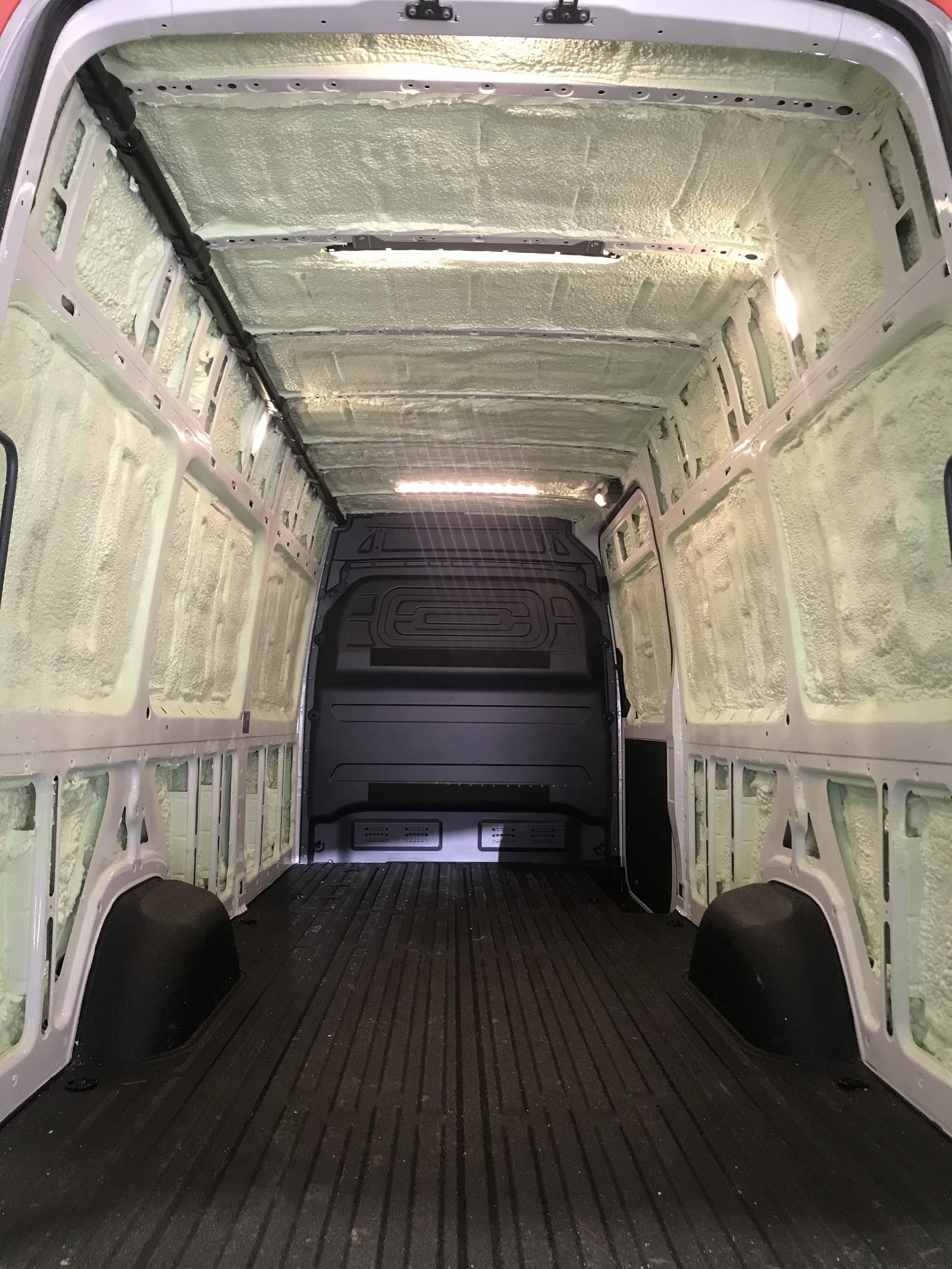
Containers turn up all over the country around Athabasca: secure storage on a yard, a dry shack at a bush landing, a tool crib at a lease, a shack somebody tows out to a lake in February. Shipping container spray foam insulation in Athabasca is the work that makes one of those usable in winter, and it is the simplest application on this list to explain and the easiest to get wrong, because a container offers nothing for conventional insulation to attach to or sit in.
There is no cavity, so the foam is the assembly
A container is a sealed steel box with corrugated walls and a ribbed roof. There are no studs, no joists and no cavity. Anything fitted inside it has to be framed first, and framing inside a container both eats the floor area and, more importantly, creates an air gap between the insulation and the steel. In this climate that gap is where the water appears, because the steel is at outdoor temperature and the air in the box is not. Closed-cell foam sprayed directly onto the inside of the steel removes the gap entirely: the insulation is bonded to the condensing surface, so there is no longer a condensing surface.
Why a container sweats worse than a shed
Steel conducts well, the walls are thin, and the box is airtight by design, which is excellent for shipping and awkward for occupancy. Any moisture that gets in has no way out: breath, a wet coat, a thaw of whatever was stored damp, a kettle. On a cold night the entire inside surface of the box goes below the dew point of that air and the whole thing runs with water, which then pools in the ribs of the floor and the corners. People put a heater in and the problem gets worse rather than better, because warmer air holds more moisture to give up to the steel.
Thickness, and what it costs you inside
A container's interior dimensions are tight to begin with, and every inch sprayed comes off the width and the headroom. Closed-cell at roughly R-6 to R-7 per inch is what makes the trade acceptable, since it delivers the most R-value for the space surrendered and it is also the air and vapour control in the same layer. Open-cell is the wrong choice against steel here: it is permeable, so the moisture reaches the metal anyway, and it absorbs water rather than excluding it.
The floor and the doors
Two parts of a container that get overlooked. The floor is usually plywood over steel cross-members with nothing underneath but air and whatever the box is standing on, which makes it the coldest surface in the unit and the one people are standing on. Spraying the underside, where the box is up on blocks or skids with access beneath, is often the single best improvement available. The doors are a large double steel panel with gasket seals designed to keep weather out of a cargo box rather than to hold a temperature, and they will be the weak point no matter what is done to the walls.
Preparation and what gets left exposed
Foam bonds to clean dry steel. A used container has a history: dust, oil, residue from whatever travelled in it, and sometimes a coating that needs assessing. Cleaning the interior properly comes first. Where the container is going to be occupied, the foam needs a covering for protection, and where it is pure storage that requirement is different. We would rather establish which it is at the quote stage than assume.
Working on one in winter
A container warms quickly, which is the one genuinely convenient thing about this job. The volume is small, so bringing the steel up to a temperature where foam will bond is a matter of hours with temporary heat rather than days. That makes containers one of the few winter jobs we can take on confidently out here, and it is often the reason somebody gets one done in January.
Who quotes it and who sprays it
You are dealing with the contractor directly on shipping container spray foam insulation Athabasca. We quote the job, we schedule it, and our own installers do the work.
Shipping Container Spray Foam Insulation Athabasca: Common Questions
Why is the inside of our container wet? Because the steel goes below the dew point of the air inside and the box has no way to let moisture out. It is condensation, not a leak.
Can we frame it and use batt instead? You can, and it leaves an air gap against the steel where the water will form. The insulation needs to be bonded to the metal.
How much room does it take up inside? The thickness applied, on every surface. Closed-cell is used because it buys the most performance for the space given up.
How much does shipping container spray foam insulation cost in Athabasca? It follows the interior area and the thickness chosen, and it is one of the smaller jobs we quote. Cleaning the interior and any covering over the foam are the other two lines.
How do I choose a shipping container spray foam contractor in Athabasca? Ask whether they spray directly to the steel and what they will do about the floor. Anyone proposing a framed cavity inside a container has not dealt with one in this climate.
Size the assembly with the R-value calculator, then get a free Athabasca quote. More on Shipping Container Spray Foam Insulation Alberta province-wide.