
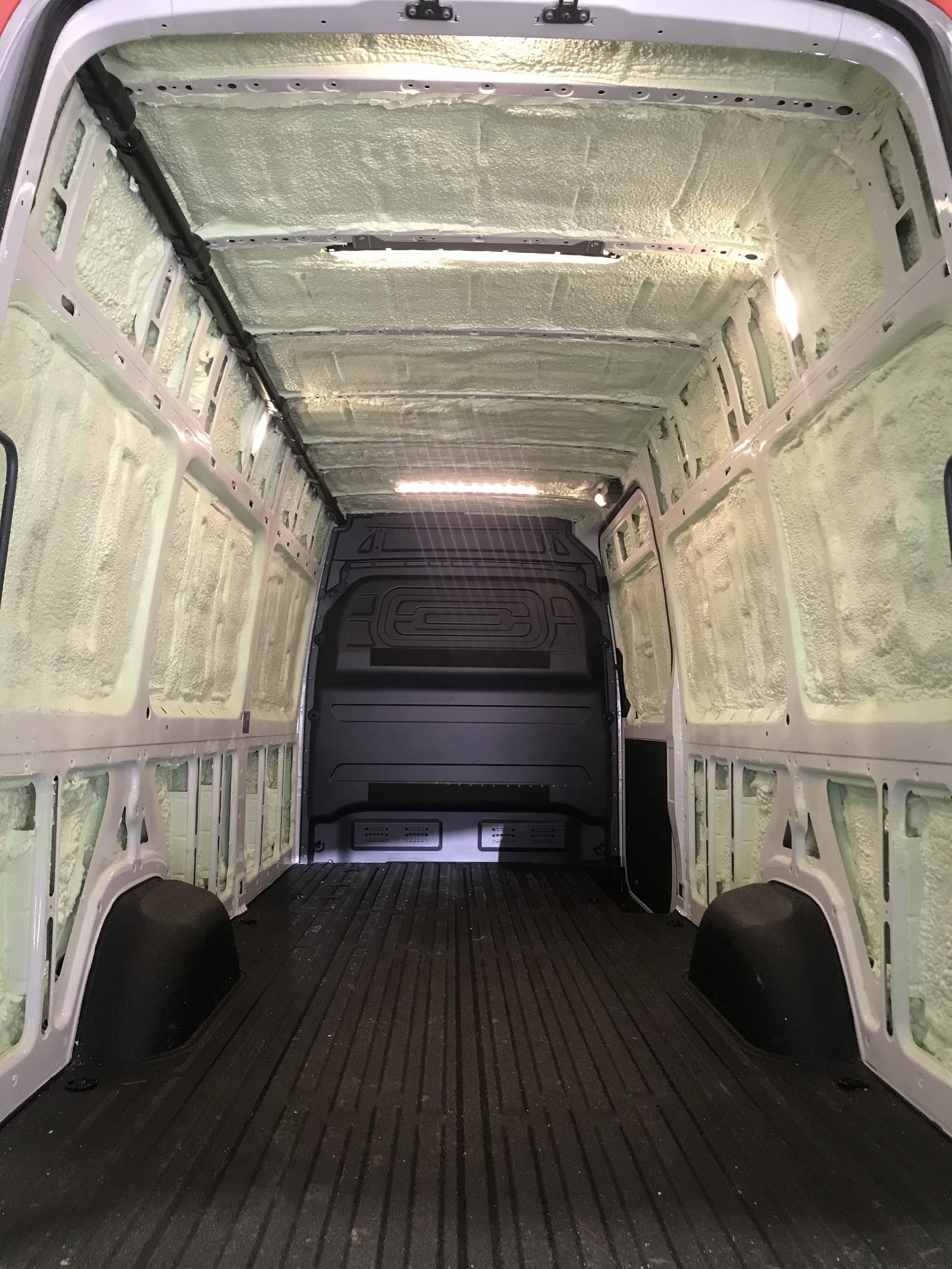
Shipping container spray foam insulation in Drayton Valley is one of the most common small jobs we get asked about, because sea cans are everywhere in this part of the country. They sit on leases as tool cribs, in service yards as secure storage, in farmyards as the shed that never needed a building permit, and behind shops holding everything that will not fit inside. They are also, thermally, the worst-behaved box anybody owns.
A sea can is a condenser with a door on it
A container is a sealed steel shell with no insulation and almost no thermal mass. Its skin follows the outdoor temperature almost immediately: it heats up fast in sun and drops fast at night. Whatever air is inside carries moisture, and the moment the steel goes cold that moisture condenses on the walls and ceiling and runs down to the floor. In a warm spell with cold nights it will do that daily. That is the origin of the phenomenon everyone who owns one knows as container rain, and it is why tools in a sea can rust while tools in a wooden shed do not.
Corrugation is the reason conventional insulation does not work
The walls are not flat. They are a deep repeating corrugation, and the ceiling is the same. There is nothing to fasten to except the steel itself, and anything rigid or batt-shaped only touches the ridges, leaving an air channel behind it at every flute. Those channels run the full length of the box, connecting floor to ceiling, so any moisture that gets behind the insulation circulates along them and condenses against the steel out of sight. A container insulated with board and batt usually ends up wetter than one left bare, because now the water is trapped.
Why foam is the one material that suits the geometry
Closed-cell foam is applied as a liquid and bonds to what it lands on, so it fills the flutes, covers the corrugation ridges and goes over the structural members in a continuous adhered layer. There is no air channel behind it because there is no behind. At roughly two inches it is a vapour barrier in its own right, so moisture cannot reach the steel at all, and at about R-6 to R-7 per inch it delivers a usable R-value without consuming much of the limited interior width. On a box where every inch of floor space matters, that last point decides a lot of jobs.
What the can is being used for changes the thickness
A tool crib on a lease that only needs to stop the sweating is a different specification from a container being converted into an office, a lunch trailer or a heated store. The first is about surface control and needs less. The second is a conditioned space and needs the thickness, the door seals and a ventilation plan, because once a steel box is properly sealed there is no accidental air exchange left in it at all. Tell us which it is, because the two jobs are not close in scope.
The floor and the doors
Container floors are usually plywood on steel cross members, sitting a few inches off the ground on blocks or skids. In winter that underside is in outdoor air, so a can being used as occupied or heated space needs the floor addressed or it will be the cold surface instead of the walls. The doors are the other item: the original gaskets are often perished, and on a sealed container the door is the only remaining path for air and the only one you can actually fix.
Shipping Container Spray Foam Insulation Drayton Valley: Common Questions
Why does it rain inside our sea can? Because the steel skin cools faster than the air inside it, so the moisture in that air condenses on the walls and ceiling and runs down.
Can we insulate it with rigid board instead? You can fasten board to the ridges, and it leaves an air channel in every flute where moisture condenses against the steel out of sight. That is usually worse than doing nothing.
How much thickness do we lose inside? Less than with a framed-out system, which is why foam suits a container. Closed-cell delivers around R-6 to R-7 per inch, so a modest thickness does real work.
How much does shipping container spray foam insulation cost in Drayton Valley? It is priced per board foot over the area sprayed, so the number follows the interior surface area and the thickness the use requires. A storage can needing only the sweating stopped is a smaller scope than a container being converted to occupied space.
How do I get a shipping container spray foam insulation quote in Drayton Valley? Tell us what the container is for and whether it will be heated, and whether it is on a yard in town or out on a lease, since access affects scheduling. We quote it, schedule it and stand behind the work.
Size the assembly with the R-value calculator, then get a free Drayton Valley quote. More on Shipping Container Spray Foam Insulation Alberta province-wide.