
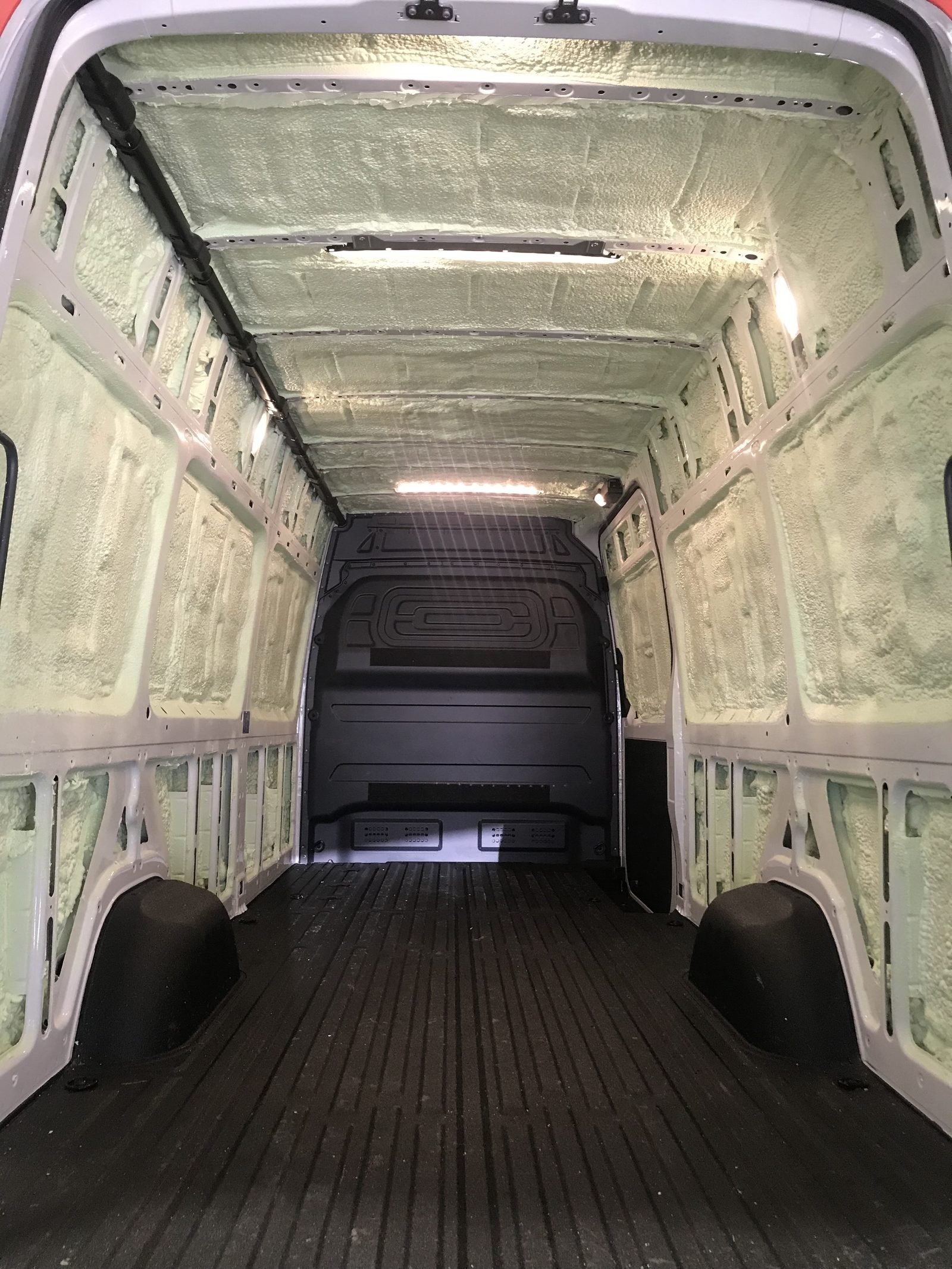
Shipping container spray foam insulation in Ponoka is closed cell foam sprayed directly onto the inside of the steel with nothing behind it. These sit on yards and acreages all round this town and they are asked to do considerably more than the storage they were built for.
Thin steel with nothing behind it
A sea can has no mass and no insulation, so it reaches the outside temperature within about an hour and then holds it. There is nothing in the construction to slow anything down. That is fine for a sealed cargo crossing an ocean and it is a poor cupboard for anything with a temperature range on the label, which is most of what ends up in a Ponoka container: fluids, chemical, batteries, tools, electronics and anything with a seal in it.
Why nothing rigid fits the inside of one
The walls are corrugated, so a flat board can only touch the high points and leaves a continuous void behind it. Air moves in that void, reaches the cold steel and condenses there, out of sight, which is worse than no insulation because the water now forms where nobody will find it. Closed cell foam sprayed straight onto the skin removes the void entirely, and that is the whole reason it is the assembly for this shape.
The floor and the ground underneath
Two things get missed on nearly every one of these. The timber floor has absorbed whatever was spilled on it during its working life and it has to be sound and dry before anything is applied to anything else. And what the box is standing on decides whether it stays square: set straight onto ground that heaves, a container racks, and a racked container has doors that no longer close. Both are established before a quote rather than found during the work.
Storage or workspace, settled before the quote
A container used to keep things dry and a container somebody works in are different jobs at different prices. The second needs the foam covered, needs air to be able to change, and needs the electrical thought about properly. Deciding which it is going to be at the start avoids the common outcome where a box is insulated as storage and converted six months later, which costs more than doing it once.
Shipping Container Spray Foam Insulation Ponoka: The Covering Requirement
Where the container is used as an office, a shop or anywhere people spend time, the foam does not stay exposed. A container in Ponoka that people occupy needs a thermal barrier over the foam, usually a sprayed coating or a light lining, and that is priced with the job rather than added afterwards.
Shipping Container Spray Foam Insulation Ponoka: Common Questions
Why not use rigid board? The corrugations mean it only touches the high points, and the void behind it condenses out of sight.
What has to be fixed before insulating a container whose doors have stopped closing? The box has racked because the ground moved. Levelling comes before insulating.
Are we going to work in it? Worth settling now. An occupied container needs the foam covered and it is a different quote.
Size the assembly with the R-value calculator, then get a free Ponoka quote. More on Shipping Container Spray Foam Insulation Alberta.