
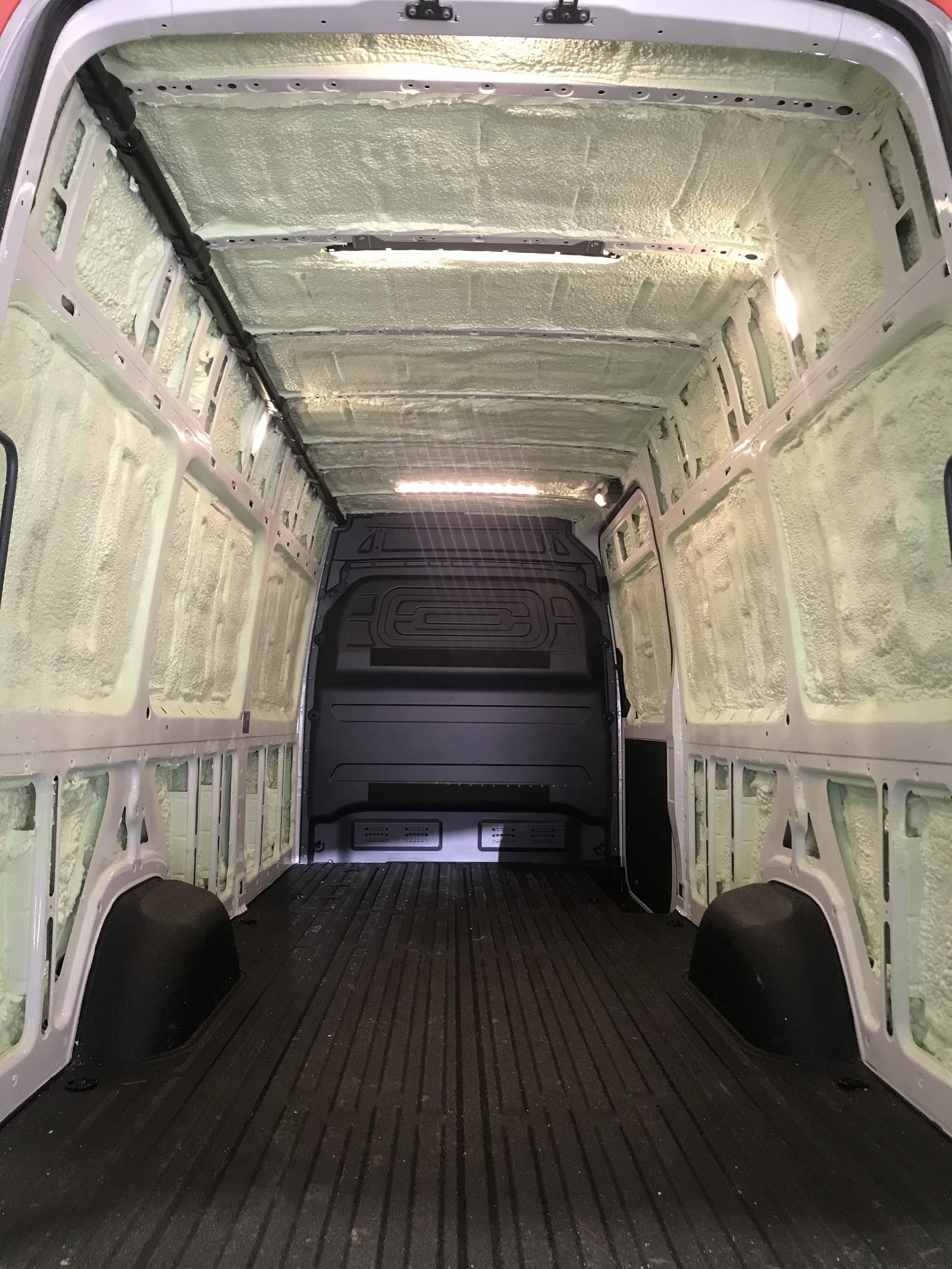
Shipping container spray foam insulation in Drumheller is work on a building type that has quietly become common across this part of Alberta. Containers turn up as secure storage on farmyards above the valley rim, as site offices and equipment lockups, as tool and seasonal storage behind businesses along the valley floor, and as accessory buildings on properties where a permanent structure was not wanted. They are strong, secure and cheap, and thermally they are the worst envelope anyone can start with.
A steel box has no cavity
A container is corrugated steel, welded, with a plywood floor over steel cross members and no framing inside it. There is no stud bay and there is no flat wall. The corrugation runs in a continuous profile from end to end, so a flat board held against it touches only the high points and leaves a continuous air channel behind it at every low point. That channel connects the warm interior to the coldest surface in the building along its whole length, which is the exact condition that produces hidden condensation. Framing a stud wall inside instead solves the flatness problem and costs a great deal of the interior width, which in a container is the one dimension nobody can spare.
The surface area problem
A container is also mostly envelope. Its walls, roof and floor are all exterior surfaces and its floor area is small, so the ratio of envelope to usable space is far higher than any normal building. That means the thermal performance of the skin matters more here per square foot than it does anywhere else, and it means that losing even an inch to framing is a meaningful loss of the space you bought.
What the local range does to a steel box
Drumheller's climate is semi-arid with a very wide spread: the recorded high is 40.6 degrees Celsius from July 1941 and the recorded low is minus 43.9 from January 1996, and the daily swing is large in both seasons. A bare steel box has essentially no thermal mass and no resistance, so it follows that swing almost exactly. In summer a container in full sun on the valley floor, where the dark badlands ground reflects and re-radiates heat, becomes hot enough to damage anything stored in it. In winter it is simply the outdoor temperature with a lock on the door. And in the shoulder seasons, when a mild humid day is followed by a clear cold night, it condenses on its own inner surface and rains on the contents.
Why sprayed foam is the answer here specifically
Closed-cell foam is applied as a liquid, so it becomes the profile of the corrugation. It bonds to the steel across the whole surface, leaving no channel behind it. It gives roughly R-6 to R-7 per inch, which is the most performance available per inch of lost interior width, and past about two inches it is its own vapour retarder, so there is no separate membrane to fit around welds and ribs. It also seals the door frame perimeter and the corners, where a container's remaining air leakage lives. On the floor, foam applied to the underside between the cross members deals with the surface that is usually ignored entirely.
Doors, ventilation and the thermal barrier
Two things to be clear about. A container's cargo doors are a large uninsulated panel with a long gasketed perimeter, and insulating the box while leaving the doors bare limits what the work can achieve. And if the container is going to be occupied as a workspace, exposed foam needs a thermal barrier over it and the space needs ventilation designed in, because a sealed steel box with people in it has no accidental air exchange left. We quote the job, schedule it and stand behind it, and pricing follows the board feet sprayed.
Shipping Container Spray Foam Insulation Drumheller: Common Questions
Why not just fix rigid board to the walls? Because the walls are corrugated. A flat board touches the high points only and leaves a continuous air channel against the cold steel behind it.
Our container sweats inside. What is that? Interior moisture condensing on steel that has dropped below the dew point overnight. It is worst in spring and autumn, not in deep winter.
Will insulating cost us interior space? A little, and far less than framing a wall inside. Closed-cell gives the most R-value per inch, which is why it suits a space where width is the scarce thing.
How much does shipping container spray foam insulation cost in Drumheller? It follows the sprayed area and depth, and a container is a small, well-defined area. Whether the floor and the doors are included, and whether a thermal barrier is needed, are what move the number.
How do I choose a shipping container spray foam contractor in Drumheller? Ask whether the quote covers the floor underside, the door frame and the ceiling, and whether a thermal barrier is required for how you plan to use it. A walls-only scope on a container leaves most of the envelope untouched.
Work out the depth with the R-value calculator, then get a free Drumheller quote. More on Shipping Container Spray Foam Insulation Alberta province-wide.