
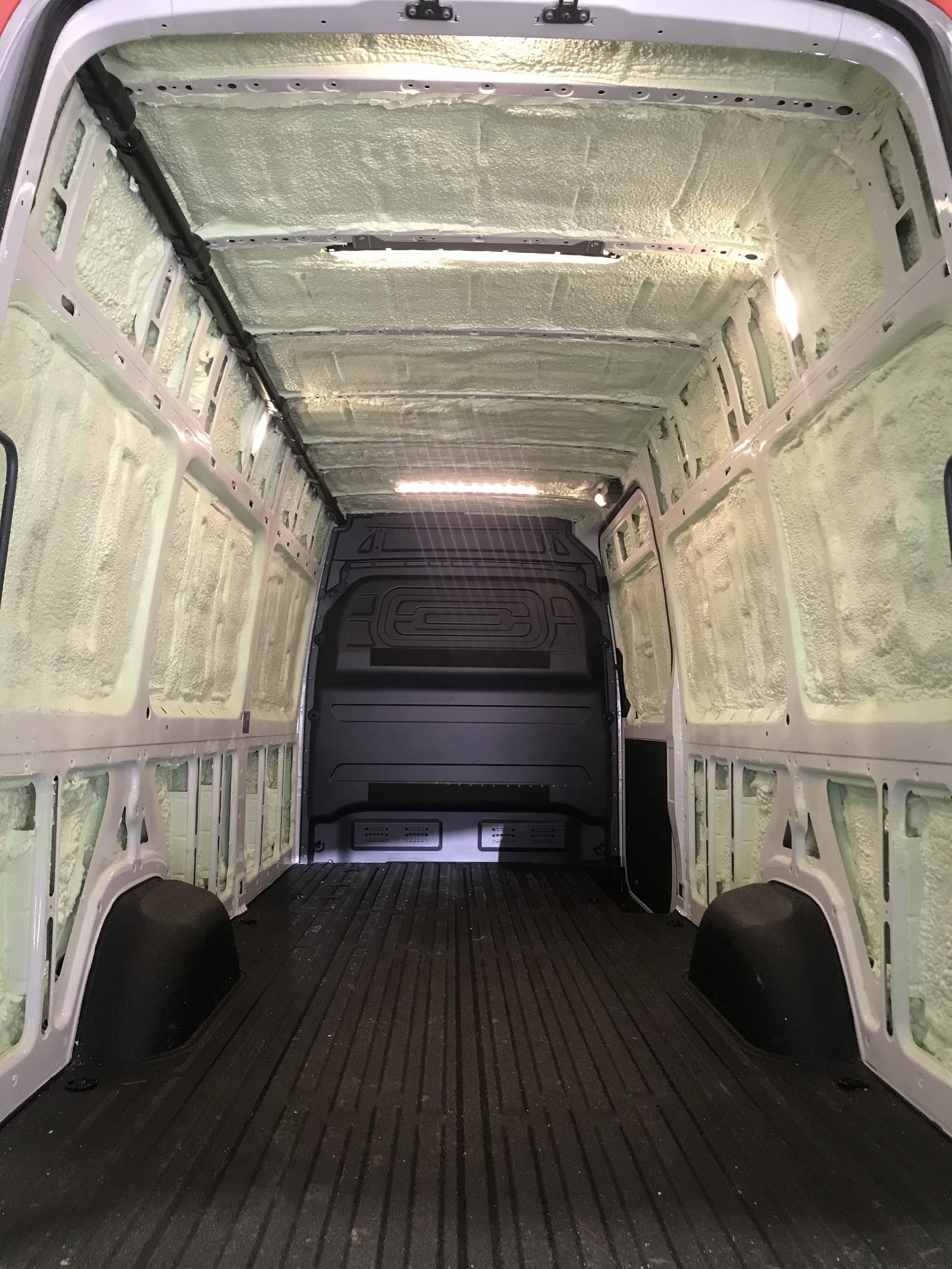
Shipping container spray foam insulation in St. Paul is mostly work for farms and service yards. A container is the cheapest secure dry box available, so they turn up on grain and cattle operations as tool and parts storage and on oilfield service yards as site offices, lunch trailers and equipment lockers. The reason people call about insulation is rarely the temperature. It is that the inside of the steel is wet.
A container is a condensation machine before it is anything else
The walls are a single sheet of corrugated steel with no thermal mass, so the inside surface is at outdoor temperature within minutes of the weather changing. Anything warm or humid inside, a person working, a heater running, a wet machine part, a thawing pail, puts moisture into the air, and that moisture finds the coldest surface in the box immediately. In this part of Alberta the cold is sustained for months at a stretch with no mid-winter thaw, so what forms on the ceiling and walls freezes and keeps accumulating, then melts onto everything stored inside when the weather turns. Container rain is not a leak and no amount of roof sealant fixes it.
Why closed-cell is the only sensible material in a box this size
Closed-cell foam applied directly to the inside of the corrugations does three things at once. It adheres to the profile so there is no gap behind it, which is the whole problem with any panel system in a container. At roughly R-6 to R-7 per inch it reaches a useful value in a thickness that does not steal much of a space only eight feet wide. And at about two inches it is its own vapour barrier, so no poly is needed and no poly should be added. Open-cell foam and fibre batts both leave moist air able to reach cold steel, which is the one outcome the job exists to prevent.
The frame, the floor and the doors
The corner posts, the top and bottom rails and the door frame are heavy steel sections that run continuously from outside to inside. They stay cold and they will condense even when the panels are insulated, so the foam has to be run across them rather than stopped at them. The floor is usually a treated plywood deck on steel cross-members sitting on blocks, with outside air moving underneath; insulating that deck matters as much as the walls if the box is going to be occupied. And the door gaskets are a container's only designed air seal, so if they are perished, the box leaks regardless of what is sprayed inside it.
Yard office versus cold store
The two uses pull in different directions and the specification should follow the use. A site office needs a thickness that lets a small heater hold a working temperature, plus ventilation, plus a protective finish over the foam where people are inside. A secure parts store usually only needs the condensation stopped, which is a thinner continuous layer and no finish. Telling us which one it is changes the quote substantially, and quoting both the same way is how containers end up over-insulated or still dripping.
Siting and ventilation
A container sitting flat on the ground stays wet underneath; blocked up with air movement under the floor it stays dry. A fully sealed insulated container with a fuel-fired heater inside is a ventilation and combustion-air question that has to be answered before anybody puts a heater in. And any cutting for a window, a vent or a service penetration is best done before the foam goes on rather than through a cured layer afterwards.
Who quotes it and who sprays it
We quote the job, schedule it and stand behind it, and our own installers do the work on shipping container spray foam insulation St. Paul. You deal with us from the first site visit to the last pass of foam.
Shipping Container Spray Foam Insulation St. Paul: Common Questions
Why does it rain inside our container? Because the steel reaches outdoor temperature and the moisture in the air condenses on it. Through a long cold spell it freezes, builds up and then releases when it warms.
Can we use batt or panels instead? Not well. Both leave an air gap against the corrugated steel, and the condensation happens in that gap where it cannot dry.
How much space does the insulation take up? A couple of inches off each surface, which is why closed-cell is used here. In a box eight feet wide that difference matters.
How much does shipping container spray foam insulation cost in St. Paul? It follows sprayed area and thickness, so a thin continuous layer to stop condensation prices differently from an office-grade thickness. Any required finish over the foam is its own line.
How do I choose a shipping container spray foam contractor in St. Paul? Tell them the intended use and ask how they treat the corner posts and the door frame. A crew that sprays only the flat panels leaves the parts that condense first.
Size the assembly with the R-value calculator, then get a free St. Paul quote. More on Shipping Container Spray Foam Insulation Alberta province-wide.