
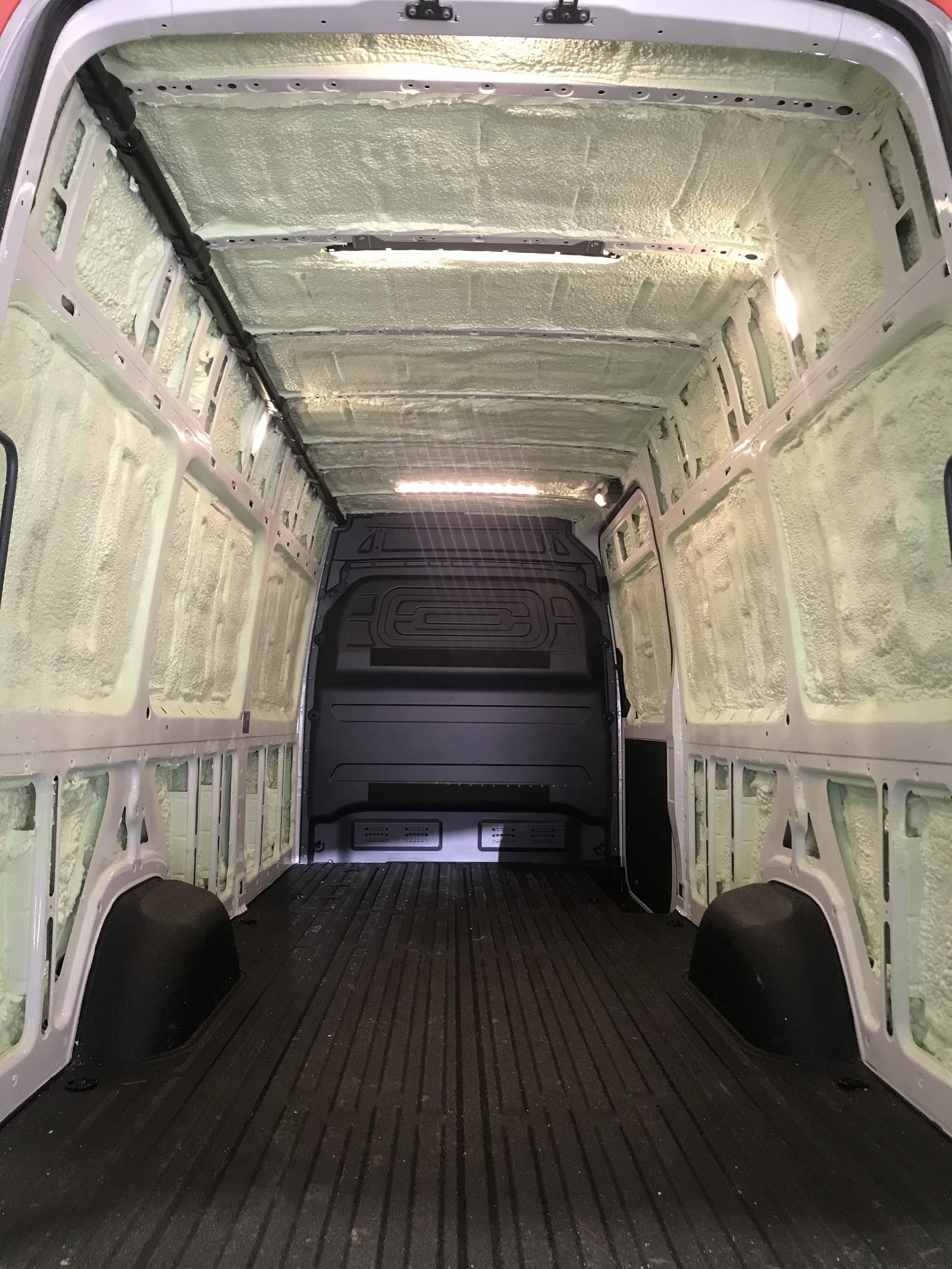
Shipping container spray foam insulation in Bonnyville is mostly lease and job-site work. Containers are the default secure storage on an oilfield site, they hold tools and spares at service yards around town, and plenty get converted into site offices, dry rooms and lunch trailers. They are convenient, they are strong, and thermally they are about the worst enclosure anybody could choose for a northeast Alberta winter.
Six sides of bare steel
A container is a welded steel box. The walls, the roof, the doors and the floor structure are all conductive, all continuous, and all in direct contact with outdoor conditions. There is no cavity, no framing and no thermal break anywhere in it. That means every interior surface is at or near outdoor temperature, and any air inside with any moisture in it will condense on all of them at once. This is why people describe containers as raining inside. It is not a defect in the container; it is a steel box in a cold climate behaving exactly as physics requires.
The corrugations are the reason sheet products fail
The wall panels are not flat. They are corrugated for strength, which means any rigid board or batt placed against them touches only the ridges and leaves a continuous air channel running the full height behind it. That channel connects the warm interior to cold steel over the entire wall area, and it also connects top to bottom, so air circulates in it continuously. Insulation installed that way does not insulate; it hides the condensation rather than preventing it. Framing out the interior to create a flat surface works but costs a surprising amount of the interior dimension, which in a container is scarce.
Sprayed to the steel, inside, in one layer
Closed-cell foam applied directly to the inside of the container fills the corrugations completely and bonds to the steel, which removes the air channel and the condensing surface in one operation. At roughly R-6 to R-7 per inch it reaches a usable value in a thickness that leaves the interior usable, and past about two inches it is its own vapour barrier, which is essential in an enclosure where there is nowhere for trapped moisture to go. The corners, the door frames and the ceiling at the roof ribs are all handled in the same pass because the material follows the shape.
Why this matters more on a lease than in town
A container on a remote site is checked rarely, has no heating most of the time, and is opened by somebody who needs a part at two in the morning in February. What is inside it has to be dry and serviceable without anybody managing the environment. An uninsulated container in this district will put frost on every tool in it and then wet them all through in the spring, because the freeze here is unbroken and the thaw comes all at once. A sprayed container stays close to the temperature of its contents and does not cycle the same way.
Doors, floor and what gets skipped
The cargo doors are the difficult detail: they have to keep working, so the foam has to stop short of the sealing surfaces and the hardware, and the frame around them is a direct thermal path. The floor is the other one. A container floor is plywood on steel cross-members with outdoor air underneath, and on blocks or skids that air moves freely. Treating the walls and roof and leaving the floor produces a box that is cold at the bottom and dry at the top. If the container is being converted for people to work in, the floor is not optional and neither is a plan for ventilation.
Who you are dealing with
For shipping container spray foam insulation Bonnyville, we quote and manage the whole job and our own installers do the work. The free quote comes from the people who will be on site.
Shipping Container Spray Foam Insulation Bonnyville: Common Questions
Why does it rain inside my container? Every interior surface is bare steel at outdoor temperature, so any moisture in the air condenses on all of them. The container is doing nothing wrong.
Can I use rigid board instead? The corrugations mean board touches only the ridges and leaves an air channel behind it connecting warm air to cold steel. It conceals the problem rather than solving it.
Do the doors and floor need doing? The floor does, or the box stays cold at the bottom. The doors need the frame treated while leaving the sealing surfaces and hardware clear.
How much does shipping container spray foam insulation cost in Bonnyville? It follows the sprayed area and thickness, so a twenty-foot unit and a forty-foot one differ roughly as their surface areas do. Whether the floor and door frames are included is the main thing that separates two quotes.
How do I choose a shipping container spray foam contractor in Bonnyville? Ask how they handle the corrugations and the door hardware. Those two details are where container work is either done properly or not.
Size the assembly with the R-value calculator, then get a free Bonnyville quote. More on Shipping Container Spray Foam Insulation Alberta province-wide.