
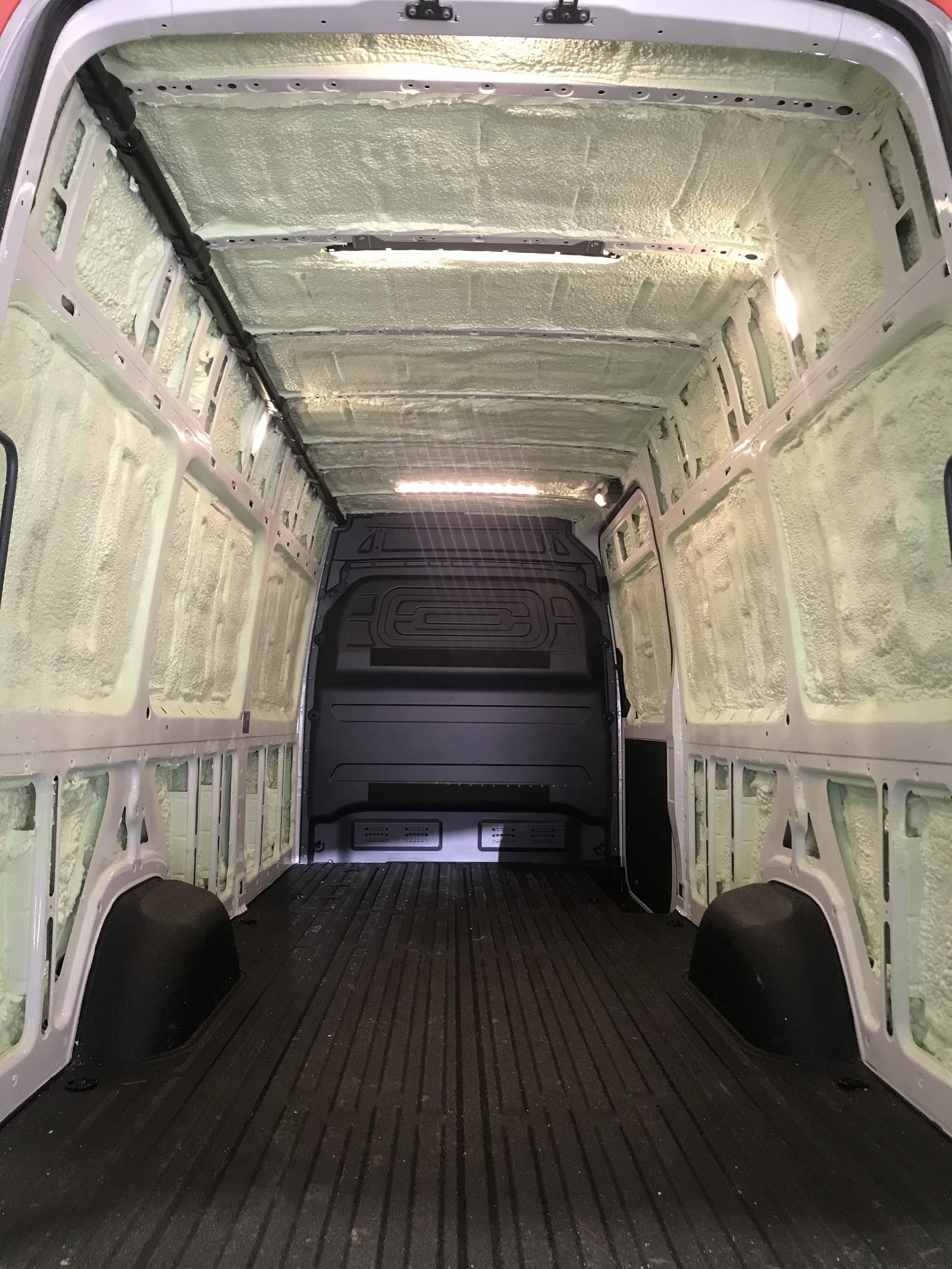
A container is the newest building on most yards around here, and it arrived for a specific reason: the granary was full, the shop was full, and something had to hold the overflow. Shipping container spray foam insulation in Raymond is therefore nearly always about contents rather than comfort. What is in them is treated seed, chemical and fertiliser in jugs and totes, irrigation fittings and couplers, batteries, tools and spare parts. Each of those has an opinion about temperature and moisture, and the box they are in is the worst thermal performer on the property.
A steel box swings further in a day than any building does
This is the fact that matters. A container is thin corrugated steel with nothing behind it, so it has almost no thermal mass and no resistance to heat flow. Sun on the roof and the south side in the afternoon drives the interior well above outdoor air temperature; a clear night pulls it back down below it. That daily swing is far larger than anything a framed building experiences, and the consequence is condensation forming on the inside of the roof and walls almost every clear night, then evaporating by mid-morning. Nothing leaked. The water came out of the air inside the box. It is the reason people find rust on fittings, swollen cardboard and caked product in a container that has never taken a drop of rain.
What that does to what is stored
Treated seed loses viability and the treatment can cake. Liquid chemical and fertiliser have handling temperature ranges, and the labels on them are worth reading before deciding whether the container needs to be frost-free or merely dry. Batteries lose capacity and can be damaged by hard freezing. Steel fittings, couplers and gaskets corrode at the mating surfaces, which is exactly where corrosion causes a problem the following spring. Deciding which of those the container actually has to protect is the first step, because frost-free and dry are two different specifications and only one of them involves a heater.
Closed cell against the steel is the only sensible assembly
There is no cavity and there is no flat surface. The corrugation means any panel or batt touches only the ribs and leaves a continuous air channel behind it, against the coldest steel in the box, which is the exact condition that produces the condensation. Closed-cell foam sprayed directly to the inside of the corrugated steel fills the profile, bonds to it, removes the air space, and at roughly two inches becomes its own vapour control at about R-6 to R-7 per inch. In a container, where every inch of interior space is cargo space, performance per inch is not an abstraction.
The doors and the vents
The door end is a quarter of the surface area and all of the moving parts. The gasket is designed to keep weather out at sea, not to be an air seal on a heated box, and once the container is insulated the doors are the weak point by a wide margin. The practical answer on a container that needs to hold a temperature is to build an insulated bulkhead inside the doors with a smaller access door in it, and treat the original doors as a weather cover. The factory vents at the top of the side walls are the other item: they are there for a reason at sea and they are an unmanaged hole in a storage box on land, so they get a decision rather than being sprayed over without thought.
Set it down properly
A container sitting flat on soil has moisture coming up under it continuously and a wooden floor that will take it up. Get it up on blocks or a pad with air under it and drainage away from it. Insulating the floor from inside is possible and raises the deck height; whether it is worth the lost headroom depends on whether anything in there is sitting on the floor through the winter.
Who quotes it and who sprays it
Shipping container spray foam insulation Raymond is work we take care of ourselves. We scope it, we quote it, we schedule it, and our own installers are the ones holding the gun.
Shipping Container Spray Foam Insulation Raymond: Common Questions
Why is there water inside when it has never leaked? Because the steel cools below the dew point of the air inside almost every clear night. The water is condensing out of the air in the box.
Does it need heat, or just insulation? Depends on the contents. Dry is an insulation and sealing result. Frost-free for chemical or batteries means a small heat source as well.
What about the big doors? Build an insulated bulkhead inside them with a person door, and let the original doors be the weather cover. Unmodified container doors will not hold a seal on a conditioned box.
How much does shipping container spray foam insulation cost in Raymond? By sprayed area and thickness. A container's area is small and known, so the variables are the thickness, whether the floor and doors are in scope, and whether you are doing one or several in a visit.
How do I choose a shipping container spray foam contractor in Raymond? Tell them what is stored in it and see whether the specification changes. Seed, chemical and spare parts do not all want the same box.
Size the assembly with the R-value calculator, then get a free Raymond quote. More on Shipping Container Spray Foam Insulation Alberta province-wide.