
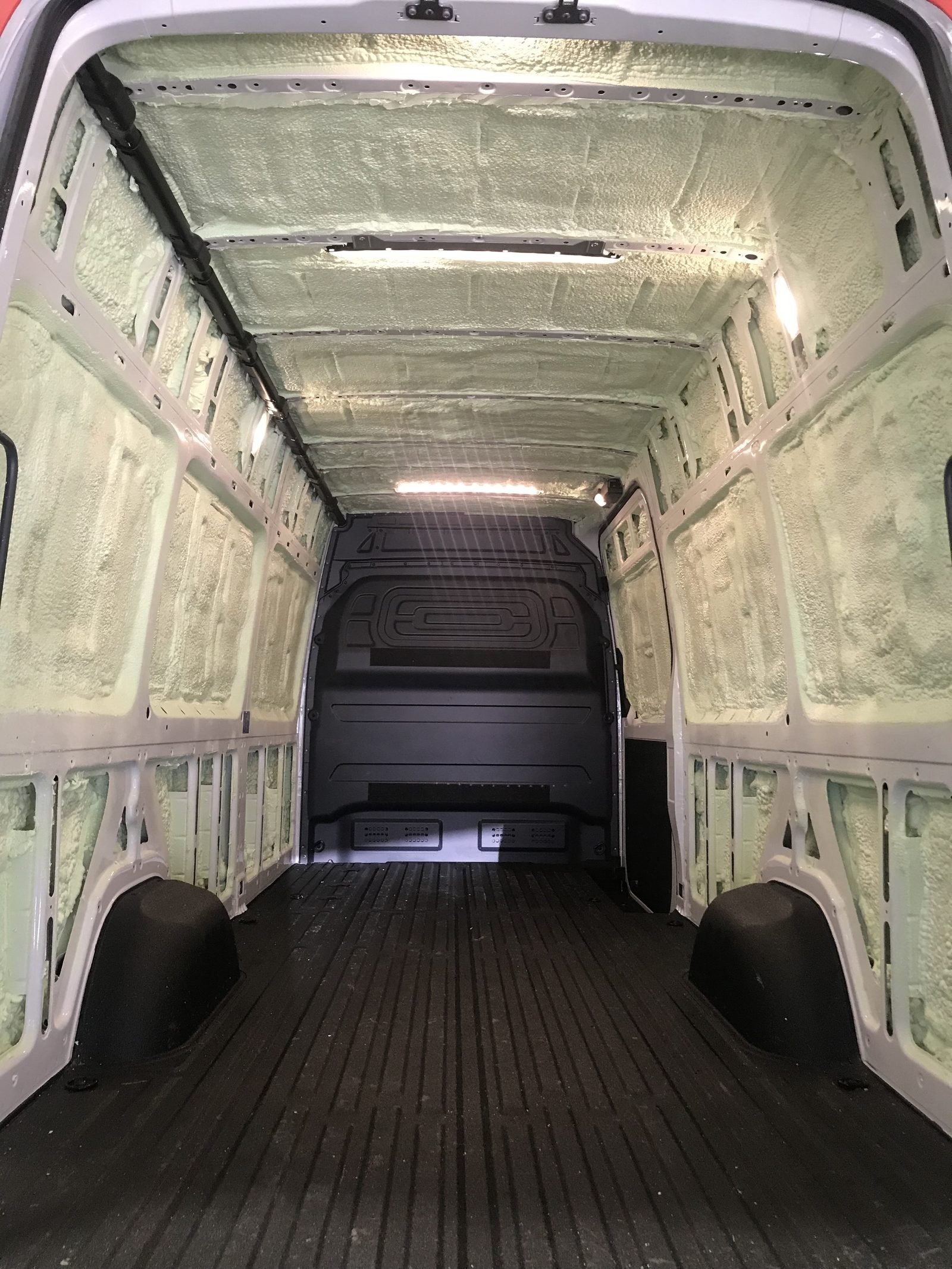
Shipping container spray foam insulation in Cold Lake is unusually practical in the cold months, and the reason is simply size. A container is a small sealed volume, and a small volume comes up to temperature quickly.
A small box is quick to warm, which makes winter work realistic
Where a large shed needs serious equipment and hours of fuel before the substrate is ready, a container can be brought up in a fraction of the time and held there easily. That changes the economics of a winter job completely: on a Cold Lake property the container is frequently the one building that can sensibly be done in January, and it is worth knowing when everything else on the place has to wait for spring.
Bare steel is close to the ideal surface
Unlike a dusty barn or an oily shop wall, the inside of a container is a smooth continuous skin with nothing on it. Foam bonds to that extremely well, provided it is dry and free of loose rust. Light surface discolouration is not a problem; flaking or scaling rust is, because the foam bonds to the flake rather than to the steel and takes the flake with it when it lets go. That gets checked before anything is sprayed.
Cardboard is the worst thing to put in one, and it is what goes in
On a posting cycle a household's belongings are already boxed, labelled and stacked long before anybody thinks about where they are going to sit, and a container in the yard is the obvious answer. Cardboard is close to the worst material to put in an uninsulated steel box. It absorbs water out of the air, loses its strength as it does, and passes what it has absorbed to whatever is inside it, so a stack that went in square in October is soft and leaning by March and the contents have taken the moisture rather than the box. Around Cold Lake this is the common case rather than an unusual one, because almost every container here is holding a household in the middle of a move rather than equipment. If the boxes are staying a full winter, the envelope stops being optional.
Straight onto the skin, with no gap at all
The foam goes straight onto the inside of the skin with no gap behind it. It insulates and it stops air reaching the steel, and stopping the air is what ends the condensation. Anything installed with a space behind it leaves the steel accessible, so water still forms and now forms out of sight. Where a container is fitted out for people rather than storage, the foam is finished with a thermal barrier in a Cold Lake unit exactly as it would be in any other occupied building.
Shipping Container Spray Foam Insulation Cold Lake: Common Questions
Can this be done in winter? More easily than almost anything else on the property, because a small box warms up quickly.
Can spray foam go over rust inside a container? Light discolouration is fine. Flaking or scaling rust is not, because the foam bonds to the flake rather than the steel.
Why does water drip inside when there is no hole? There is none. It is condensation on the cold ceiling above your contents rather than a leak.
Size the assembly with the R-value calculator, then get a free Cold Lake quote. More on Shipping Container Spray Foam Insulation Alberta.