
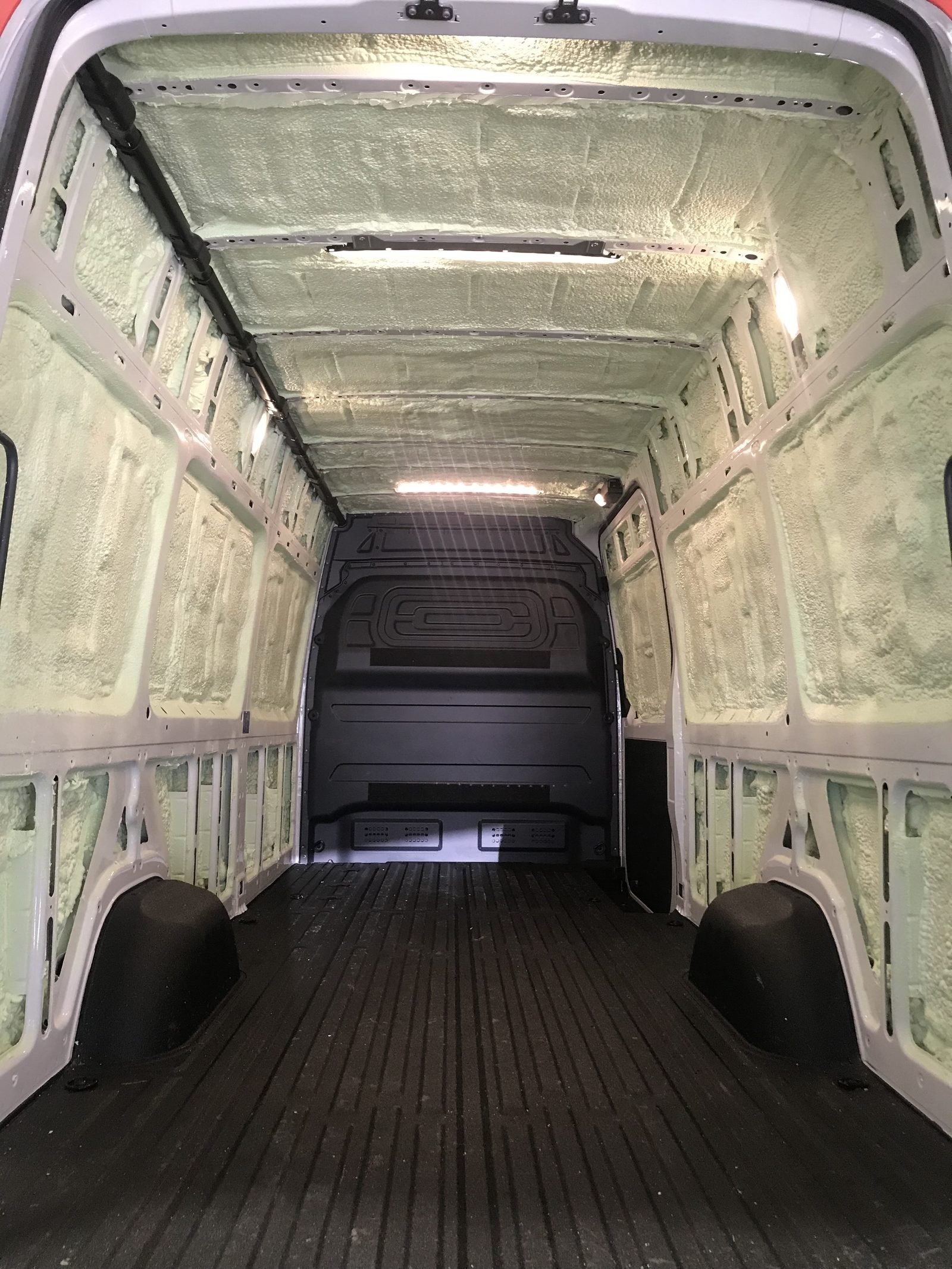
Shipping container spray foam insulation in Fort Saskatchewan covers two populations that share one failure. There are the containers on acreages and farm yards holding tools and seasonal equipment, and there are the ones on contractor laydown yards around the industrial district holding material, spares and consumables. Both are steel boxes and both sweat.
Thin steel reaches outside temperature within the hour
A container has no insulation and effectively no thermal mass, so its inner surface tracks the air outside almost exactly. Whatever moisture is in the air inside meets that cold surface and condenses, and because the coldest surface is the ceiling, the water forms above everything stored and falls onto it. Owners describe a leak and then cannot find a hole, because there is none. The water was already inside as vapour before anything froze.
Five months with no thaw turns it into one event
This is where a container here behaves differently from one in the south. Nothing clears. What condenses freezes onto the ceiling and the upper walls, more joins it every week, and the whole accumulation releases together when things finally warm. A Fort Saskatchewan owner therefore opens a can in April to find everything wet at the same moment rather than noticing a problem developing, and by then anything with fabric, paper or a bearing in it has been in that condition for months.
Nothing can be allowed to get behind it
The method is a closed cell foam applied straight onto the inside of the steel with nothing behind it. It insulates and it stops air reaching the skin, and stopping the air is what actually ends the condensation. Anything installed with a gap behind it leaves the steel accessible, so the water still forms and now forms where nobody can see it, which is worse than leaving the container alone. The corrugated profile is why nothing rigid closes that gap: board crosses the ridges and leaves a continuous void, while sprayed foam follows the profile into every corrugation.
Anything people occupy needs the foam covered
On a laydown yard a container is frequently fitted out as an office, a lunch room or a tool crib with staff in it, and once that happens the foam cannot stay exposed. A thermal barrier over it is required on a Fort Saskatchewan site, normally drywall or an approved panel, and that belongs in the scope from the start rather than appearing when the unit is inspected.
Shipping Container Spray Foam Insulation Fort Saskatchewan: Common Questions
Everything was wet at once in spring. What happened? Frost accumulated on the ceiling all winter with nothing to clear it, then released together.
Can we use rigid board instead? Not effectively. The corrugated wall leaves voids behind board and the condensation then happens out of sight.
What has to go over the foam in a site office container? Then the foam has to be covered, and that belongs in the scope from the beginning.
Size the assembly with the R-value calculator, then get a free Fort Saskatchewan quote. More on Shipping Container Spray Foam Insulation Alberta.