
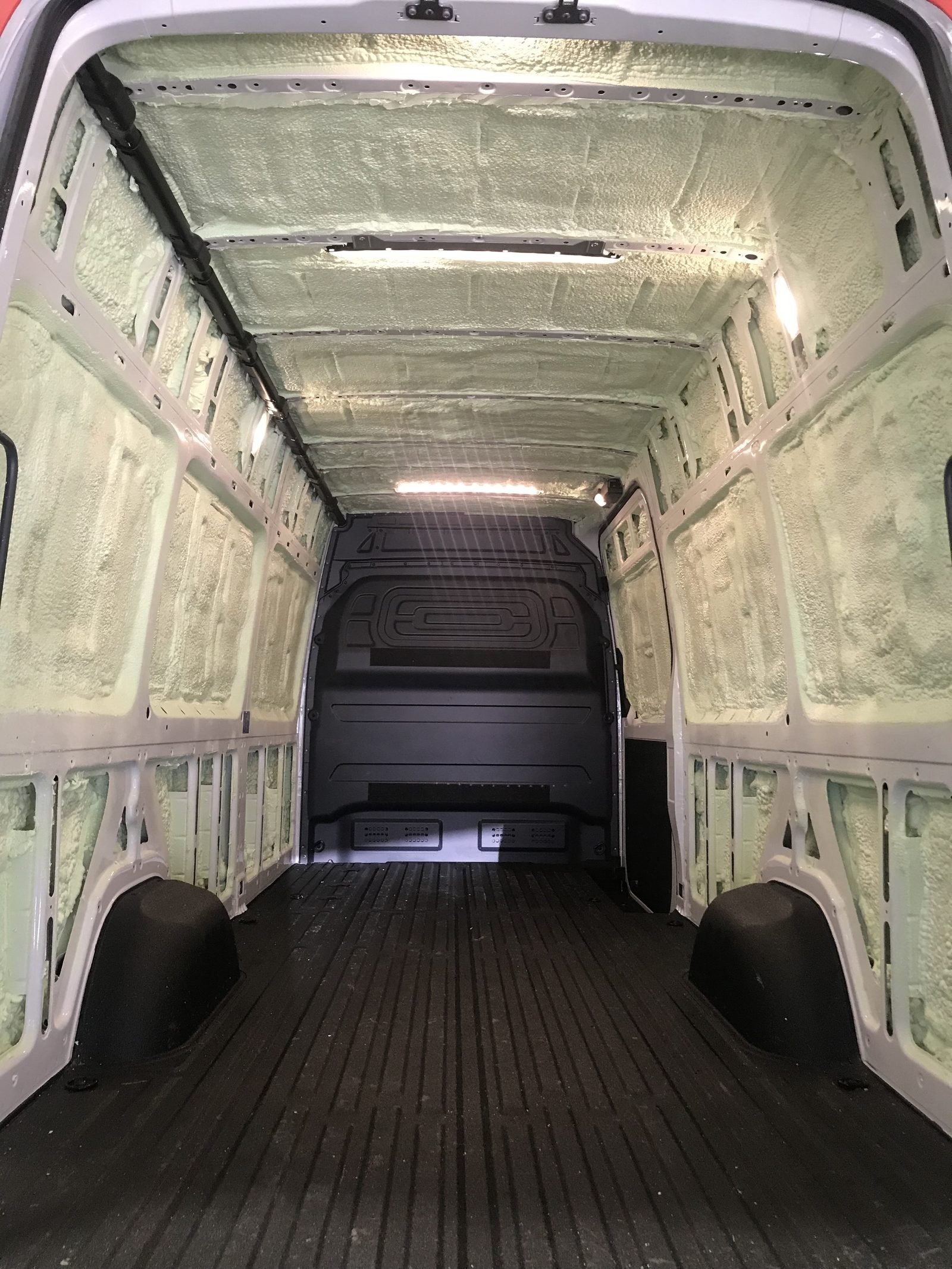
Shipping container spray foam insulation in Brooks is closed cell sprayed directly onto the inside of the steel, with nothing behind it. The corrugations are why nothing rigid fits, and the sun is why the job gets asked for out here.
Inside a closed container on a thirty-degree day
A sea can is thin steel with no mass and no ventilation, standing in full sun on bare ground. It does not sit at the outside temperature, it goes well past it, because the sun loads the skin and there is nothing inside to absorb any of it and nowhere for the heat to go. Owners who put a thermometer in one are generally shocked at the reading. On a hot Brooks afternoon the inside of a closed container is not a storage environment, it is an oven with a lock on it.
Label temperatures on what farms actually store in them
Look at what is actually in these boxes around here and the problem becomes concrete. Veterinary supplies, agricultural chemicals, seed, adhesives, paint, batteries, fuel additives and anything electronic all carry a maximum storage temperature on the packaging, and a good many of those numbers sit below what a closed container reaches in August. Nothing looks wrong afterwards, which is the difficulty. The product is simply less effective than it should be when it finally gets used, and nobody connects that back to the box it was kept in.
The night is cool, and that is when it sweats
Dry air out here loses its heat quickly after sundown, so the steel drops fast while the contents are still warm. That is the moment condensation forms, on the inside of the skin, above whatever is stacked below it. It is why containers in a dry climate still get wet inside, and why the fix is closed cell sprayed straight onto the steel with no gap behind it. Anything with a space behind it simply moves the condensing surface out of sight.
Shading it helps, and it is not enough
People try a few sensible things first. Painting the roof a lighter colour, parking it under a tree, adding a vent. All of those help a little and none of them change the fundamental problem, which is a skin with no resistance in it. It is worth being straight about that rather than letting somebody spend a season on half measures. If the contents matter, the box needs an insulated lining.
Shipping Container Spray Foam Insulation Brooks: The Covering Requirement
Where the container is used as an office, a lunch room or anything else people occupy, the foam does not stay exposed. A container in Brooks that people spend time in needs a thermal barrier over it, usually a sprayed coating or a light interior lining, and that gets priced with the rest of the job rather than after it. A box used purely for storage is a different case and is quoted as one.
The crew on your job
For shipping container spray foam insulation Brooks, we quote and manage the whole job and our own installers do the work. The free quote comes from the people who will be on site.
Shipping Container Spray Foam Insulation Brooks: Common Questions
How hot does it actually get in there? Well past the outside temperature. There is no mass and no ventilation to slow it down.
Will painting the roof white fix it? It helps slightly. It does not change a skin with no resistance in it.
Do we need the foam covered? If people occupy it, yes. Pure storage is quoted differently.
How much does shipping container spray foam insulation cost in Brooks? A steel box in the Brooks sun gets very hot on top, and the roof panel is where most of that arrives. The ceiling is usually specified thicker than the walls for that reason, and the quote should show the two separately.
Best shipping container spray foam insulation contractor in Brooks? Ask whether the ceiling gets more than the walls. On a Brooks container the roof takes the sun all afternoon, and a contractor quoting one uniform thickness has not accounted for where the heat actually arrives.
Size the assembly with the R-value calculator, then get a free Brooks quote. More on Shipping Container Spray Foam Insulation Alberta.