
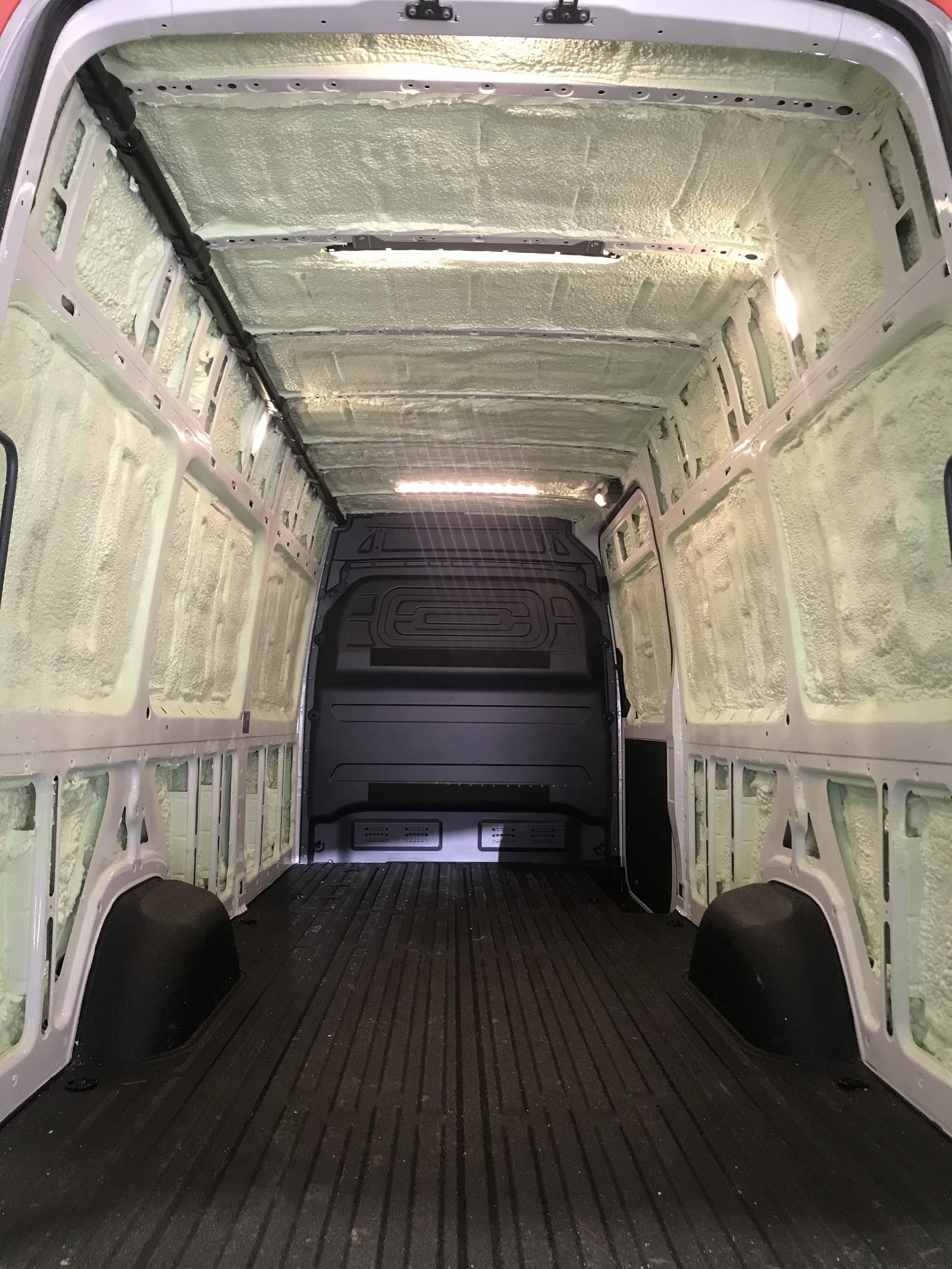
Sea cans are everywhere in a town that services bush and oilfield work. They sit on lease sites, in laydown yards, behind shops and on acreages, holding tools, parts, fuel drums and anything that needs to be secure and movable. A container is a structurally excellent box and a thermally terrible one, and the reason is that it is made entirely of one material that conducts heat extremely well.
Container rain
This has a name among the people who use them because it is universal. Steel walls and roof cool below the dew point of the air sealed inside, usually overnight under a clear northern sky, and moisture condenses across the whole interior surface. On the roof it collects and drips. On the walls it runs down behind whatever is stacked against them. The contents then sit in it until the next cycle, and because the box is sealed there is no mechanism for drying. A container opened after a winter of this has rust on everything steel and mildew on everything else.
The corrugation is the whole difficulty
A container's walls are corrugated, its roof is corrugated, and there is no flat surface and no framing anywhere to fasten anything to. Rigid board cannot be made to follow the profile without a frame, and building a frame inside a container costs the interior dimension, which is the one thing a container does not have to spare. Batt needs a cavity that does not exist. Closed-cell foam is applied as a liquid, expands into every valley of the corrugation, bonds to the steel across the whole surface, and takes up only the depth it is sprayed to. It is the only common insulation that fits the geometry without rebuilding the box.
Depth and dew point
In a container the thing to get right is that the steel must stop being a surface that interior air can reach. Closed-cell at roughly R-6 to R-7 per inch becomes its own vapour barrier at around two inches, and on a container that threshold matters more than the R-value does, because a thin coat that insulates a little while still letting vapour through to the steel will concentrate the condensation rather than eliminate it. The right depth on a container is the depth that puts the dew point inside the foam, and that is the number we work from.
Where the thermal bridges are
The frame, the corner castings and the door end are solid steel and they conduct straight through regardless of what is sprayed on the interior face. The doors in particular are a problem: they have to open, so they cannot be sealed into a continuous layer, and they are where most of the remaining condensation will concentrate after the rest of the box is done. On a container that is staying in one place, the practical answer is to insulate the door leaves themselves and accept the gasket line as the weak point, or to build a secondary interior door.
Containers that become rooms
A fair number of the containers here get converted into something used rather than just stored in: a site office, a tool crib, a generator or pump enclosure, a heated storage room on a yard. For any of those the whole interior including the floor needs doing, because the floor sits on the ground and is the coldest plane in the box. Foam also stiffens and quietens the shell, which matters in a steel room with a generator in it.
Who you are dealing with
There is no handing you off here. We quote and manage shipping container spray foam insulation Slave Lake start to finish, and our crews do the spraying.
Shipping Container Spray Foam Insulation Slave Lake: Common Questions
Why does it rain inside our sea can? Because the steel cools below the dew point of the sealed air inside and the moisture condenses on every surface. It is the container's own air, not a leak.
Can a corrugated wall be insulated? Spray foam follows the corrugation and bonds to it, which is why it is the standard answer for containers. Board and batt both need a frame that costs you interior space.
How thick does it need to be? Enough to put the dew point inside the foam, which is generally past the two-inch mark for closed-cell. Thin coats can make condensation worse rather than better.
How much does shipping container spray foam insulation cost in Slave Lake? Board feet over the interior surface at the depth required, and a container is a small, well-defined area, so it is one of the more predictable jobs we quote.
How do I choose a shipping container spray foam contractor in Slave Lake? Ask what depth they intend to spray and what they are doing about the doors. Those are the two answers that decide whether the container stops sweating.
Size the assembly with the R-value calculator, then get a free Slave Lake quote. More on Shipping Container Spray Foam Insulation Alberta province-wide.