
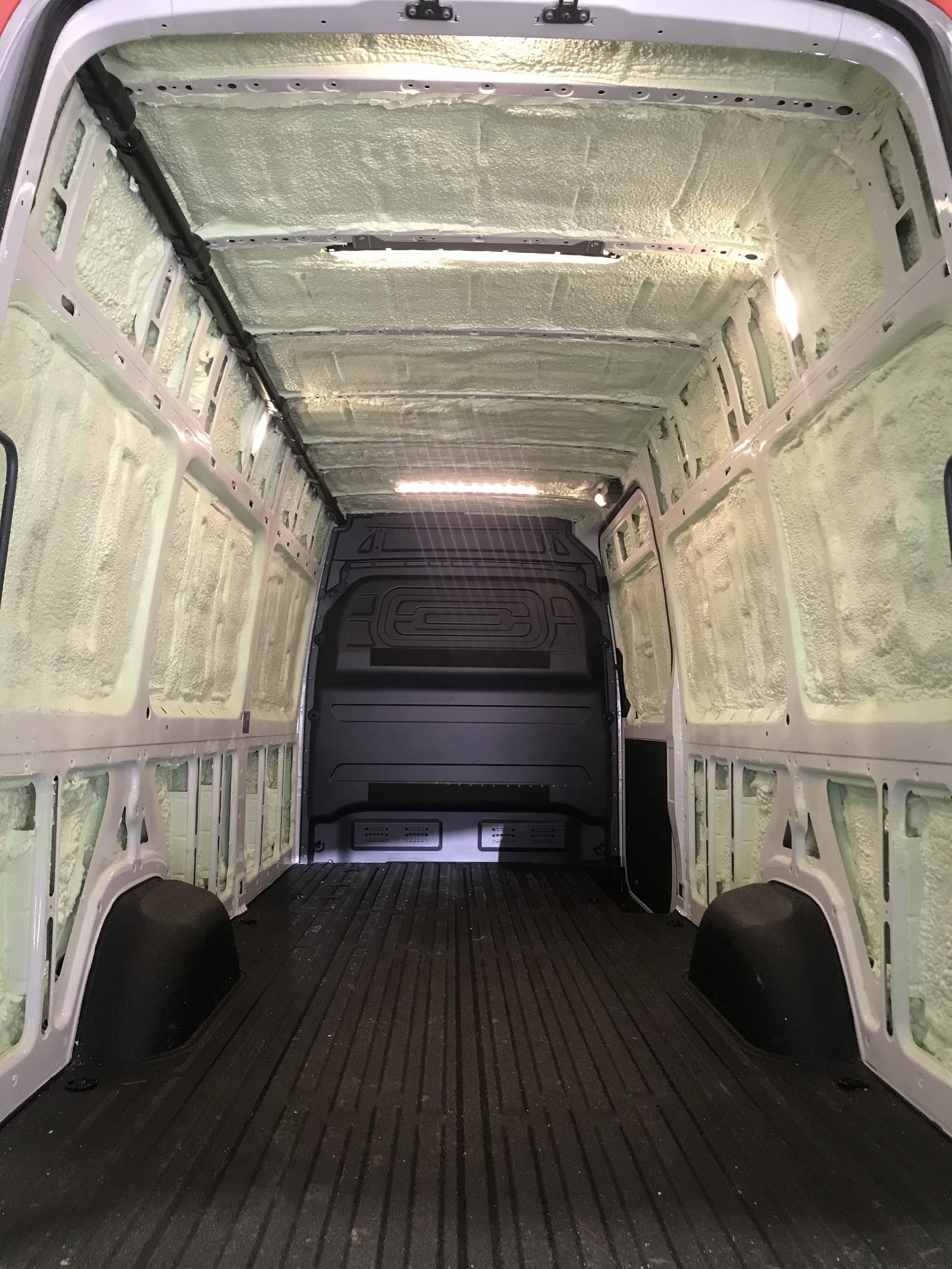
A sea can is the standard answer to secure storage on a farm or a bush property around Barrhead, and for good reason: it arrives on a truck, it needs no foundation, it locks, and nothing is getting into it. What it is not is dry. Shipping container spray foam insulation in Barrhead is the job that turns a lockable steel box into something you can keep tools, feed, chemical or a quad in without ruining them.
The box rains on its own contents
A container is a sealed steel shell with no insulation and no absorbency anywhere in it. Whatever moisture is in the air inside — from the ground underneath, from damp items that went in, from a thaw — condenses on the underside of the roof and the upper corners when the temperature drops at night, collects, and drips. People describe a leaking roof on a container that has never leaked in its life.
The reason it is worse than a shed is the ratio. A shed has some volume of air and a lot of absorbent material in it. A container is almost all steel surface, so there is nowhere for a gram of water to hide and every drop that forms is visible. The swing is bigger too: the sun on dark steel on a March afternoon moves the inside temperature a long way, and the clear night afterwards takes it straight back down.
There is no cavity, so the foam is the assembly
That makes the specification simple and it also makes it unforgiving. There is nothing to fit insulation into, which means whatever goes on the inside surface has to adhere to the inside surface. Closed-cell applied to the steel bonds to it and follows the corrugation, leaving no gap for air to move through, and at depth it handles vapour on its own account so the point where water would form sits inside the layer rather than on the metal.
Framing a container out and putting batt in is the alternative and it is the one we are most often asked to replace. It eats interior width you cannot spare, and it leaves an air space against the coldest surface in the box, which is the thing that was causing the problem.
Depth is a real trade-off here, because every inch comes off the inside. Two inches is the sensible starting point: it is where closed-cell becomes its own vapour retarder, it gets a useful R into the walls, and it leaves the door opening usable. Going thicker is a decision about what the container is for.
The floor, the doors and the ground it sits on
Three details on a container in a yard like this. The floor is a thick plywood deck on steel cross-members with outside air underneath, and with the can sitting on blocks or ties in a yard where snow drifts right up to it, that underside is both the coldest surface and the wettest. Spraying it from below, where there is room, or insulating over it inside, makes more difference than anything else to a container used as a shop or an office.
The doors are the whole end wall and they are the one surface that has to keep working. Gaskets that are perished will undo the work, and foam has to be kept clear of the locking gear and the seal faces.
And the ground. A container set on soil in a shaded yard sits over permanently damp earth. Blocking it up clear, with a gravel pad and drainage away from it, changes the moisture load inside before anything is sprayed.
Who does the work
On shipping container spray foam insulation Barrhead, the people who quote the work are the people who do it. We insulate it ourselves and we answer for the result.
Shipping Container Spray Foam Insulation Barrhead: Common Questions
Why is everything in our sea can wet when it has never leaked? Moisture in the air inside condenses on the cold steel overhead at night and drips back down. It is the container sweating, not the roof failing.
Can we frame it out and use batt instead? You can, and it is the assembly we are usually called in to replace. It costs interior width and leaves air against the cold steel.
Does the floor need doing? If the can is being used as a shop, an office or anything you stand in, yes — that deck is the coldest surface in the box and the air under it is outdoor air.
How much does shipping container spray foam insulation cost in Barrhead? Sprayed area prices by the board foot at the depth you choose, and on a container depth is also a decision about interior space. Access to the underside and prep of the steel are separate considerations.
How do I choose a shipping container spray foam contractor in Barrhead? Ask what thickness they are proposing and what it costs you in internal width, and ask how they will keep foam off the door seals and locking bars.
Size the assembly with the R-value calculator, then get a free Barrhead quote. More on Shipping Container Spray Foam Insulation Alberta province-wide.