
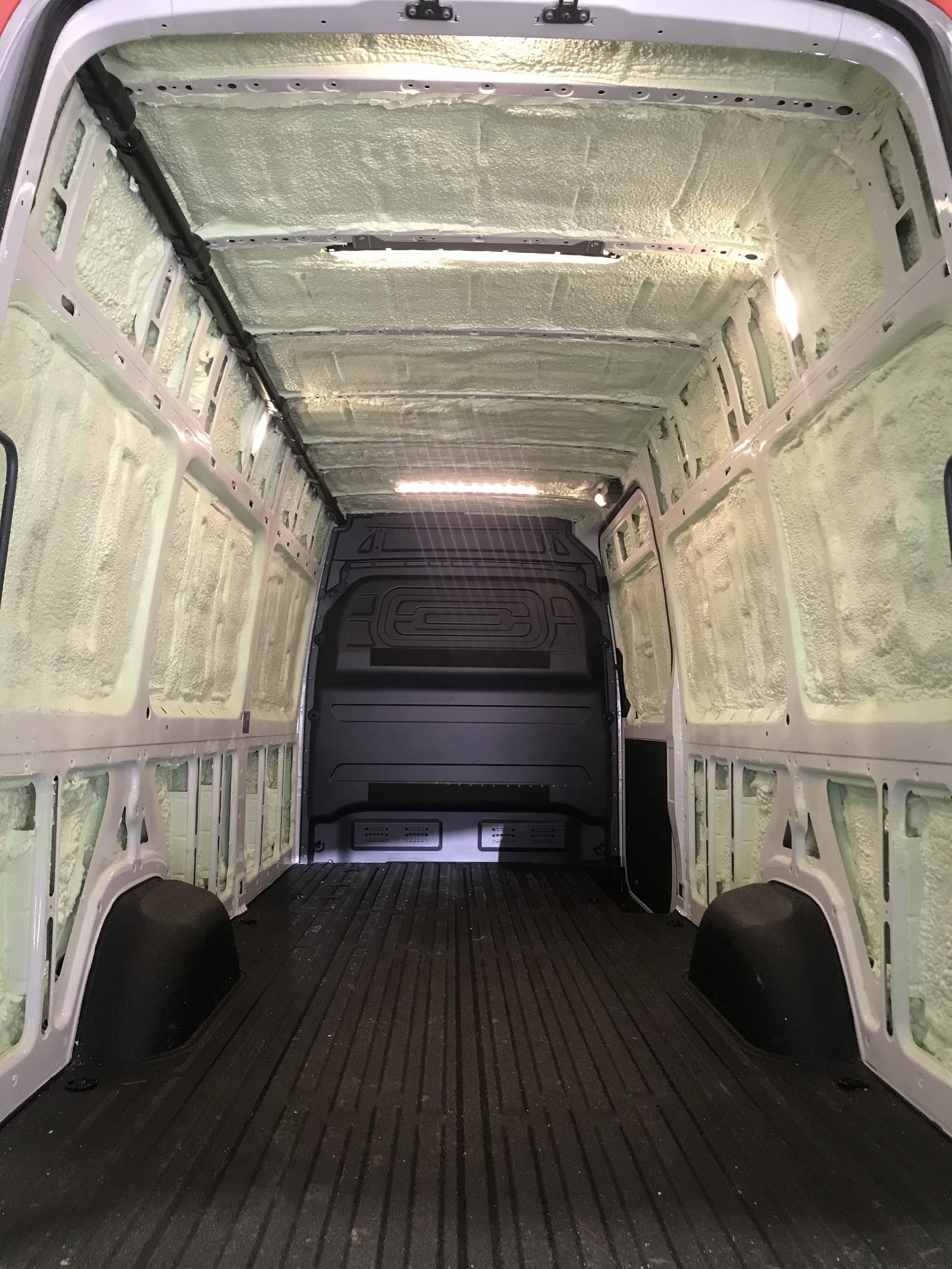
There is a container on almost every service yard and farm yard around Clairmont. They are secure, they are weatherproof, they can be dropped where they are needed and moved when they are not, and they cost a fraction of a building. They are also a thin steel box with no insulation whatsoever, which in this climate produces a very specific and very predictable problem.
A container rains on its own contents
Steel has essentially no thermal mass and no resistance to heat flow, so the shell tracks the outdoor temperature almost exactly. Any moisture in the air inside, and there always is some because it came in when the doors were last open or evaporated off something stored inside, condenses on the ceiling and the walls as soon as the shell cools. In a northern winter it does not just condense, it frosts, and then releases all at once during the next mild stretch. Tools, equipment, cardboard and anything with a circuit board in it sit underneath while that happens. Owners describe water inside a container that has never leaked, and that is exactly right: nothing leaked in, it formed in there.
Insulating has to happen on the inside
Insulating the outside of a container defeats the point of owning one. It can no longer be stacked, slung, trucked or set down without damaging the insulation, and the corner castings have to stay clear. So the work goes on the interior, and that means the interior dimension is the constraint. A container is not a generous space to begin with, and every inch taken off the width and the headroom is noticeable the moment anything is stored or anyone has to work in there.
Closed cell is the right material for the dimension
At about R-6 to R-7 per inch, closed cell delivers more thermal performance per inch of lost space than anything else, and at roughly two inches it is a vapour barrier in its own right, which means no separate poly to detail in a space with no framing to attach it to. It also bonds to the steel, which matters more here than in any other application, because the failure mode being solved is moist air reaching cold metal. If there is a gap behind the insulation, the container will still rain; it will just do it where it cannot be seen.
The corrugations are why nothing else fits
Container walls are a deep corrugated profile and the ceiling is the same. Any flat material fastened across that profile touches only the high points and leaves a continuous series of voids behind it, each one an air channel against cold steel. Foam follows the corrugation completely and fills it, which is both the sealing argument and the reason a sprayed finish takes up less effective depth than framing out the walls to take batt.
Floors, doors and what the box is for
The floor is usually a treated timber deck over steel crossmembers that are fully exposed to the outdoor air underneath. If the container is going to be heated or used as a work space, that floor is a large uninsulated surface and it should be in the scope. The door gaskets are the other item: they are designed to keep weather out of a sealed box, and on an older container they are frequently flattened or torn. And it is worth saying what the container is for before anything is specified, because a secure tool store, a heated site office and an enclosure protecting a pump from freezing are three different targets.
The crew on your job
We quote the job, schedule it and stand behind it, and our own installers do the work on shipping container spray foam insulation Clairmont. You deal with us from the first site visit to the last pass of foam.
Shipping Container Spray Foam Insulation Clairmont: Common Questions
Why is there water inside a container that does not leak? Because it condensed in there. Thin steel tracks the outdoor temperature, and whatever moisture is in the air inside forms on the shell and falls.
Can it be insulated on the outside? Not practically. That ends the ability to stack, lift and move it, which is most of the reason to own one. The work goes inside.
Why closed cell rather than something cheaper? Interior space is the scarce resource. Closed cell gives the most performance per inch and handles vapour itself, and it bonds to the steel so no air reaches it.
How much does shipping container spray foam insulation cost in Clairmont? It follows the interior surface area and the thickness, so a standard container is a predictable, self-contained job. Whether the floor and the doors are included is the main variation.
Who does shipping container spray foam insulation in Clairmont? We do. We ask what the container is for, quote the right thickness for that use, schedule it and stand behind the work.
Size the thickness with the R-value calculator, then get a free Clairmont quote. More on Shipping Container Spray Foam Insulation Alberta province-wide.