
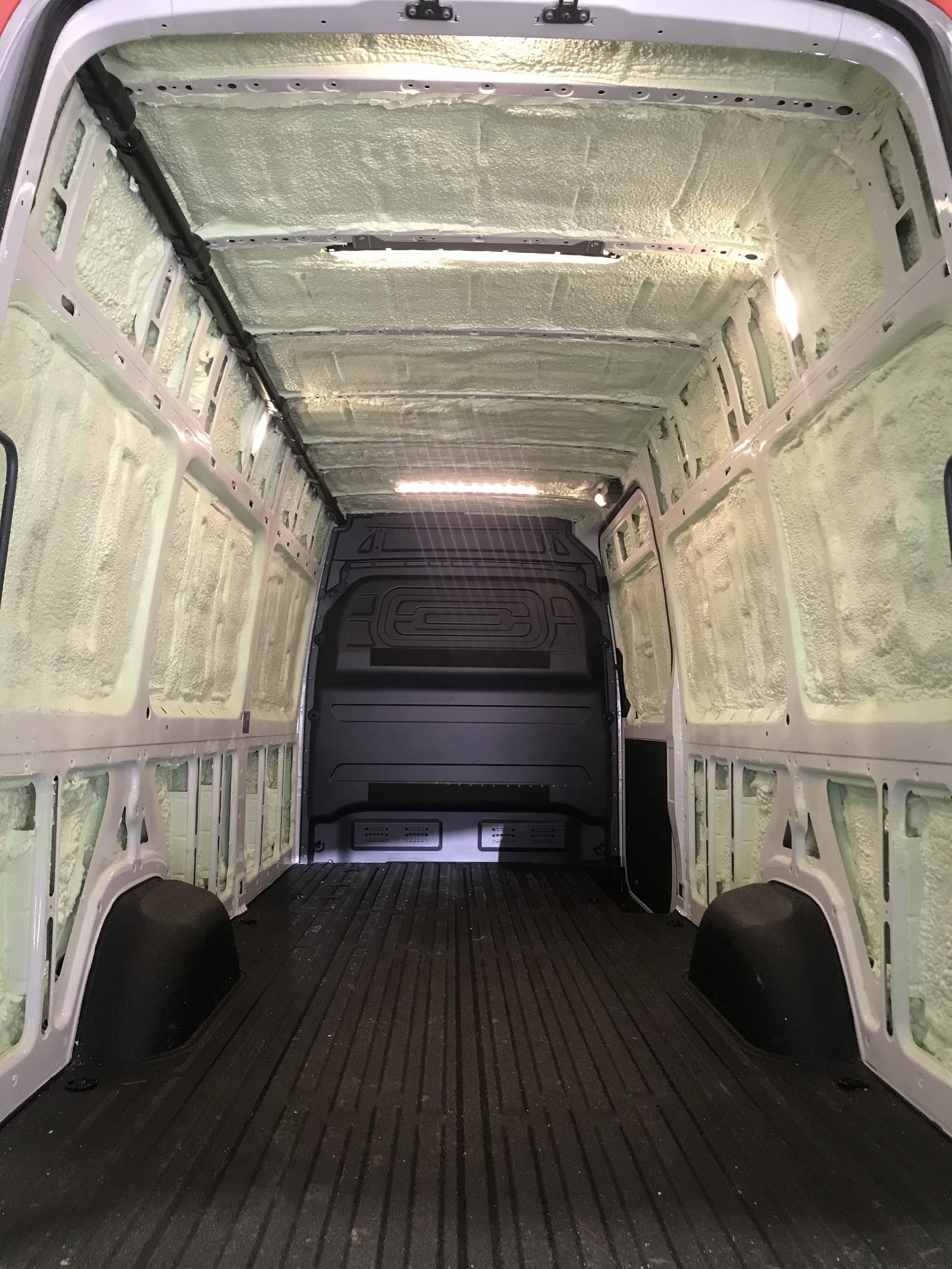
Vehicle Spray Foam Insulation Acheson gets bought by yards rather than by households. This is an industrial park: service bodies, picker trucks, enclosed cargo haulers, skid-mounted gensets and a laydown row of sea cans doing duty as tool cribs. Nearly every one of those is a thin steel or aluminum skin with something warm happening behind it, and that sentence is the entire problem.
Why a cold skin collects water nobody sees
Put a propane heater and two guys inside an enclosed hauler for a shift and you have built a small weather system. Warm damp air travels to whatever surface is coldest and surrenders its moisture there. In a working unit that surface is never the plywood or the deck; it is the outer sheet, with a prairie January pressing on the far side. The water forms on the inside face of that sheet, runs down the stiffeners and pools low in the panel, where nobody looks until a seam starts weeping rust.
Vehicle spray foam insulation for a fleet yard in Acheson
Closed cell answers a metal shell on several counts at once. It carries about R-6 per inch, which matters a great deal when every inch is cargo room you paid for. It behaves as its own air barrier and vapour retarder, so there is no separate membrane to tape, slit around a tie-down anchor and get wrong. And it bonds as one continuous layer, so damp air has no route to arrive at the metal to begin with. The side benefit is stiffness: a bonded panel stops drumming, and a quieter box is noticeably easier to work out of all day.
Board bridges the rib and foam follows it
Rigid board only sits on the high points. Every rib, every channel, every wire run and every rolled corner in a cargo body leaves a gap behind the sheet, and those gaps join up — one connected void running the length of the unit with air moving freely inside it. The board insulates a modest fraction of the surface and conceals the rest. Sprayed foam goes exactly where board cannot: down into the channel, around the stiffener, up over the curve of a roof bow, tight against the metal the whole way.
How thick, and what the thickness takes away
Thickness trades against two things on a working vehicle: interior room and payload. On a service body where the compartments are already tight, a thinner continuous layer that genuinely touches steel beats a fat one that forces you to rebuild the shelving. Sea cans used as crib space in an Acheson yard take more happily, because nobody measures headroom in a container the way they measure it in a van.
What vehicle spray foam insulation needs before the gun starts
The surface has to be clean, dry and bare. Old adhesive, carpet glue, flaking underbody coating and surface rust all come off first, because foam bonds to whatever it finds and what it finds must be metal. Rust gets wheeled back to sound steel. We walk the unit beforehand and mark what has to stay reachable: harness runs, lamp bodies, brake lines, the plates you unbolt to service something. Those get planned around and left accessible instead of buried.
You deal with us, not a dispatcher
We quote the unit, we book the bay time, and our own sprayers run the gun. The phrase that gets typed in is "Best Vehicle Spray Foam Insulation Acheson", and what it usually means is somebody wants one crew that has done a cargo body before.
Vehicle Spray Foam Insulation Acheson: Common Questions
Can you do a sea can we are running as a tool crib. Yes, and container work is routine in Acheson because the yards out here use them hard year round. There is more on shipping container spray foam insulation.
Will it quiet the box down. Usually. Closed cell stiffens the panel it grips, and a stiff panel cannot drum the way a loose one does.
Do we have to strip the interior first. Anything we spray has to be bare. If the walls are already lined, we need them opened up, and taking a liner down properly beats spraying around it badly.
We also handle spray foam insulation for the buildings on the same yard, the wider spray foam insulation Alberta picture, and how far we travel on the service areas page.