
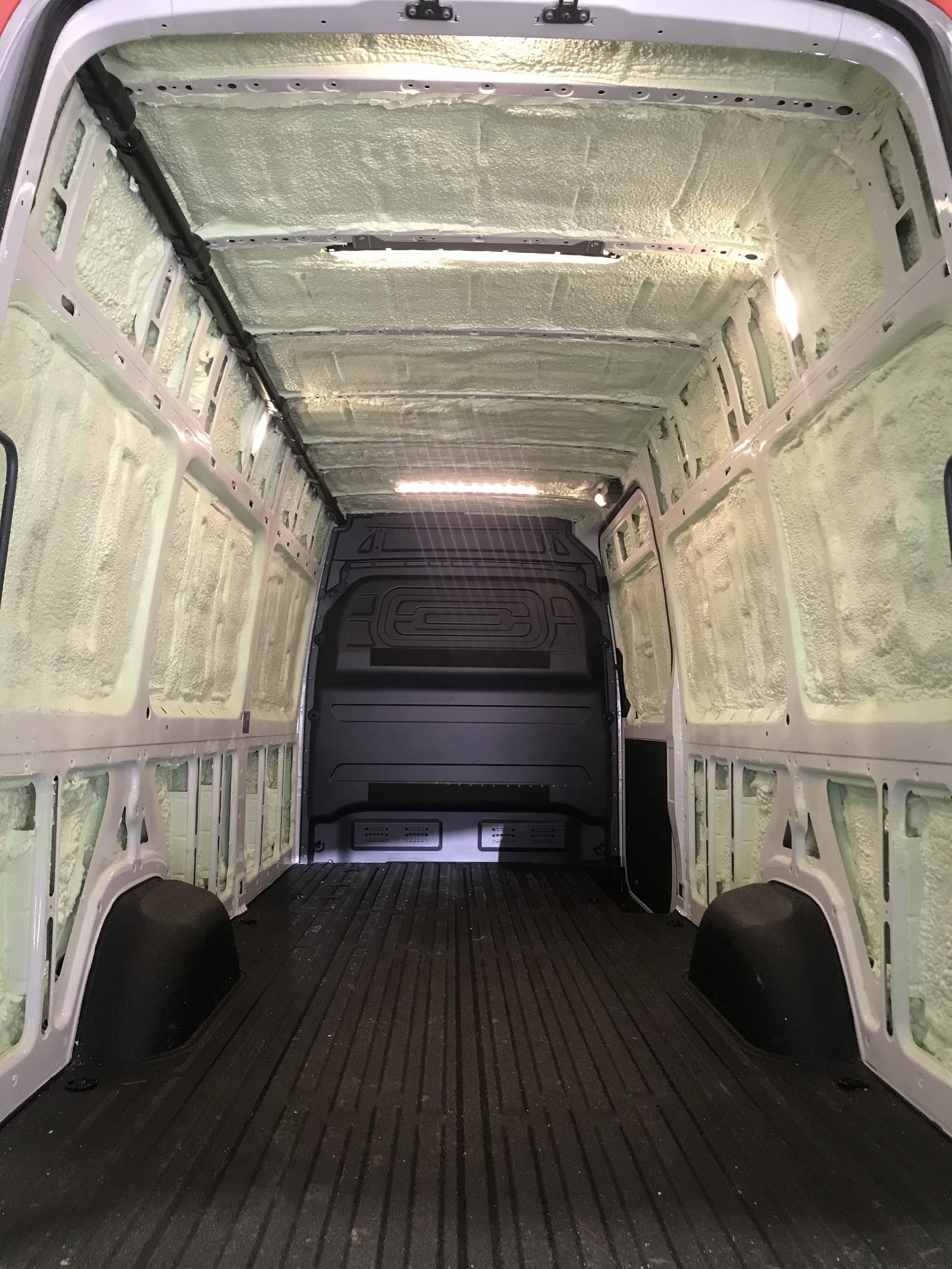
The complaint we hear most often from a Camrose trade is not about comfort at all. It is that everything stored in the enclosed trailer has gone rusty, and the trailer has never leaked a drop. Sockets with a bloom on them, cordless battery terminals turning green, a chop saw table pitted along the fence. Vehicle Spray Foam Insulation Camrose gets specified for that problem far more than for warmth, and the reason is condensation rather than rain.
This is a town that services a wide farm district as well as its own streets, so the mobile workshop trailer is a standard piece of kit here. It goes out loaded, sits at a yard all day, and comes back into a warm shop at night.
Tools rusting in a trailer that has never leaked
Steel has thermal mass. A trailer and everything metal in it spends the night at the outdoor temperature, so by morning the whole load is genuinely cold. Open the doors into a mild morning, or back the trailer into a heated shop, and warm moist air pours in and meets that cold mass. Water forms on every metal surface at once. That is the same mechanism that fogs a pair of glasses coming indoors, and on a tool load it happens every time the temperature swings. Nothing dripped from the roof. The air brought the water in and the cold steel pulled it out.
The second half of the problem is occupancy. Anybody working out of the trailer with a heater running is adding vapour to that air, and the coldest surface available to it is always the skin, never the middle of the box.
Closed cell is the only vehicle spray foam insulation we will put against a metal skin
Closed cell cures into a dense, shut-cell structure that does not pass air and does not let vapour diffuse through it, which means the metal behind it never sits at the dew point in the first place. It carries about R-6 per inch, so the depth needed to get a usable number is small enough to live with inside a box. It also bonds hard to clean steel and aluminium, adding real stiffness to a panel that was flexing before. Open cell is a fine material in a building wall and is good at absorbing sound at about R-3.6 per inch, but it is open to moisture by design, and against a vehicle skin that is the wrong property entirely.
Trailer spray foam insulation around the ribs, not across them
A cargo trailer is not a flat-sided box. The walls are channels and hat sections, the roof is a set of bows, the front corners are a radius and the wheel wells are a shape nothing straight will ever match. Rigid board can only bridge from one high point to the next. Behind it you are left with a continuous void that joins every rib to every other rib, and air circulating in that void carries moisture to the coldest part of the panel. Foam is applied wet and expands into the section, so the channel is filled, the radius is followed, and the wheel arch is covered as one piece with no joint to come apart on a gravel road.
Thickness, payload and what a Camrose trade actually needs
Depth is decided against the inside of the trailer, not against a target number. Shelving depth, the width a cart has to pass through and the clear height at the door all come first. We take more depth on the ceiling and the upper walls, where it buys the most and costs the least usable space, and less at a pinch point. Weight matters on a tandem that is already carrying a full load, so foam goes where it earns its mass.
The things we refuse to bury
Before any foam moves we agree what stays accessible. Trailer brake wiring to the axles, marker light wiring, the junction at the plug, any bolted cross member, and panels that have to come off for service. Those are masked and planned around. We also need the inside stripped, dry and free of adhesive residue and loose rust, because foam holds to the surface it lands on. Search for Best Vehicle Spray Foam Insulation Camrose and you will get plenty of pages about the foam; the preparation is the part that decides whether it lasts.
Vehicle Spray Foam Insulation Camrose: Common Questions
Will this stop my tools going rusty. It removes the cold surface that the moisture was condensing onto, which is the cause. Ventilating the trailer when it comes into a warm Camrose shop helps as well, but the insulation is what stops the metal sitting below dew point.
The trailer is aluminium, not steel. Aluminium works the same way thermally and takes foam well, but it needs a different surface preparation because of the mill finish. We scuff and clean accordingly.
Can you do it with the shelving still fitted. We would rather not. Anything bolted to the wall shadows the panel behind it, and a shadowed patch of bare metal is where the next condensation problem starts.
See also shop spray foam insulation for the building the trailer comes home to, shipping container spray foam insulation, and our local spray foam insulation services. Elsewhere in the province, Spray Foam Insulation Alberta and the spray foam insulation service areas we cover.