
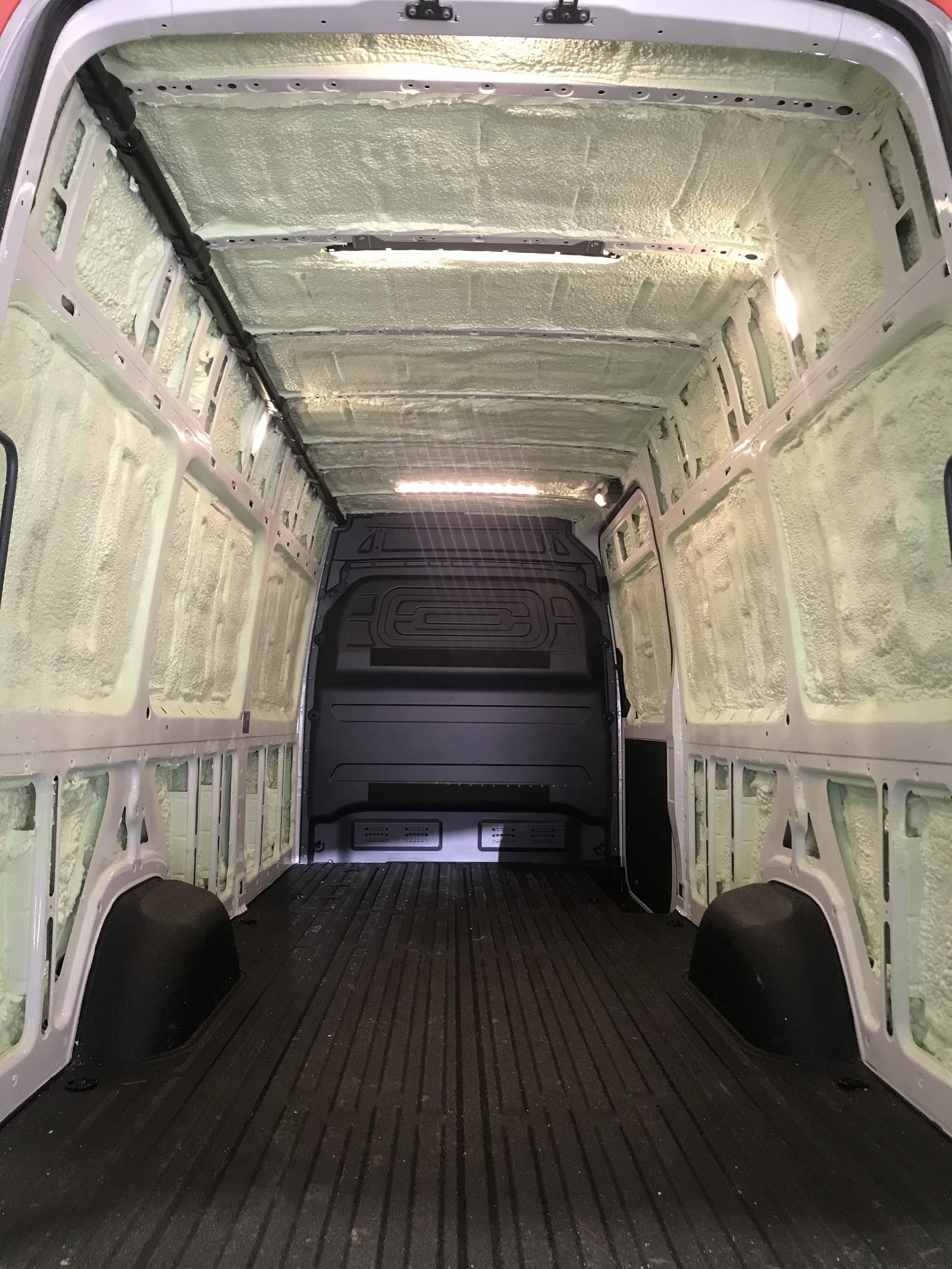
An enclosed cargo trailer sits at a shop door all week with a trade's whole kit inside it. Come Monday the chop saw table has orange freckles on it, the fasteners in their trays have gone dull, and a battery charger left plugged in has bloomed white at the terminals. Vehicle Spray Foam Insulation Lacombe gets asked about because of that, not because anybody is cold.
The mechanism is unglamorous. The trailer is a thin aluminium or steel box that follows outdoor temperature almost exactly, while the air inside it carries whatever moisture came in on wet lumber, a damp tarp, a washed-out bucket or a frosty morning's load-in. Each night the skin drops below the dew point of that air and the moisture plates out onto the inside of the sheet. It beads, runs down behind the wall liner, and reaches tools and the floor edge. Day after day, that is enough to put a film of rust on everything steel in the trailer.
Vehicle spray foam insulation and tools that rust in storage
Taking the cold surface out of the box is the whole intervention. Closed cell sprayed to the inner skin is about R-6 per inch and functions as an air barrier and vapour retarder at the same time, which means the interior air no longer has a cold plate to give its water to. The contents stay at a more stable temperature as well, so a trailer parked in a central Alberta cold snap does not swing as far overnight.
Foam goes where a board has to be cut around
Cargo trailers are built from formed uprights, roof bows, wall tracks and e-track rails, and the interior face is a landscape of channels and fastener heads. A rigid board has to be scribed to every one of those and still only touches the proud surfaces, leaving a continuous void behind the panel that links the whole wall together. Air gets into it and condenses against cold metal in a cavity nobody can inspect or dry. Sprayed foam enters the channel, wraps the fastener, closes the corner where the wall meets the roof, and leaves no connected gap at all.
Trailer spray foam insulation, deck height and axle rating
Weight is a real constraint on a tandem unit that is already loaded to its working limit. Foam over every interior surface is mass, and mass arrives before the cargo does. Depth on the floor also raises the deck, which changes how a ramp gate behaves and how a wheeled cart rolls in. We size the layer against your axle rating and your door opening rather than filling the cavity to its depth because the cavity is there.
Getting the inside clean enough to bond
The inside of a working trailer is dusty, often oily, and frequently has remnants of a previous liner glued to it. All of that comes off: sweep, wash, dry, scuff, and take any rust back to bright metal. Then the running lights, brake wiring, interior lamp runs and anything bolted through the wall are mapped so they remain reachable. Alongside the trailer, farm and acreage buildings are covered under agricultural spray foam insulation, and a yard container under shipping container spray foam insulation.
We take care of the work
We are the contractor from the first look to the last pass. No referral, no subcontracted spray crew.
Vehicle Spray Foam Insulation Lacombe: Common Questions
My tools rust in a trailer that never leaks. How? Condensation on the inside of the skin. The box gets cold, the air inside does not, and the difference leaves water on the metal.
Will it keep a trailer usable as a workspace in winter? It makes a heater effective instead of futile, because the heat stops being pulled straight out through the skin. What it chiefly does is stop the sweating.
Is this common on hobby farms around Lacombe? Very. Horse trailers, utility trailers and converted stock units all show it, and most people looking up the Best Vehicle Spray Foam Insulation Lacombe found the rust first.
For the province, read Spray Foam Insulation Alberta. Buildings start at spray foam insulation, and the full set of our service areas is there too. Free vehicle spray foam quote on request.