
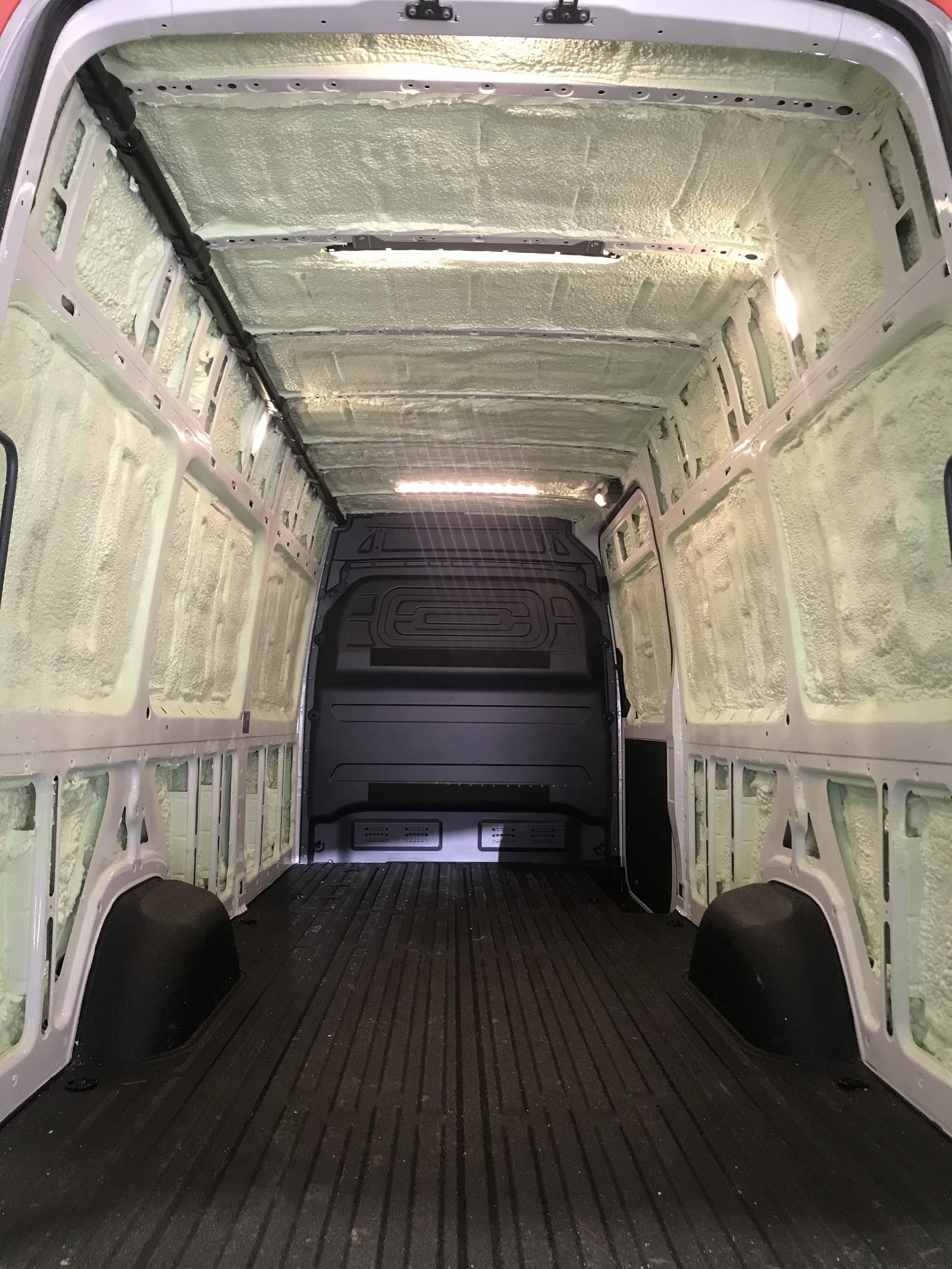
Vehicle Spray Foam Insulation Spruce Grove is sled trailer season for most of the winter. This is an Edmonton commuter city whose weekends happen west of it, and the enclosed hauler that goes out full of machines comes back with something nobody loaded: snow. It is packed in the tunnels, up under the running boards, in the tracks and all over the gear piled on the deck, and once that trailer is sitting in a driveway at home it starts to melt. From that moment the trailer has a water problem rather than a snow problem.
Snow goes in and does not come out as snow
A couple of machines can carry a surprising amount of packed snow, and in a closed box none of it leaves. It melts on the deck, the air takes up as much as it can hold, and the first cold night puts all of it back onto whichever surface is coldest. In a bare hauler that is the roof sheet, right above the machines. It forms up there in a film or a layer of frost, and the next mild afternoon it comes down — on the seats, on the gear bags, on the deck. Plywood that gets soaked weekend after weekend swells, then delaminates at the edges, and the fasteners start to pull.
Meltwater ends up on the ceiling and then on your gear
People look for a leak first, because the symptoms are exactly a leak's: wet seats, drips along the centre line, dark patches on a plywood ceiling liner. The giveaway is that it happens after a dry week. There is no rain to blame, which means the water was already inside, in the air, and the roof simply handed it back. The second giveaway is that the drips follow the roof bows — the bows are metal, they are the coldest line in the ceiling, and condensation forms along them first.
Why vehicle spray foam insulation in a hauler is closed cell
Closed cell is about R-6 per inch and it comes as its own air barrier and vapour retarder, bonded to the panel it is sprayed onto. On a sled hauler the point is not warmth. The point is that there is no longer a surface cold enough for the melt to condense on and no cavity for it to hide in, so the water that comes off the machines goes out of the vents when the doors open instead of circling round the inside of the trailer for a week. The bond is worth having for its own sake too: a sheet with foam stuck to the back of it is stiffer, does not boom on the highway, and does not shake its lining screws loose.
Enclosed trailer spray foam insulation over bows and the ramp
A hauler's roof is a series of bows with sheet stretched over them, the walls have a rib at every upright, and there is a formed radius at the top corners. Board can be cut between bows but it cannot wrap them, so it leaves the coldest part of the ceiling exposed and a connected void behind the rest — which is the one place in the trailer you cannot see, dry out or inspect. Sprayed foam goes over the bow itself and into the corner, so the cold line disappears. The ramp door is its own panel and gets the same treatment, or it stays the one surface in the trailer that still sweats.
Thickness against ramp clearance and handlebar width
Two measurements decide this job: the clear width when two machines sit side by side with bars turned, and the clearance at the top of the ramp door when a machine drives up. Both are tight in a standard hauler and both are spent by thickness. In most cases we put the depth in the roof, where the condensation is actually forming, and keep the sidewalls modest so loading does not change. Owners searching Best Vehicle Spray Foam Insulation Spruce Grove are generally weighing that against the idea of filling every cavity, and filling every cavity is rarely the right answer in a hauler.
What has to be dealt with first
Salt, sand and grit get washed out and the deck given real time to dry. Rust at the ramp hinge, the lower wall and under the deck edge gets brushed back, because those are the spots that stay wet longest. Dome-light and winch wiring is planned and routed first, the roof vent and any fan is kept reachable, and the D-rings and tie-down track stay exposed so they still work. We would rather spend an afternoon on preparation than spray onto a damp liner and watch the bond let go in a year.
Vehicle Spray Foam Insulation Spruce Grove: Common Questions
My trailer drips and I cannot find the leak. Then there probably is not one. Check whether it happens after a dry week, and whether the drips line up with the roof bows; both point at condensation off melted snow.
Will this keep the trailer warm enough to work in. Not on its own, and that is not the aim here. With the roof and walls sealed, a Spruce Grove hauler holds heat long enough to be worked in with a small heater, which is a side benefit rather than the reason.
Should the floor be done too. Sometimes, from underneath, where road spray and a cold deck are making the plywood sweat. It is a separate decision from the roof and we will say which one your trailer needs.
Related: spray foam insulation for shipping containers, our other spray foam insulation services locally, Spray Foam Insulation Alberta province-wide, and the spray foam insulation service areas list. Ask for a free spray foam quote in Spruce Grove.