
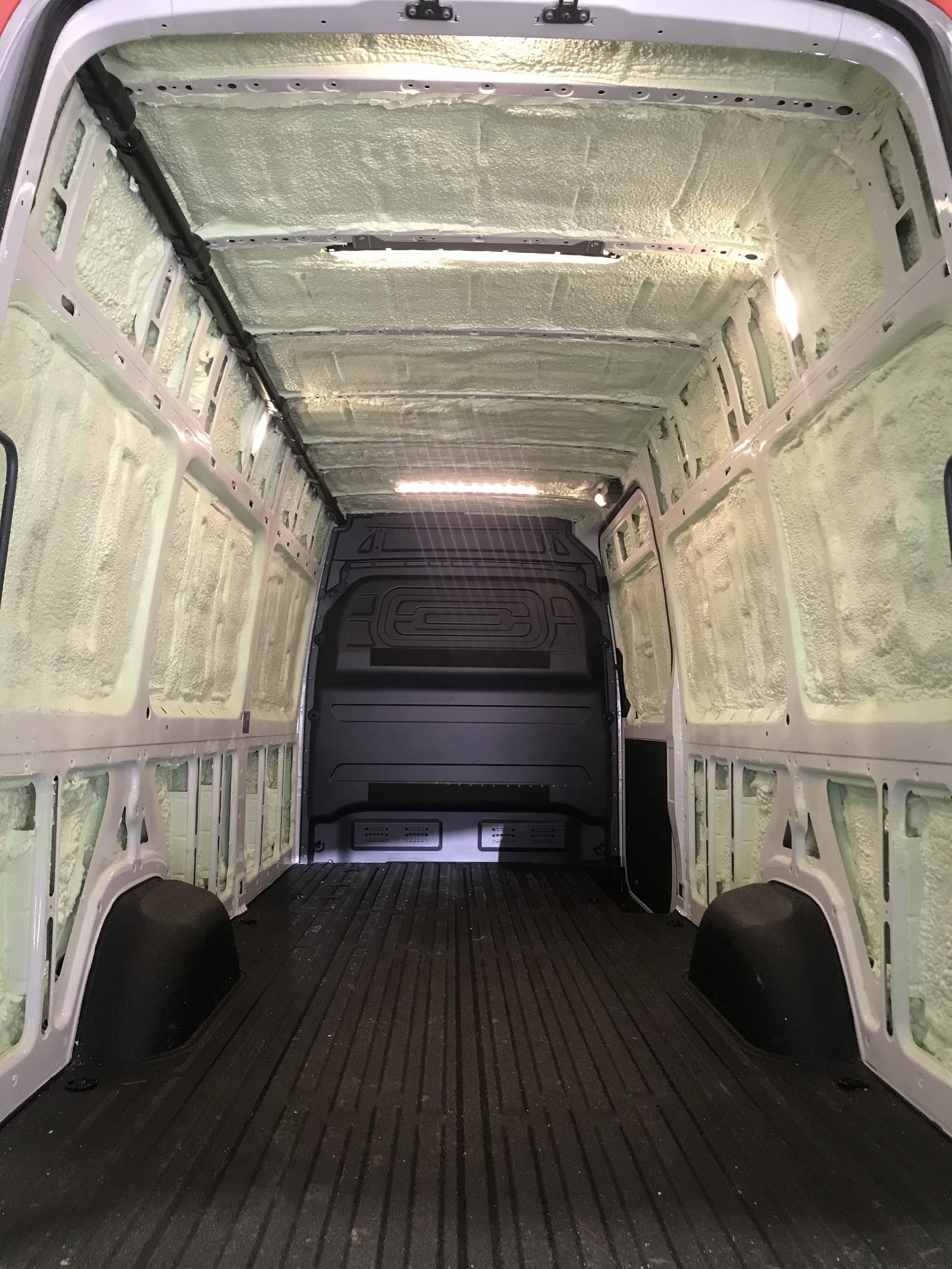
A lot of the trailers we are asked about around Wainwright have had a second life. An old equipment deck gets a box put on it and becomes a shop on wheels for harvest; a cargo trailer becomes a parts and welding unit; something that used to haul hay ends up as a bunk unit for a crew working a long way from the yard. Vehicle Spray Foam Insulation Wainwright usually turns up on the list once somebody has tried to heat one of those conversions and discovered that heating it made it wetter.
That is not a fault in the heater. It is what happens when you add heat to a box whose walls cannot hold any.
Running a heater in an uninsulated trailer makes the problem worse
Warm air carries more water than cold air. Fire a heater into a bare metal box and the air temperature climbs within minutes while the skin stays exactly where the weather put it. Now you have air capable of holding a lot of moisture, a crew adding moisture to it, and a wall sitting at the outdoor temperature. Every bit of that water comes out on the inside of the sheet and on the frame members behind it. People read the dripping as a sign they need a bigger heater. A bigger heater makes more of it. The only way out is to stop the skin being the coldest thing in the trailer.
Vehicle spray foam insulation and how fast a box comes up to working temperature
The practical thing an insulated unit gives you at harvest is time. A treated box reaches a working temperature quickly off a modest heat source and then holds it, so tools, fluids and hands are usable when somebody opens the door at first light. An untreated box is still cold an hour later because everything the heater produces is going straight out through the sheet. Closed cell is the material that does this in a vehicle: about R-6 per inch, so shallow walls still get a real number; its own air barrier and vapour retarder, so nothing has to be taped across a frame member; and bonded to the panel, so a trailer that used to boom on a field road quietens down. Open cell at about R-3.6 per inch absorbs sound well and suits buildings, but it is permeable and would hold water against the steel, which defeats the whole purpose.
Equipment trailer spray foam insulation on an older Wainwright unit
Older units are perfectly good candidates, with one condition: the metal has to be sound. Foam bonds to whatever is on the surface, so flaking paint, powdery rust, chaff dust, grease and the glue from an old mat all have to come off first. Where the sheet has gone thin or holed, that is a repair and it happens before we arrive, not under our foam. We would rather tell an owner that than spray over it and have the job fail in two winters.
Substrate temperature is the other condition people do not expect. Foam applied to steel that is too cold will not cure or bond the way it should, so the trailer needs shelter and enough time to come up to temperature through its whole thickness. That is why we schedule this work for a shoulder season or into a heated bay rather than promising a yard job in deep winter.
What stays serviceable on a harvest unit
Conversions are full of things that get worked on. Before any foam is applied we mark out and mask the brake wiring to the axles, marker and work light runs, the generator or inverter cabling, any air or hydraulic line, the heater and its fuel supply, and every access panel that gets removed in the field. On a unit that already carries a welder or a compressor we go through the mounting points as well. None of that gets buried.
Depth against the space the job needs
Thickness is set against the inside of the box, surface by surface. Bench depth, the clear width to walk past a parts rack and the height at the door come first; the ceiling and the upper walls take the most depth because the only thing lost there is head height. On a tandem that already hauls a heavy fit-out, the weight of the foam is part of the same sum.
Vehicle Spray Foam Insulation Wainwright: Common Questions
My trailer has surface rust inside. Is it a write-off for this. Usually not. Surface rust comes off and we spray sound metal. A Wainwright trailer with rust right through the sheet needs a repair first, and we will say so rather than cover it.
Can it be done during harvest. Realistically no. The unit has to be emptied, stripped, cleaned, dry and up to temperature, and that is a shoulder-season job.
Do I still need to vent it once it is sprayed. Yes. Insulation deals with the cold surface; ventilation deals with the moisture a crew puts into the air. You need both. Anyone bidding on the back of a search for Best Vehicle Spray Foam Insulation Wainwright should be telling you the same.
Related: machine shed spray foam insulation, oilfield tank spray foam insulation, shipping container spray foam insulation and the rest of our local spray foam insulation services. Province-wide, Spray Foam Insulation Alberta and our spray foam insulation service areas.