
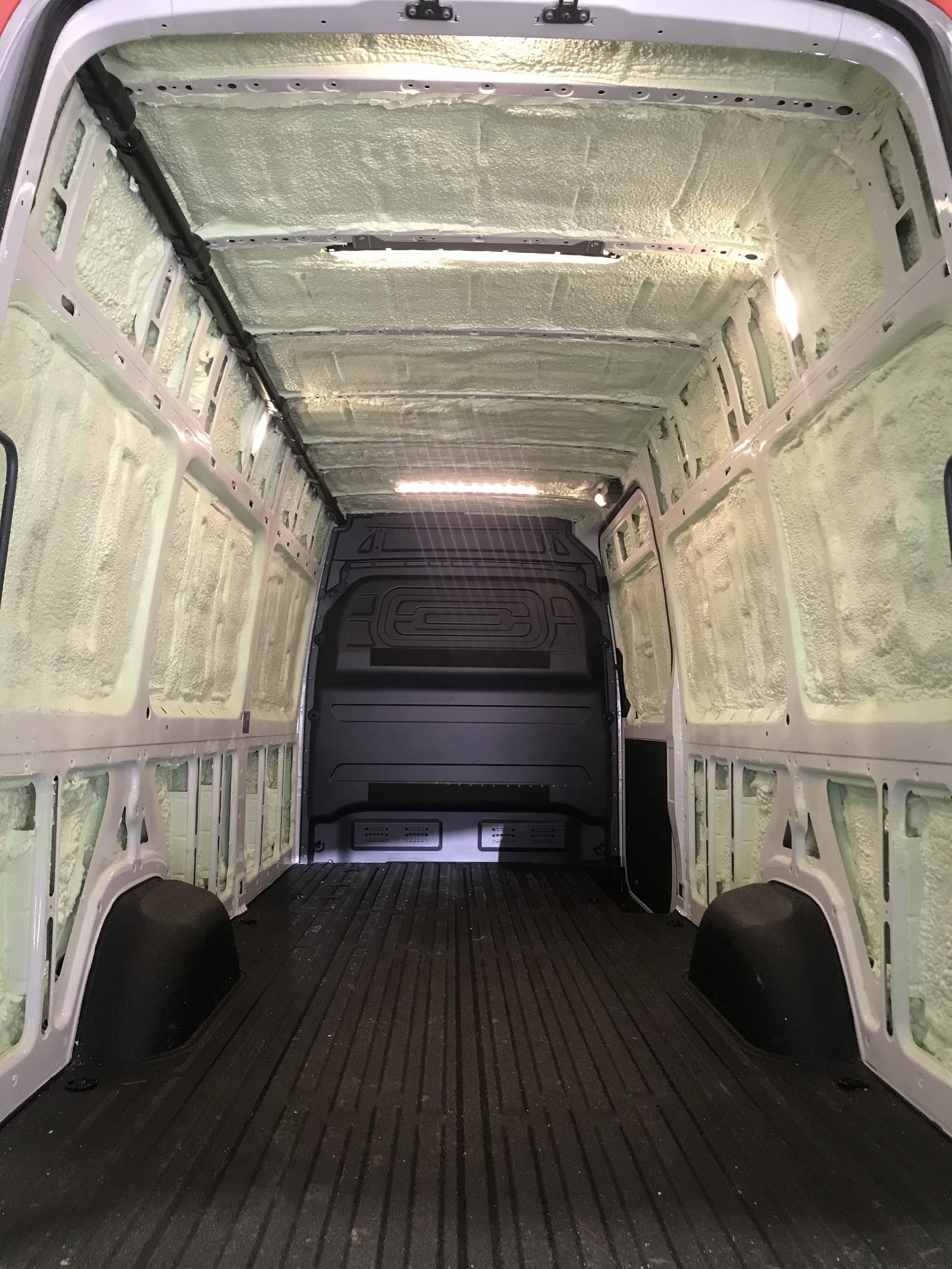
The unit that gets us called most often around here is a holiday trailer or a fifth wheel that the family uses well past the summer. Vehicle Spray Foam Insulation Westlock is almost always booked in the spring, after the owner has opened the trailer up and found grey mildew along the edge of the mattress on the outside wall, black spotting at the bottom corner of the slide, and a musty smell that was not there in August.
A week of hunting season puts a lot of water into a trailer
Late October, two or three people sleeping in it, a propane furnace running all night, a wet dog, boots inside the door and something cooking. The air in that trailer is far wetter than the air outside, and the coldest surfaces available are the aluminium siding and the steel and timber framing behind it. The vapour goes there, becomes water and soaks into the cavity, the mattress edge and the corner of the slide. Then the trailer gets parked for five months and nothing ever dries out. The mildew in spring is the record of what happened in autumn.
Where an RV loses the argument: framing, the slide and the underbelly
Three places do most of the damage. The framing members conduct straight through from the siding to the inside, so there is a cold stripe at every stud whatever is in the cavity between them. The slide is a box within a box with its own thin walls and seals, and it is never as warm as the room it slides into. And the underbelly is a wrapped floor cavity with plumbing in it, which is why the water lines are the first thing to freeze and the floor edge stays cold under bare feet.
RV spray foam insulation has to be closed cell
This is not a place for anything that lets air through. Closed cell is about R-6 per inch and it is its own air barrier and its own vapour retarder as it goes on, so it does not just insulate the cavity, it stops interior air ever reaching the back of the siding. Sprayed in, it follows the formed aluminium, wraps the framing instead of stopping either side of it, and gets into the odd shapes around a wheel well and a wiring run. It also bonds to a thin panel, which takes the flutter out of a sidewall on a gravel road. A rigid board can only sit between the studs and bridge everything else, which leaves a connected gap with cold metal behind it — the exact condition that produced the mildew.
Thickness, and the inches vehicle spray foam insulation costs you inside
An RV has no spare room anywhere. Cavity depth is whatever the factory framed, headroom is already short and a slide has a mechanical clearance that cannot be reduced by even a little. So the practical work is deciding which cavities get opened and sprayed, where depth is available and where it plainly is not. Weight is a live issue too, because a holiday trailer is usually towed by something already working hard.
What has to come out before anything is sprayed
Interior panels off where we need access, the cavity cleared and dried, old adhesive and tape removed, any surface rust on the framing taken back. The furnace ducting, the water lines, the wiring and the slide mechanism all get located and planned around first — on an RV that is most of the skill, because every one of those things will be needed again and none of them should ever be under foam.
Who does the job
We quote the job, schedule it and stand behind it, and our own installers do the work on vehicle spray foam insulation. Owners typing "Best Vehicle Spray Foam Insulation Westlock" into a phone are generally trying to find one person who will look at the trailer before quoting it, which is how we would want to do it anyway.
Vehicle Spray Foam Insulation Westlock: Common Questions
Can you make a holiday trailer usable in real winter. We can make it dramatically better and we will not promise you a house. The windows, the door and the slide seals stay the weak points, and the honest version of this is that the shell stops being the problem.
The dealer says it is already an all-season package. Is it. Sometimes partly. We would rather open a panel and look than argue with a brochure, and in Westlock we have opened plenty where the cavity was far emptier than the label suggested.
We also have a stock trailer in the yard. Same job. Same physics, different priorities. Livestock put a huge amount of moisture into the air, so on that unit the roof sheet is where we would start, and the thickness decision is driven by weight rather than headroom.
If what needs doing is a sea can instead, see shipping container spray foam insulation. For the house, shop or shed, start at spray foam insulation, or see Spray Foam Insulation Alberta and our spray foam insulation service areas.