
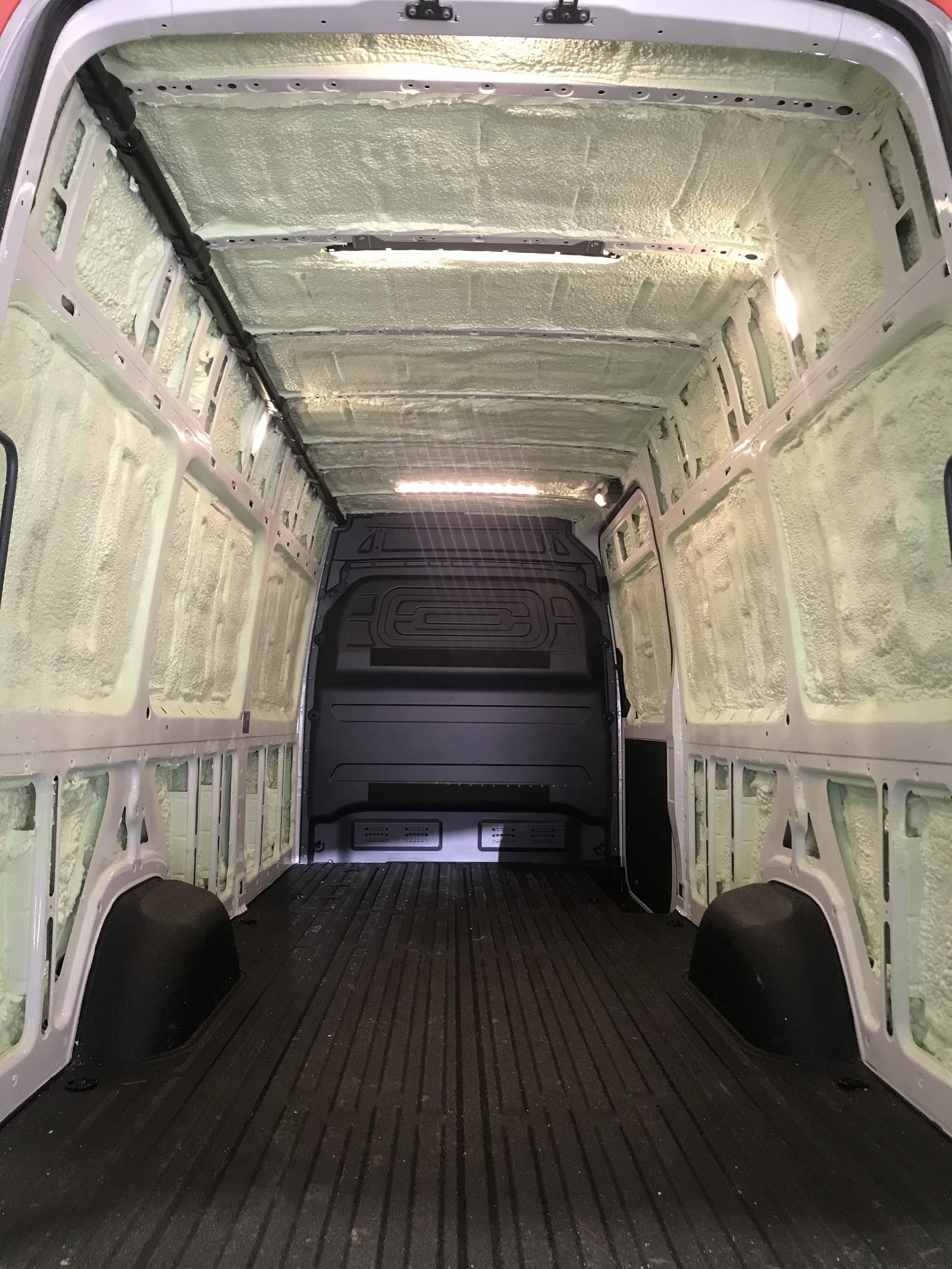
A high-roof cargo van can be bone dry when it gets parked on a driveway in Airdrie on a Friday night and have water beading across the inside of its roof by Saturday morning, with nobody having opened a door. That is the job. Vehicle Spray Foam Insulation Airdrie is rarely bought because a van is cold. It is bought because the van is wet, and the cold is only what made it wet.
Van conversions are everywhere in this town, because a commuter driveway is a cheap workshop and the mountains are a morning away. The moisture problem arrives with the build, not with the weather.
The wet ceiling in a van that was dry when you parked it
Two people asleep in an enclosed metal box put a steady stream of water vapour into a very small volume of air. Add a kettle, a diesel heater, a wet dog after a walk along Nose Creek, and the air inside is carrying far more moisture than the air outside. Warm air holds it; cold steel takes it straight back. The ribbed roof panel is the coldest surface in that van by a long way, because it is a single layer of painted steel with the night pressed against the other side. The vapour finds it, gives up its heat, and turns into liquid water on the back face of the panel where nobody can see it. From there it runs down inside the wall, collects on the bottom flange of the rocker, and starts rust under a wall that has already been lined and trimmed.
Why a van conversion gets closed cell vehicle spray foam insulation
Closed cell is the material for a thin metal shell, and R-value is only part of the reason. At about R-6 per inch it carries more thermal performance for every inch of interior space it costs, which matters when the space is measured between your shoulders. More importantly it cures as its own air barrier and vapour retarder, so there is no separate membrane to be taped across a curved rib and no seam to fail behind a cabinet. It also bonds to the panel and stiffens it, which is why a sprayed van stops drumming over rough pavement. Open cell foam, at about R-3.6 per inch, absorbs sound well and belongs in building walls, but it will hold moisture against bare steel, so it has no place against a vehicle skin.
Camper van spray foam insulation and the headroom you trade for it
Every inch on the roof is an inch of standing height. The phrase people type into a search bar is Best Vehicle Spray Foam Insulation Airdrie, but what they are actually trying to settle is how thick to go before the van stops being usable. Our answer is that thickness is not a single decision across the whole shell. The roof is the surface where lost space hurts most and where a thinner pass can be justified. The lower walls and the wheel arches can take more depth without anyone noticing, and that is also where the cold bridging is worst. Weight is part of it too. A conversion that will be loaded with water, batteries and gear has a payload ceiling, and foam is part of that budget.
What we need from an Airdrie van before we spray
Clean, dry, bare steel. Factory protectant, road salt, old adhesive from a previous liner and any loose surface rust all have to come off, because foam bonds to what is on the panel rather than to the panel itself. We walk the shell with you first and mark what must stay reachable: the main harness runs, the fuel and brake lines, body plugs, and any panel that has to come off again for service. Those get planned around. Burying a connector in cured foam turns a small electrical job into a demolition job.
Vehicle Spray Foam Insulation Airdrie: Common Questions
Will the van be quieter on the drive south. Noticeably. Foam bonded to a large flat panel stops it acting like a drum skin, so tyre and wind roar on the highway between Airdrie and Calgary drops along with the condensation.
Can you spray it once the walls are already in. Not properly. Foam has to reach the back of the ribs and the inside of the channels, and once furring and panelling are fitted those cavities are closed. Spray first, build second.
My van is a work van, not a camper. Do I still have a moisture problem. If it is heated and occupied, yes. A tradesman eating lunch with the engine off is doing the same thing to the air as a camper, and tools stored in a van that sweats will show you where the water went.
Related work: shipping container spray foam insulation for yard storage, soundproofing spray foam insulation where noise is the main complaint, and the full range of local spray foam insulation services. Province-wide, Spray Foam Insulation Alberta and the towns we cover on our spray foam insulation service areas page.