
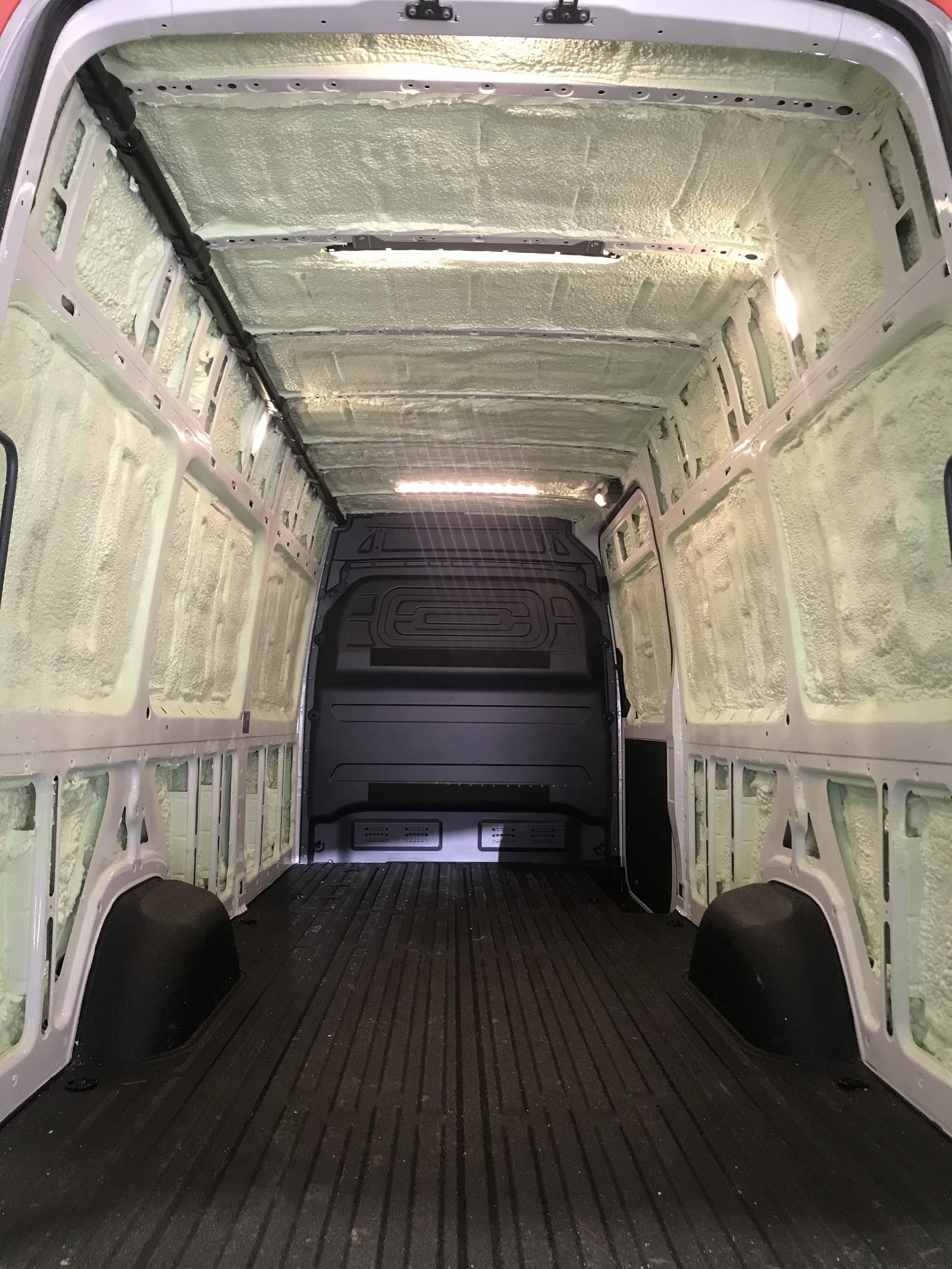
Most jobs behind the phrase Vehicle Spray Foam Insulation Beaumont begin on a driveway on a mild evening in May. Somebody bought a cargo van, pulled the bulkhead and the old shelving out, and is now standing inside an empty steel box trying to decide what belongs against the walls before a bed platform and a little galley go in. Beaumont is commuter country with deep lots and wide driveways, so the conversions here are generally owner-built, patient, and lived in over long weekends rather than flogged by a business.
Two adults asleep release a startling amount of water
A sleeping person gives off moisture steadily all night. Two of them in a small vehicle, with a kettle in the morning and a heater ticking over on low, add up to more water than anybody expects. None of it departs through the walls. It migrates to the chilliest thing within reach, which inside a van is always the outer panel, and by first light it is standing in beads across the roof. Once a bunk and some cabinetry are in the way, the same water is forming on the hidden face of the sheet, out of sight for a couple of winters.
Why camper van spray foam insulation uses closed cell
Closed cell is the right chemistry for sheet metal because it does four jobs in one pass. It delivers roughly R-6 for every inch, so a thin skin of it still means something. It is its own vapour retarder and its own air barrier, which removes the plastic-and-tape stage that most home-build conversions get wrong. It locks to the steel so there is no cavity behind it for humid air to sit in. And it glues the panel into a stiffer piece, which is why a foamed van rattles and booms far less at highway speed than a bare one.
Vehicle spray foam insulation suits a shaped wall and a flat board does not
The walls of a cargo van are a landscape — pressed ribs, rolled returns, wheel arch curves, a roof with bows across it. Lay a flat board against that and the board can only touch the raised ridges. Behind it sits a connected gap that wanders the length of the vehicle, and air inside a connected gap circulates, carrying moisture straight back to the metal. You have paid for insulation and installed a chimney. A sprayed layer takes the shape of the pressing instead: into every groove, over each bow, around the arch.
Choosing a thickness you can live inside
A van conversion is a fight over inches, and every inch of wall is an inch off the width of the bed. Thickness has to be set against what you intend to sleep in and carry. Interior width tends to decide the walls, available headroom decides the ceiling, and the floor usually wants the least because the build-up on top of it stacks quickly. Thinner and continuous always outperforms thicker with gaps at the ribs.
Preparation, which is most of the job
Everything we spray must be bare, dry and sound. Factory adhesive, old carpet glue, loose sound-deadening pads and any blooming rust come off before we start, since foam takes hold of whatever is on the surface and a glue film is not a surface. We go through the shell with the owner first and agree what must remain serviceable — the loom to the rear lamps, the fuel filler neck, the bolts behind the rear arch, the roof fan opening if one is planned. Those are worked around on purpose.
The people who quote it are the people who spray it
We look at the vehicle, we work out the number, and our own installers apply the foam. Searches for "Best Vehicle Spray Foam Insulation Beaumont" mostly come from owners who would rather ask one set of questions and get one answer.
Vehicle Spray Foam Insulation Beaumont: Common Questions
Is it too late if the build is already half finished. Not necessarily, but anything we spray has to be opened back up. Half-built conversions in Beaumont are a common call and the usual outcome is removing one wall of cabinetry rather than the whole interior.
Will the foam hold up to the van flexing. Closed cell adheres and stays adhered; it moves with the panel instead of hanging off it on fasteners.
Can you also do the holiday trailer parked beside it. Yes. Enclosed trailers and tent-top units behave the same way as a van — a cold outer skin with warm bodies on the inside.
Related reading: spray foam insulation for the house and garage, shipping container spray foam insulation, the provincial view at spray foam insulation Alberta, and our service areas.