
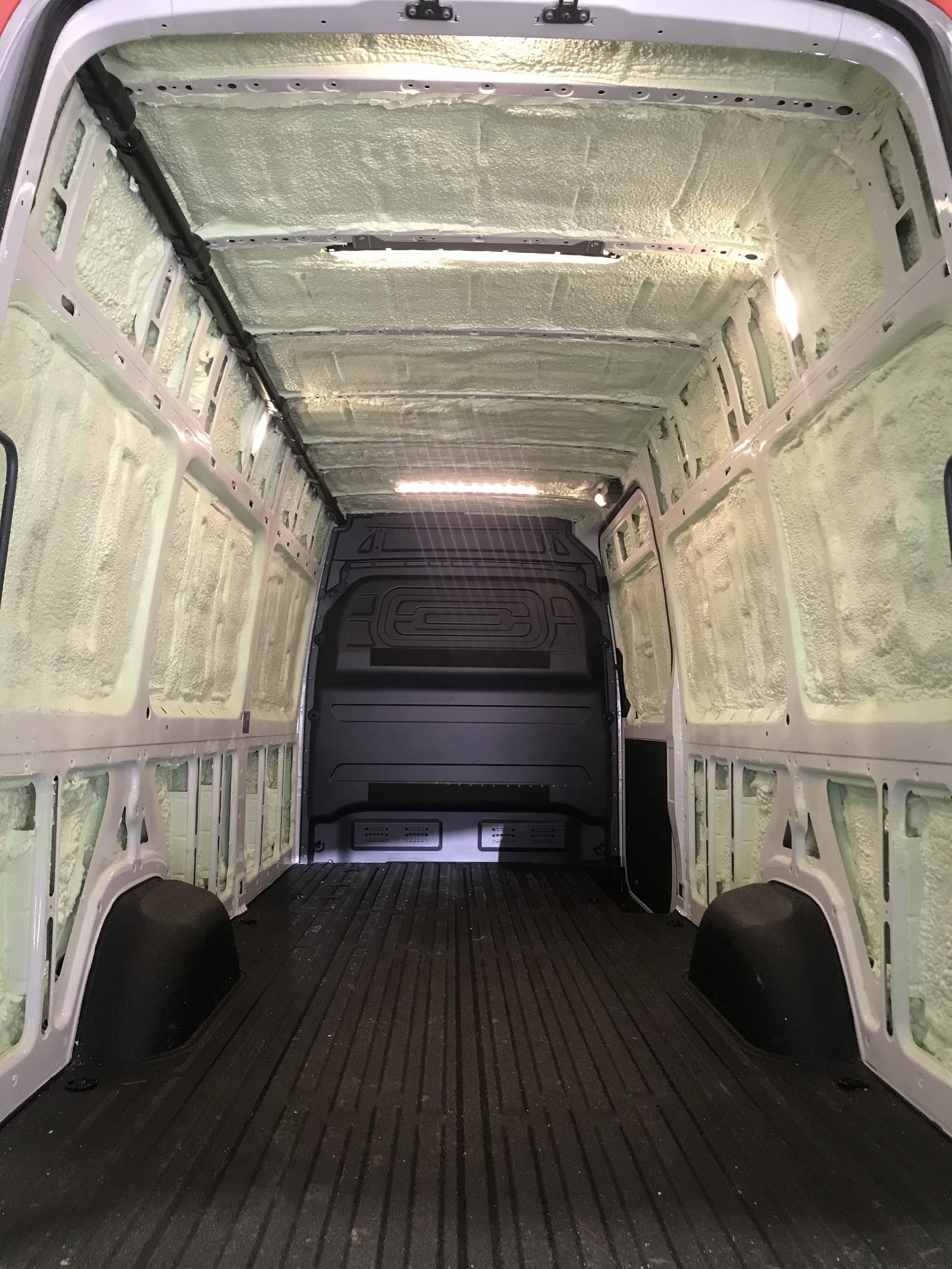
The cardboard reports the problem before the panel does. A straight truck runs vegetables from a Coaldale packing door into town, the boxes come off with darkened top flaps, and everyone assumes somebody hosed the deck. Vehicle Spray Foam Insulation Coaldale deals with the actual cause, which is that the ceiling of the box was the coldest surface available and the load's own humidity went straight to it.
Air holds moisture in proportion to how warm it is. Produce respires, the doors open and shut at every stop, and warm wet air keeps being introduced into a box whose roof panel is sitting at whatever the morning is doing outside. At the panel the air cools, can no longer carry what it is holding, and the surplus turns to liquid on the metal. It does not stay put. It wicks along the roof bows, creeps down the corner extrusions, and finishes up on whatever is stacked highest.
Vehicle spray foam insulation works on the cold side of the sheet
The fix is not drier air in the box, because you cannot control that on a route with twelve stops. The fix is making sure the box has no cold surface for the moisture to find. Closed cell applied to the inner face does that: roughly R-6 per inch, acting as its own air barrier and vapour retarder, so the inside of the foam stays near cargo temperature and the dew point sits inside the foam rather than on the steel.
Van spray foam insulation and what a rigid board leaves behind
Board is a flat product in a ribbed box. It touches the high side of each bow and spans everything between, so the finished wall contains a long, joined-up void with cold metal on one face. Air finds its way in at a screw hole or a cut edge and condenses in there permanently, out of sight and impossible to dry. Sprayed foam rises into every channel, seals around rivet heads and locks into the corners, which removes the void instead of lining it.
Depth measured against pallet width
Inside width decides how a box loads. Lose two inches each side and a standard pallet arrangement may stop working, which costs more over a season than the heat ever did. We take the dimensions that matter to you first, then set thickness where the metal is genuinely coldest and keep it thin where the load is tight. Weight is part of the same conversation, since foam on every surface is mass carried on every trip.
The hour before the gun: clean, dry, planned
Foam bonds to a prepared surface and to nothing else. Produce residue, sugar film, old glue from a previous liner and flaking paint all come off, rust is wire-brushed back, and the box has to be dry and warm enough that the chemistry behaves. Liftgate hydraulics, lamp looms, door seal tracks and bolted kick plates are marked and worked around so they stay serviceable afterwards. A yard container gets the same treatment under shipping container spray foam insulation, and the cooled room it feeds is covered by cold storage spray foam insulation.
We take care of the work
Our own people scope your unit and our own people spray it. Nothing about the job gets handed off to a third party.
Vehicle Spray Foam Insulation Coaldale: Common Questions
My boxes come off damp but the deck is dry. Where is it from? The ceiling. Condensate forms on the cold roof panel, collects, and drops onto whatever is on top of the stack.
Will foam make the box harder to wash out? No, because we finish behind a liner or a coating where the inside gets cleaned. The foam sits against the metal, not in the load space.
Is this worth doing on short Coaldale to Lethbridge runs? Yes, and often more than on long hauls, because frequent door openings keep reintroducing humid air. People searching the Best Vehicle Spray Foam Insulation Coaldale are usually running exactly those short, stop-heavy routes.
See Spray Foam Insulation Alberta for the provincial picture. For buildings, start at spray foam insulation, or browse our service areas. Free vehicle spray foam quote on request.