
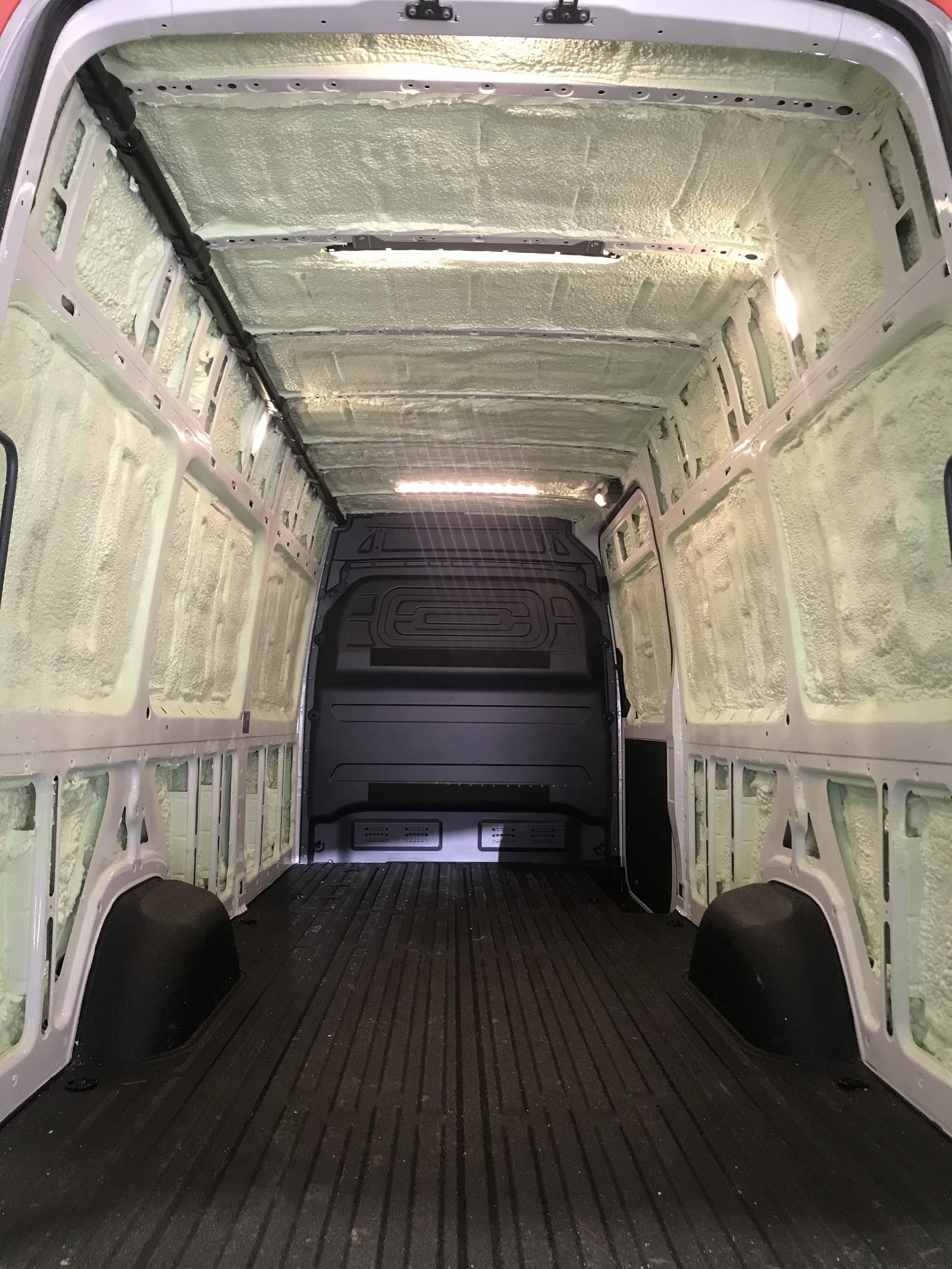
The typical unit behind Vehicle Spray Foam Insulation Drayton Valley has an address that changes every few weeks. Site offices towed from lease to lease, doghouses, wireline shacks, pipeline crew trailers, skidded shacks that get dragged onto a pad and dragged off again. They live on gravel, they get hauled in every kind of weather, and their walls are light-gauge sheet over a frame. The work we do is about what happens on the inside face of that sheet once there is a crew and a heater in there.
Five men, a kettle, and wet coveralls
A crew trailer at the start of a shift is a humidity generator. Breathing, a kettle on, coveralls drying over a bench, a space heater holding the room up against the cold. The windows stream, which everybody notices, and the walls do exactly the same thing where nobody can see it. Moisture goes to the coldest surface it can reach; the coldest surface is the outer skin. Water forms there, runs down the inside of the sheet and sits in the bottom channel of the wall. The first sign is usually a soft spot in a floor or a stain coming up through the vinyl, by which point the metal has been wet for a long time.
Why closed cell is the material for a towed shell
Hauling is the thing that separates a field trailer from a building. Every mile of lease road works the joints, and an assembly held on with fasteners and tape loosens. Closed cell is bonded, not fastened, so there is nothing to shake free. It brings about R-6 per inch, which keeps the wall build-up sensible inside a narrow unit. It is its own air barrier and its own vapour retarder, so there is no separate layer to rip when a shelf gets installed later. And because it fuses to the panel, the shell comes back stiffer than it went out, which shows up as less flex over washboard and a lot less panel noise behind the truck.
Vehicle spray foam insulation beats a bridged board every time
A field shell's inner face is ribs, hat channels and seam flanges. Push a rigid board up against it and the board rests on the ribs while a continuous cavity opens up behind. On a unit that gets towed, that cavity also becomes a path for road dust and spray, and anything that gets in is damp. The board stays looking fine. The metal behind it does not. Sprayed material takes the profile of the channel and the flange, follows the corner radius and leaves no cavity to be a path at all.
Depth, interior width and what the hitch is carrying
Narrow units pay for wall depth in elbow room, and a trailer that already runs close to its rating pays for it in weight. We decide thickness by use. A sleeper or an office that gets heated all day earns more. A storage deck that only needs to stop the roof sweating needs less, and the depth goes overhead where the water appears rather than all round.
What we do before the gun comes out
Field units arrive with a working life on them. Diesel and hydraulic film on the lower walls, dried mud, clay, calcium chloride, remnants of old glued-on lining, scale in the corners that stayed damp. All of it is removed and the steel dried and sound before anything is applied, because adhesion is to the surface that is actually there. Then we mark up the unit with whoever runs it: the heater supply, the breaker panel feed, the lighting circuit, the plumbing chase, and the panels that get unbolted during a service. Those get worked around deliberately so the next repair is not a demolition.
One crew, from quote to cleanup
We look it over, we quote it, and our own sprayers do the application. "Best Vehicle Spray Foam Insulation Drayton Valley" is the phrase that gets searched; what operators actually want to know is whether the unit will be ready when they need it back.
Vehicle Spray Foam Insulation Drayton Valley: Common Questions
Can the unit stay in service while you do it. No, it needs to be out of use and emptied for the application and the cure. We try to fit units in Drayton Valley around a break between locations so nothing is sitting idle on our account.
It is an older shack with rust showing. Is it worth doing. Often yes, but the rust gets dealt with first. Foam over scale is foam that will let go.
Do you also do the sea cans on the yard. We do — see shipping container spray foam insulation for how a container differs from a trailer.
Also relevant: spray foam insulation for shops and homes, the wider spray foam insulation Alberta coverage, and our service areas.