
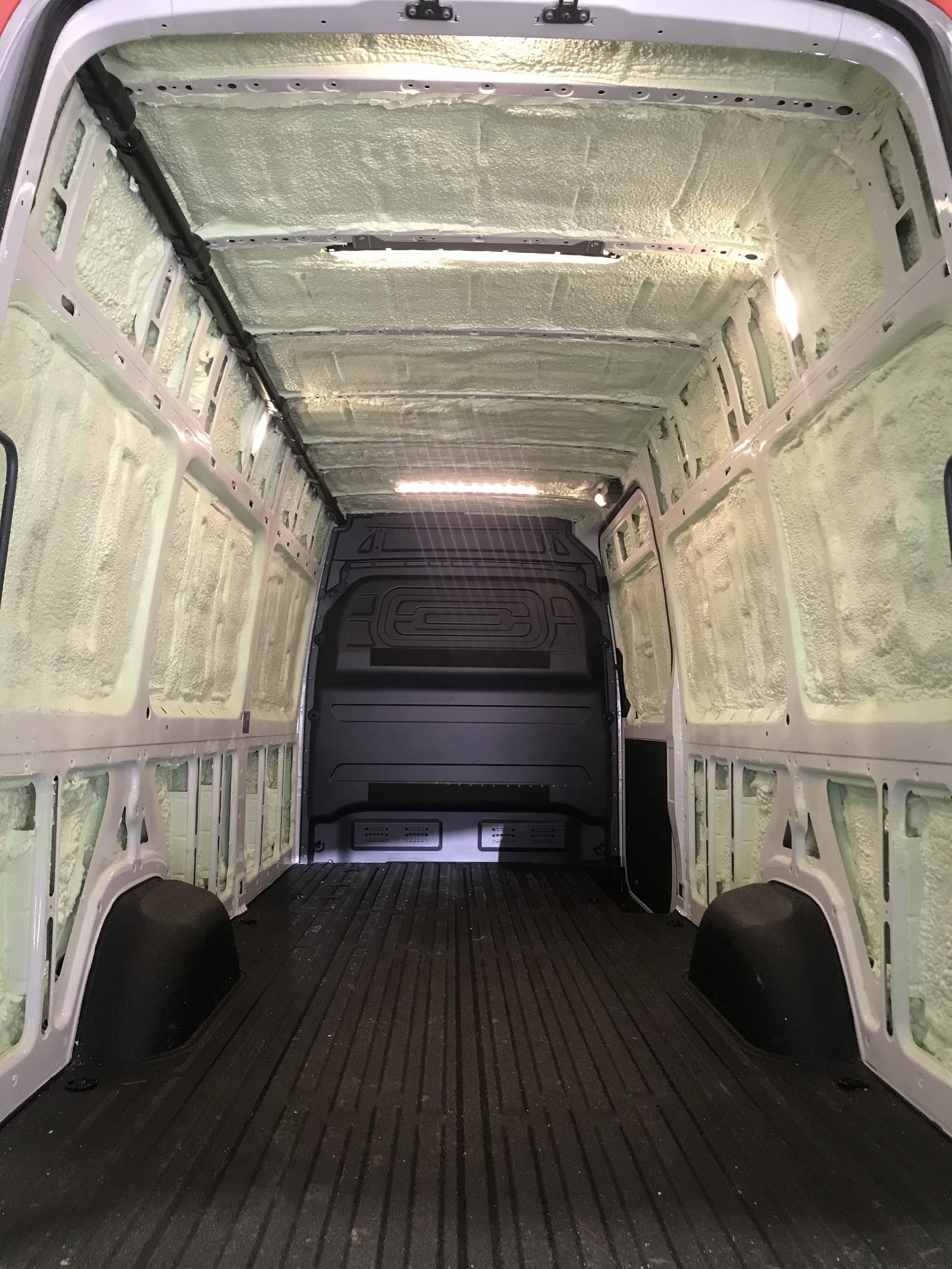
Vehicle Spray Foam Insulation Fort McMurray is mostly logistics work. This is a town organised around moving people, parts and consumables long distances in bad weather: crew buses, lube and fuel bodies, parts chase vans, laydown rows of sea cans at Gregoire Industrial and MacKenzie Industrial, catering and supply trailers feeding camps. Everything on that list is a metal envelope that gets warm on the inside and stays brutally cold on the outside for months on end.
Boots, bodies and a long run north
A crew bus at the end of a shift has thawing boots in every footwell, damp outerwear on every seat back and a cabin full of people breathing. The heater keeps it liveable, and it also keeps all of that water airborne. There is only one place the water can land: the outer sheet, which is being scoured by the wind up the highway. It condenses on the inside of the roof and on the window surrounds, it beads, and in a hard cold snap it frosts and sits there until the unit comes indoors and releases the lot at once. Same in a parts van, same in a catering body. Different cargo, identical physics.
Vehicle spray foam insulation for units that run on a shift cycle
We use closed cell against sheet metal, and the reasons stack. It supplies about R-6 for every inch, so a unit that cannot spare interior width still gets a wall worth having. It is itself an air barrier and a vapour retarder, so the wet air never arrives at the steel and the condensing surface disappears rather than being hidden. It cures bonded to the panel, which stiffens the envelope and takes the hollow boom out of a long empty box. On a vehicle that spends hours running, that last point gets mentioned more often than the insulation value does.
Board cannot follow a body and foam can
The inside of a van body or a bus shell is ribs, hat sections, wiring chases and a crowned roof. Rigid board bears on the proud edges of all that and nowhere else. The gap behind it is open and continuous, so air cycles inside it, warming low down and dumping moisture high up where the metal is coldest. The lining looks sound and the panel behind it corrodes quietly. Spray applied to the same surface goes into the chase, up the crown and around each rib, so there is no connected space left to cycle in.
Thickness versus seats, pallets and payload
What depth we apply is settled by what the unit earns its living doing. A passenger shell cannot narrow the aisle. A freight body measures itself in pallet width. A tandem running close to its rating is weight-sensitive before it is space-sensitive. Containers are the easy ones: a can has room to take a proper layer without anybody losing anything they were using. We tell you plainly what each depth takes away so you are choosing, not guessing.
Getting a used unit to a surface that will hold foam
Equipment up here comes in dirty in specific ways: oil mist and grease in a lube body, calcium chloride and road film through the lower panels, mud and clay in the wheel wells, old mastic and adhesive where a liner used to be, rust blooming wherever bare steel stayed wet. Everything gets cleaned off and dried, since foam adheres to the first thing it touches and grease is the opposite of a key. Then we walk the unit with whoever maintains it and list what must remain reachable: the harness to the rear cluster, the air line runs, the hoist or tailgate wiring, the inspection covers. Those are protected and left open.
You are dealing with the contractor
We do the walk-around, we write the quote, and our own installers spray the unit. The phrase that brings people in is "Best Vehicle Spray Foam Insulation Fort McMurray", and the thing they are usually checking is scheduling — whether a unit can go in and come out on a date they can plan a shift around.
Vehicle Spray Foam Insulation Fort McMurray: Common Questions
Can you handle more than one unit at a time. Yes. Fleet work in Fort McMurray is normally sequenced so vehicles come off the road one after another rather than all at once.
We keep tools and spares in a sea can and everything rusts. That is condensing air, not a roof leak. Shipping container spray foam insulation sets out how the roof and walls get handled.
What about a personal build, not a work unit. Also fine — camper van spray foam insulation and trailer spray foam insulation cover those.
See also spray foam insulation for buildings, the provincial picture at spray foam insulation Alberta, and our service areas.