
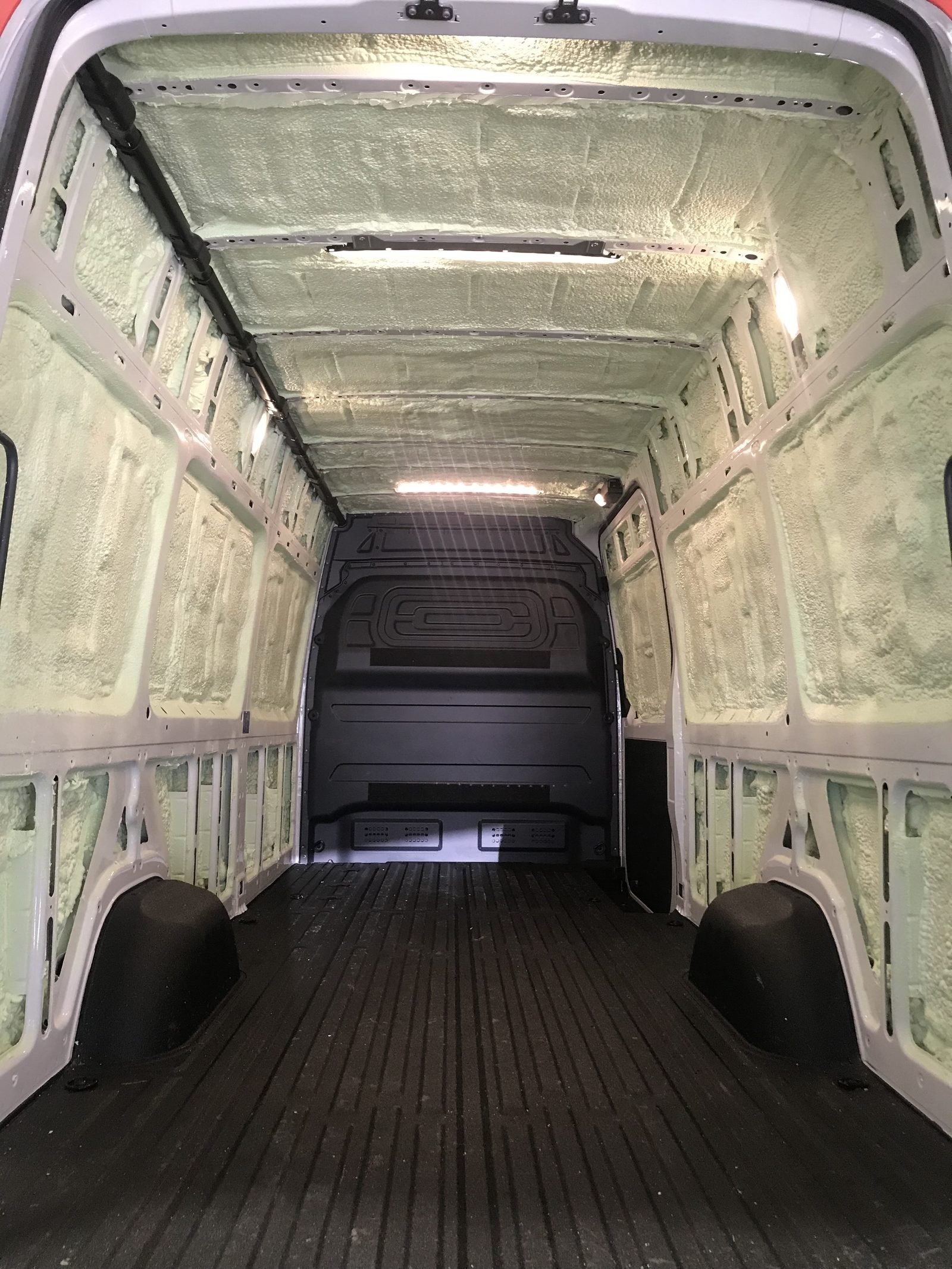
Camper van spray foam insulation in Fort McMurray gets asked about by people who intend to use the vehicle in conditions where the honest answer includes some limits. It is worth setting those out rather than overselling what a metal box can do.
What a van build can and cannot achieve
A well-insulated van is dramatically better than a bare one and it is still a thin shell with a large glass area and a floor close to the road. In genuinely severe cold it will need a working heat source, it will lose temperature quickly if that source stops, and the glazing will remain the weak point regardless of what is done to the walls. Anybody promising a van that is comfortable at extreme temperatures without heat is not describing a real vehicle.
Where the effort actually pays
Given that, the priorities are clear. The floor first, because it is closest to moving cold air and is what people are standing on. Then the walls and roof continuously, covering the ribs rather than filling between them. Then the detailing around every penetration. A build done in that order gets most of what is available, and doing it in any other order tends to leave the largest surface untreated.
Moisture is the failure that shows up later
At Fort McMurray temperatures the moisture two people produce overnight will find any part of the shell that is not covered, freeze there, and thaw when the van is warmed. Because that happens behind panelling it is invisible until corrosion appears. A continuous layer is the only thing that prevents it; a partial one relocates it somewhere harder to see.
Building for the trip, not for the driveway
Most of these vans are used to leave the city rather than to sit in it, which means the conditions that matter are the ones several hours out. Building for the coldest reasonable case is straightforward at the point of construction and impossible afterwards without stripping the interior, which is why the specification is decided by where the van will be rather than where it is parked. That is a decision made once, at the start, and it is the one part of a conversion that cannot be revisited without taking the interior back out.
Camper Van Spray Foam Insulation Fort McMurray: Common Questions
Can a van be comfortable here without heat? No, and anyone saying otherwise is not describing a real vehicle. Insulation makes a heat source effective and buys time if it stops.
What gets done first? The floor, then the walls and roof continuously over the ribs, then the detailing around penetrations. That order gets the most from the work.
Why does moisture matter so much in a Fort McMurray van? Because it freezes on any uncovered metal and thaws later, behind panelling where it is invisible until corrosion appears.
Work out the depth with the R-value calculator, then get a free Fort McMurray quote. More on Camper Van Spray Foam Insulation Alberta.