
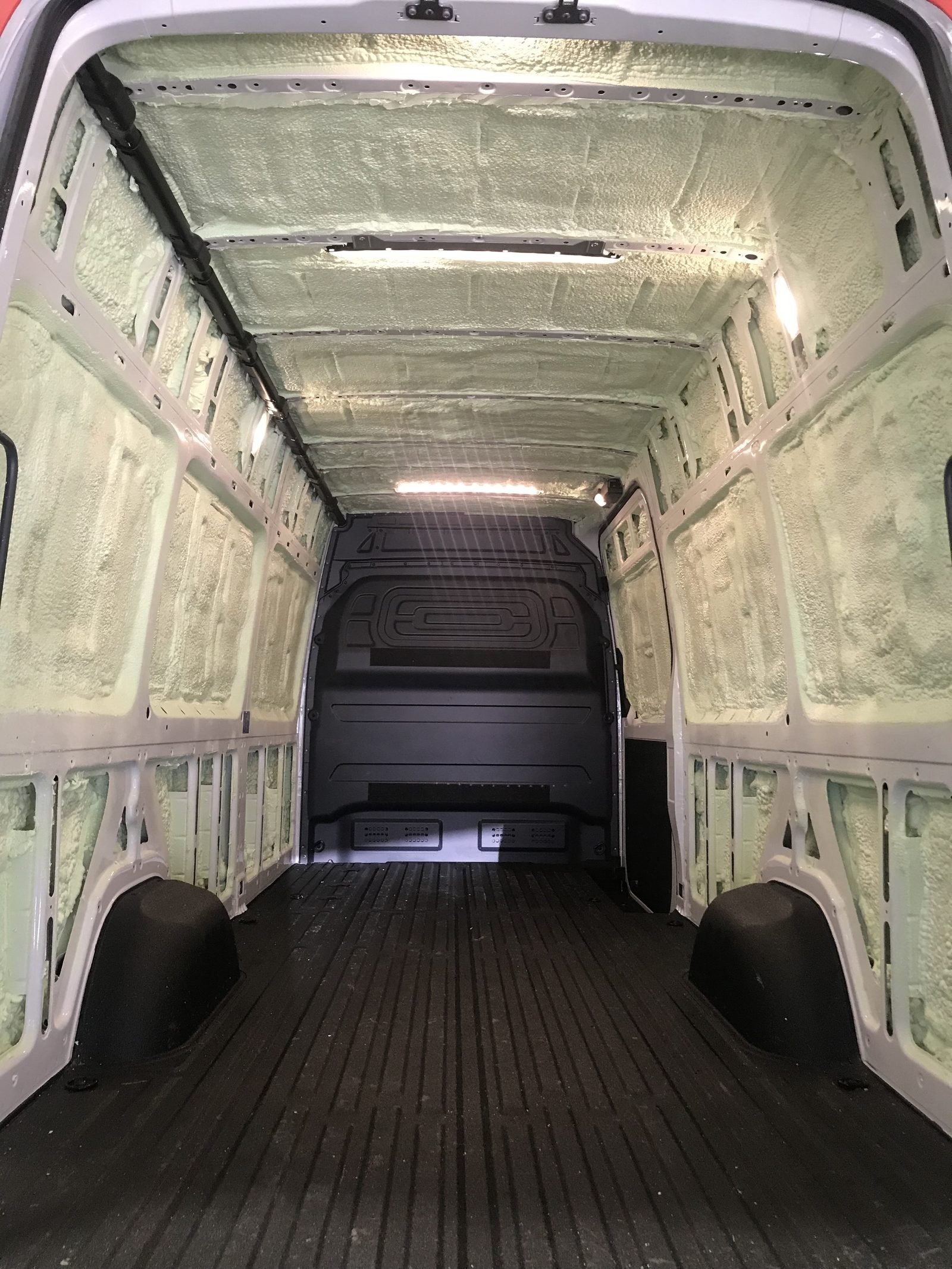
Camper van spray foam insulation in Calgary is a small job with unusually little room for error. A van conversion is a metal box that will be slept in, and the two things that decide whether it works are how the ribs are handled and where the moisture goes.
The ribs are the problem, not the panels
A van's walls are shaped steel with ribs running through them, and those ribs pass from the inside surface to the outside skin. Insulation placed only in the bays between them leaves every rib as a direct path, and in a vehicle that shows up quickly: frost lines on the inside of the wall in winter, following the ribs exactly. Foam applied across the inside face covers the ribs rather than stopping at them, which is the main reason it is used in conversions.
Condensation in a space somebody sleeps in
A person sleeping in a van puts a surprising amount of moisture into a very small volume overnight. In an uninsulated or partly insulated van that water finds the cold steel and runs, which is how conversions end up with damp bedding and corrosion behind the panelling. A continuous layer that is both insulation and air barrier is what stops the moist air reaching the steel in the first place.
Thickness is limited, so performance per inch matters
There is very little depth available in a van and every millimetre taken from the inside is interior space lost. That makes this one of the few jobs where the higher performance per inch of closed cell foam is the deciding factor rather than a preference, because reaching anything useful in the depth available is not possible with a lower-density product.
Getting it done at the right point in the build
The conversion sequence matters. Foam goes on after any wiring runs, mounting points and penetrations are located and before the panelling, because a fastener driven through foam afterwards breaks the seal and creates a cold spot behind whatever it is holding. Getting that order wrong is the most common reason a conversion has to be partly undone, and it is entirely avoidable by agreeing the sequence first. On a Calgary conversion it is worth agreeing that sequence with whoever is doing the interior.
Camper Van Spray Foam Insulation Calgary: Common Questions
Why not just use rigid board between the ribs? Because the ribs are the path. Anything placed only between them leaves each rib crossing the envelope, which is where the frost lines appear.
How much thickness is needed? As much as the space allows, which is not much. That is why performance per inch is what decides the product here rather than cost per board foot.
When in the Calgary build should it happen? After wiring and mounting points are in and before the panelling goes on, so nothing has to be driven through the foam later.
Work out the depth with the R-value calculator, then get a free Calgary quote. More on Camper Van Spray Foam Insulation Alberta.