
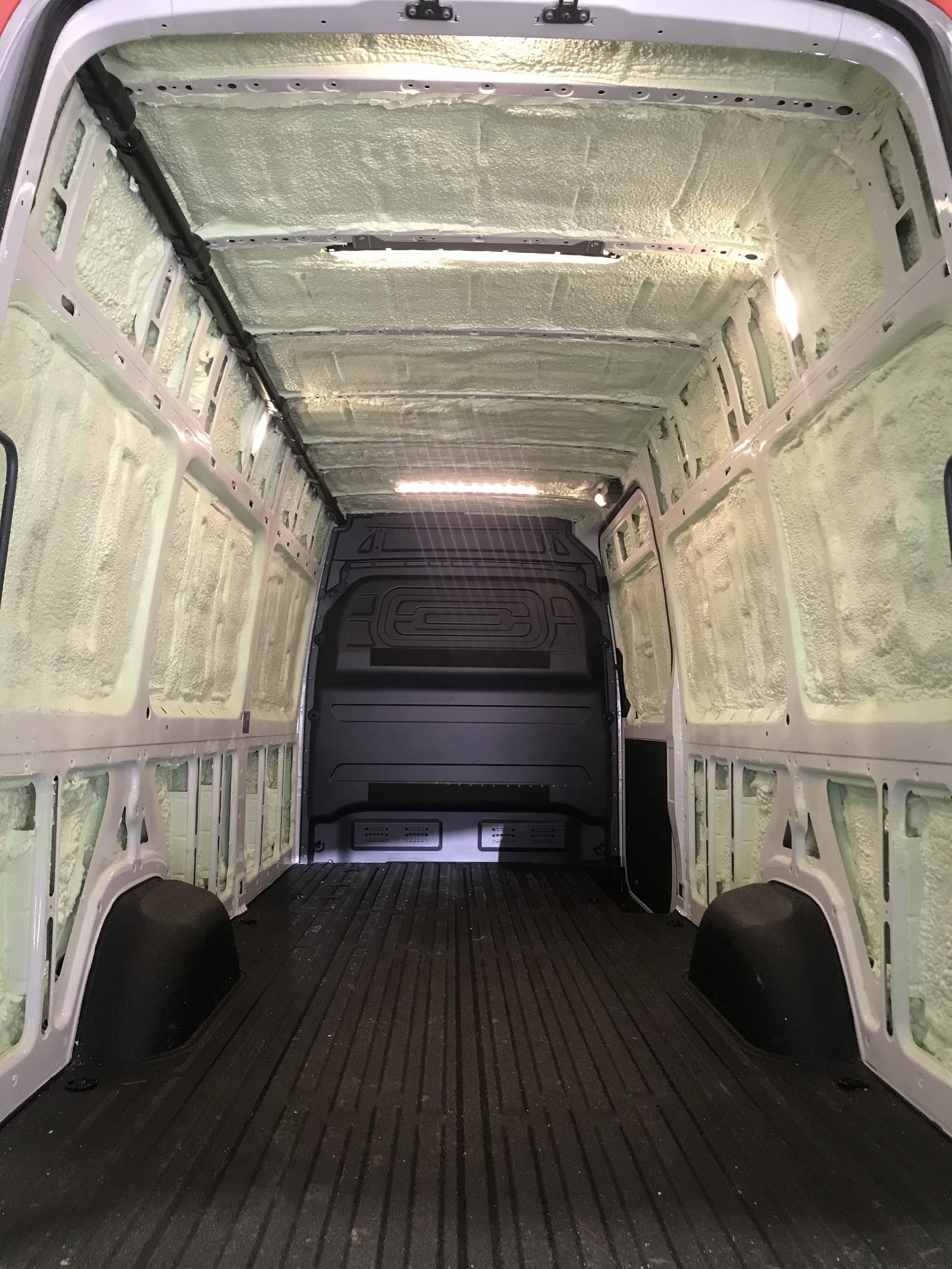
Vehicle Spray Foam Insulation High River is farm work more than anything else. The units that come in are equipment haulers, enclosed tandems that carry a welder and a bench out to a field, flat decks with a toolbox cabinet bolted on, livestock tandems, and the odd gooseneck set up as a shop on wheels during seeding and harvest. Grain country runs on units like these, and all of them share the same weakness: a thin steel or aluminum skin wrapped around a space that somebody heats.
The mobile shop that rains on its own toolbox
An enclosed hauler with a welder, a heater and a man working in it through a cold morning fills up with water vapour quickly. Welding, a propane tiger torch, a thermos, breath, snow carried in on boots. All that moisture goes to the coldest thing it can find, and in a trailer that is always the roof sheet. It beads on the underside, gathers along a rib and then drips, and what sits underneath is usually a toolbox full of bare steel sockets and a chop saw. People put the rust down to humidity in general. It is specific: the panel above the tools is cold, and the air inside gave up its load on it.
Why closed cell is what we spray on an implement hauler
Farm units have to tolerate being loaded roughly and towed on gravel, so a fixed-in-place assembly that relies on fasteners is the wrong answer. Closed cell bonds to the metal instead. It yields about R-6 per inch, which keeps the lost interior width to something you can live with. It is both the air barrier and the vapour retarder in one go, with nothing to tape and nothing to puncture when a tie-down rail gets added later. And the bond stiffens the sheet, so you lose the hollow ringing that an empty deck makes behind the truck on a washboard road.
Rigid board hides the wet and vehicle spray foam insulation does not
The inner surface of a hauler is not flat and never was. There are vertical ribs, a wheel tub on each side, a crown in the roof and seam flanges in the corners. Lay a board across that and it touches only the rib faces; everything else becomes one joined-up hollow behind the lining. Air moves in there, and because it moves it keeps bringing moisture back to the panel. The owner sees a tidy interior and finds rust blooming through a seam three seasons later. Sprayed foam goes into the tub, over the crown and down each flange, in contact the whole distance, so there is no hollow for anything to circulate in.
Setting depth against deck space and what the axles carry
Depth is a negotiation with what the unit hauls. A hauler that carries a quad or a side-by-side cannot narrow much before the machine stops fitting between the tubs. A tandem already loaded to its rating cares about mass. A livestock unit is a different question again, because stock generate their own heat and moisture and the roof is where it lands. We work out where the depth earns its keep on that specific unit rather than coating everything the same.
Preparing a unit that has had a working life
Farm equipment arrives with the season on it. Chaff and grain dust in the corners, manure in a stock deck, straw packed behind a rib, oil and grease films, calcium off the highway, scale where a floor edge has stayed wet. All of it is cleaned out and the metal dried, because foam keys to the surface it meets and chaff is not a surface. Then we go round with the owner and agree what stays serviceable: the marker lamp loom, the brake wiring, the breakaway cable, the ramp hinge pockets, the access cover over the jack. Those get worked around on purpose.
The quote and the spray come from the same people
We look at the unit on your yard, do the arithmetic on the spot, and our own installers apply the foam. Anyone arriving from a search for "Best Vehicle Spray Foam Insulation High River" is normally trying to find out whether one outfit handles the whole thing. We do.
Vehicle Spray Foam Insulation High River: Common Questions
Can it be done between seasons. That is when most of it happens. Units around High River tend to come in once the harvest is off and go back out before seeding.
Will the stock trailer be warmer for the animals. It will be drier, which matters more. Covering the cold roof stops the condensation landing on their backs.
Do you do the grain bin yard sea cans as well. We do — shipping container spray foam insulation covers that side of it.
More here: spray foam insulation for the house, the shop and the barn, the province-wide view at spray foam insulation Alberta, and our service areas.