
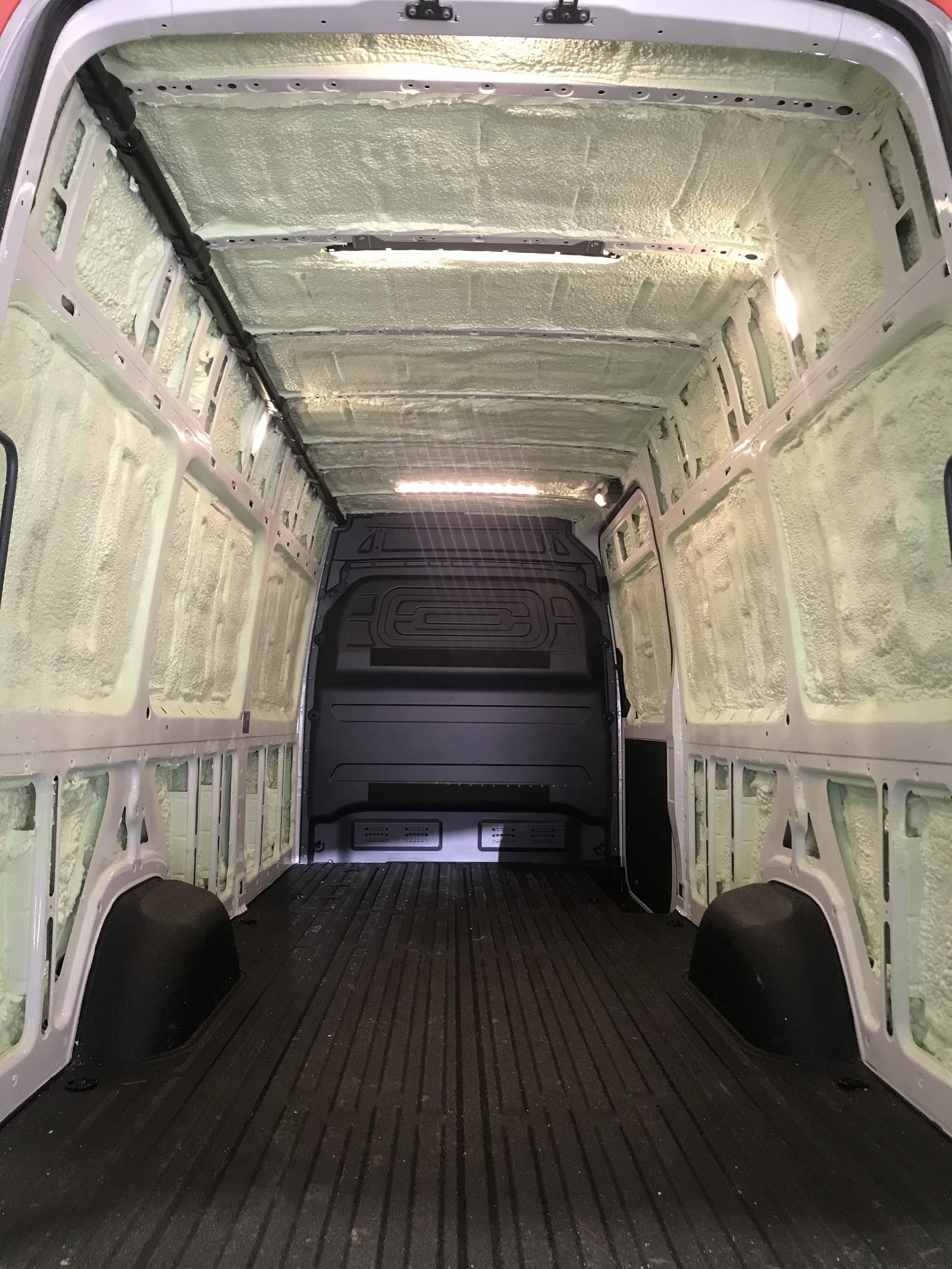
Vehicle Spray Foam Insulation Langdon is nearly always a utility trailer, and the first complaint we hear is about July rather than January. An enclosed tandem parked broadside to the sun on an acreage out here gets genuinely unpleasant inside by mid-afternoon — the roof sheet is too hot to lay a hand on, and anything in there with a plastic housing or an adhesive label comes out soft. Langdon is a commuter acreage community east of Calgary where almost every yard has a trailer doing double duty as a shed, a workshop and the thing that moves the mower.
An oven in July and a condenser in January
The same bare sheet produces both problems, which is the part worth understanding. In summer a dark roof panel in direct sun radiates heat down into the box with nothing in between, so the air under it stacks up far hotter than outside. In winter the identical panel is the coldest thing in the trailer, so when a wet mower deck, a snow-covered quad or a load of damp lumber goes in, the moisture coming off it travels up and unloads on the ceiling. Then it drips back on the load. One material fixes both because both are caused by a surface with no resistance behind it.
What a dark roof sheet does to the air under it
Radiant heat off a hot sheet does not need the outside air to be hot. It needs line of sight, which is exactly what an uninsulated interior gives it, and it is why a trailer feels worse inside than the yard does. A foam layer bonded to that sheet breaks the line of sight and stops the panel radiating into the space — the ceiling becomes a warm-ish surface instead of a radiator, and the inside temperature tracks the yard instead of running away from it. It also stops the ticking and popping as the sheet expands, which people notice once it is gone.
Why vehicle spray foam insulation is sprayed to the sheet
Closed cell runs about R-6 per inch, and it is its own air barrier and vapour retarder, so there is no separate membrane to get wrong on a trailer that flexes every time it crosses a cattle guard. Being bonded is the other half of the point. A trailer worked over gravel roads will loosen anything hung off its frame, while foam that is stuck to the back of the sheet moves with it, stiffens it and takes the drumming out. A panel that no longer drums is also a panel that no longer vibrates fasteners out of the wall.
Utility trailer spray foam insulation, the ribs and the ramp
A cargo trailer's inside face is ribs at every upright, a channel at the top rail, roof bows and a tight radius where the side meets the roof. Rigid board can sit against the rib crowns and nothing else, so there is a connected void behind the whole board — air circulates in there, carries damp to the cold metal and keeps it out of sight. Foam takes the shape of the rib and the bow, so there is no void. And the ramp door matters: a sprayed wall with a bare ramp still has a large cold panel in it, so the ramp either gets dealt with or the owner understands why the back end still condenses.
Thickness against the width of what you load
This is the trade worth getting right before anything is sprayed. Plenty of these trailers were bought because a specific thing fits — a mower deck, a side-by-side, a stack of sheet goods — and those dimensions do not move. An inch on each wall takes two inches off the clear width, which can be the difference between a machine driving in and a machine being winched in sideways. We measure the load first, then decide the thickness, and we will happily spray less on the walls and more on the roof where the roof is the real problem. Searches for Best Vehicle Spray Foam Insulation Langdon usually come from somebody who has not yet done that measurement.
Before we spray a Langdon acreage trailer
The floor and walls get swept and washed, the dried mud out of the corners, and then left to dry — a damp deck under fresh foam is a problem stored up. Gravel-road stone damage and any surface rust along the lower skin get brushed back and treated. Brake and marker-light wiring is planned and routed first, and the tie-down D-rings, stake pockets and jack are masked so they still work. Anything meant to be unbolted later does not get buried.
Vehicle Spray Foam Insulation Langdon: Common Questions
Is it worth doing on a trailer that is only storage. Often, yes, and summer is usually the reason out here. Heat ruins more stored goods in a Langdon yard than cold does.
Why does it rain inside my trailer in winter. Because something damp went in and the roof sheet is the coldest surface available. The water in the air goes there, forms on the underside and falls back down.
Will foam make it harder to find a leak. It makes a leak less likely, since the main source of interior water is condensation rather than rain, but we check and seal the roof seams and the top rail as part of the preparation rather than spraying over a known gap.
See also spray foam insulation for shipping containers, the wider spray foam insulation work we do here, Spray Foam Insulation Alberta province-wide, and our spray foam insulation service areas. Ask for a free spray foam quote in Langdon.