
A stock trailer coming off the highway into Lethbridge on a cold morning will be steaming at the vents, and the inside of the roof will be running wet. Livestock put out heat and a great deal of moisture, and a trailer skin is a single sheet of aluminium or steel with a prairie wind on the far side of it. Vehicle Spray Foam Insulation Lethbridge therefore starts with a question most insulation pages never ask: which part of this trailer should be insulated at all.
That matters because a stock compartment and a living compartment want opposite things. One needs air moving through it. The other needs air kept out.
A load of cattle is a humidifier on wheels
Animals breathe, and bedding carries water. In a closed box that air warms quickly and loads up with vapour, and the first cold surface it meets is the roof sheet directly above the load. The water condenses there and drips back down. It also condenses on the inside of the side sheets and runs to the floor seams, which is why the corrosion on an older stock trailer usually starts at the bottom rail rather than anywhere exposed to the weather. On the wind-driven side of a trailer parked broadside to a Lethbridge southwester, the skin is being actively cooled all night and the effect is worse.
Where vehicle spray foam insulation belongs in a stock trailer, and where it does not
We will not seal up a live haul compartment. Those compartments are slotted and vented on purpose, and reducing air exchange in a space carrying animals is not a trade we are willing to make for a thermal number. What we do insulate on a stock trailer is everything that is not live haul: the tack compartment, the dressing room and the nose, the gooseneck, and the roof of a covered deck where condensate falls back onto saddles and feed. Those are enclosed, they hold valuable gear, and they are where the water is doing the expensive damage.
Living quarters and tack rooms in Lethbridge
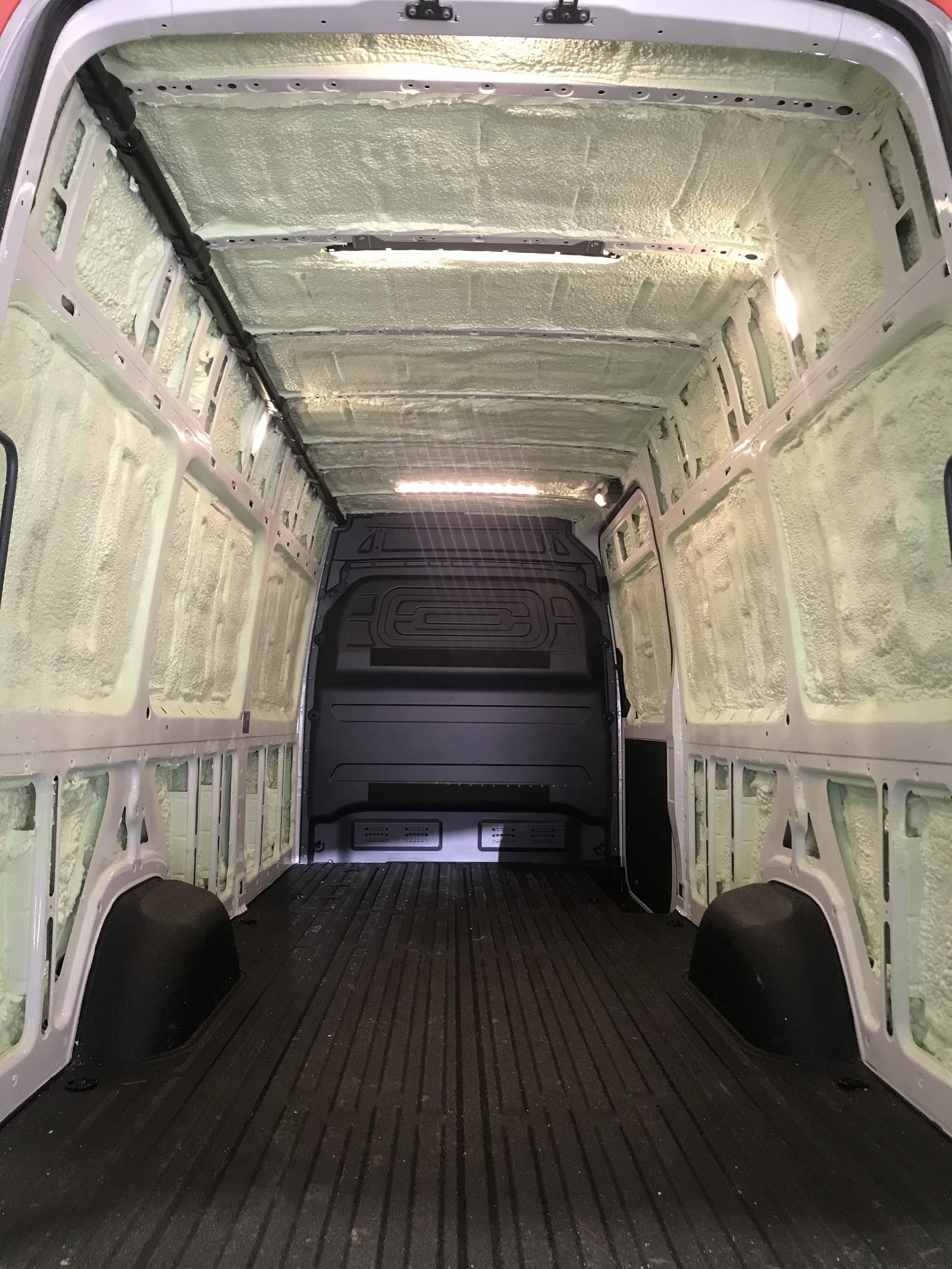
The gooseneck living quarters is where this work earns its keep. People sleep in them at rodeos and sales, which means two people breathing in a small aluminium shell overnight, often with a furnace running. The wall and roof framing in a factory living quarters is usually metal and usually touches the outer skin, so it is a cold path straight through whatever is in the cavity. Closed cell sprayed against the inside of the skin and over the framing takes that path away. At about R-6 per inch it gets a useful number out of a shallow wall, and because it cures as its own air barrier and vapour retarder there is no separate membrane to be detailed around a window frame or a roof vent. Open cell foam, at about R-3.6 per inch, is good at absorbing sound but is permeable, so it has no place against a skin that spends its nights below dew point.
Camper van spray foam insulation is the same mechanism in a smaller box
Plenty of our work in this city is not agricultural at all. A van conversion has exactly the same problem as a dressing room, just with less air volume and therefore faster condensation. See camper van spray foam insulation and trailer spray foam insulation for how we handle each.
Thickness against payload on a loaded gooseneck
A gooseneck already carries weight and the trailer has a rating. Foam adds mass, so we put depth where it returns the most: the roof and the upper walls, where lost space is head height, and a measured amount low down where cabinets and seating have to fit. In a tack room the critical dimension is usually the saddle rack clearance, so we measure that before we decide anything.
What has to be done first
The inside comes back to clean, dry, bare metal. On stock and tack equipment that means getting rid of old mat adhesive, flaking paint and any surface corrosion, and it means genuinely dry rather than swept out. Aluminium needs its mill finish scuffed and cleaned or nothing will bond. Then we agree what stays serviceable: axle and brake wiring, marker lights, the furnace and its fuel line, water lines, and any panel that gets unbolted later.
Vehicle Spray Foam Insulation Lethbridge: Common Questions
Will you foam the cattle compartment. No. Ventilation in a live haul compartment is not something we will reduce, so in Lethbridge we concentrate on the tack, nose and living areas and leave the stock section as the builder intended.
Does it help in summer as well as winter. Yes, for a different reason. The same skin that goes cold at night absorbs a lot of sun in July, and a sprayed roof keeps that heat out of a tack room.
My trailer is all aluminium. Will foam stick to it. It will, provided the surface is prepared properly. Unprepared mill finish is the usual reason a previous job let go.
See also shipping container spray foam insulation and the rest of our local spray foam insulation work. Across the province, Spray Foam Insulation Alberta and the towns on our spray foam insulation service areas page. Anyone comparing quotes after searching Best Vehicle Spray Foam Insulation Lethbridge should ask which compartments a bidder intends to seal, and why.