
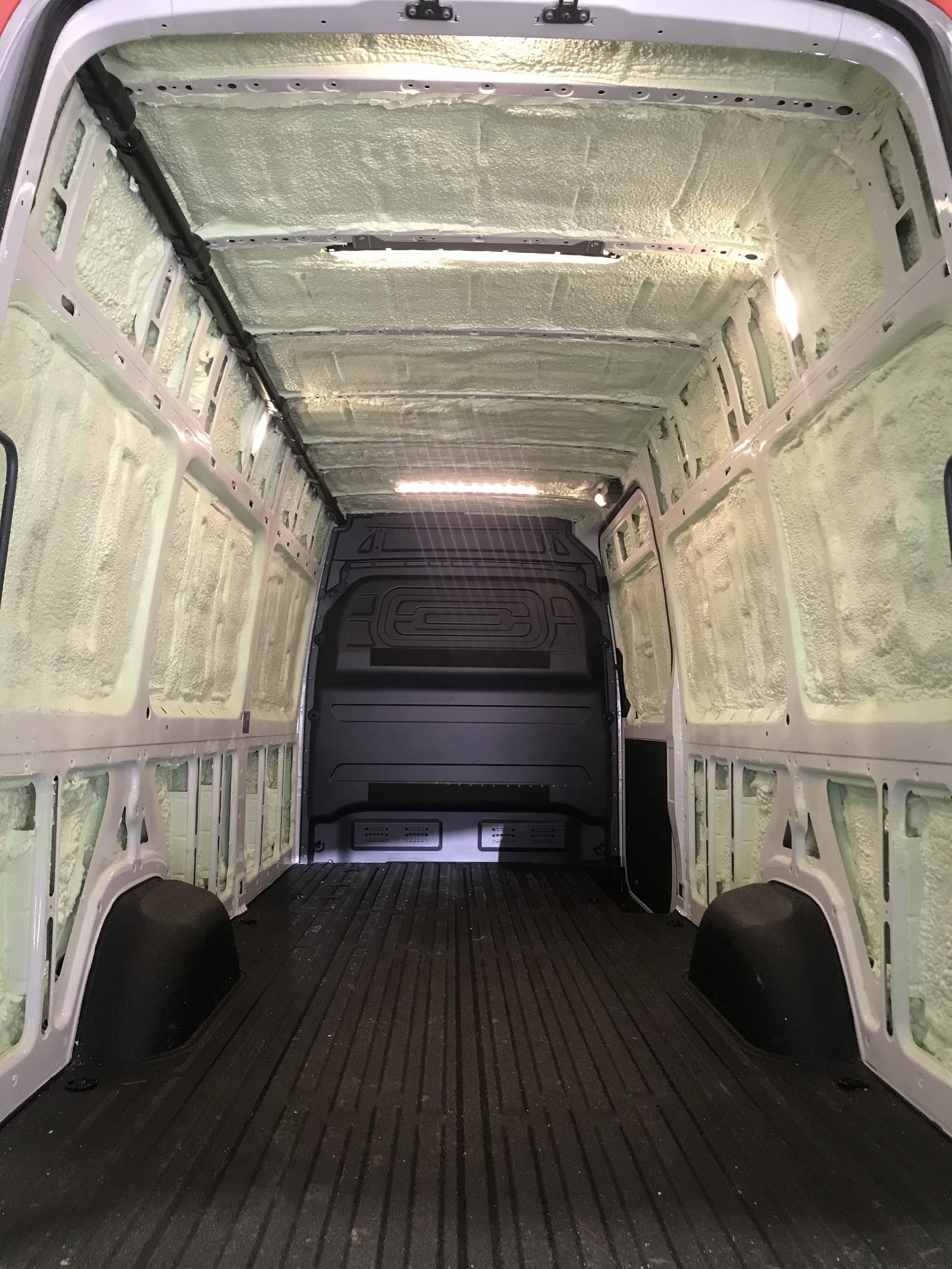
On irrigated ground the hauling season runs right up to the first hard frosts, and Vehicle Spray Foam Insulation Raymond is usually bought because of one bad night. A load comes off the field with the day's warmth still in it, gets tarped or boxed into a van body, and makes a run to the packing shed after dark when the air has gone several degrees below freezing. The pallets in the middle arrive fine. The ones against the wall are the problem, and so is the water that has come down on top of them.
A load that is still alive makes its own weather
Field produce respires. It gives off warmth and it gives off water, steadily, for as long as it is in the box. Inside a closed van body that produces warm, saturated air with nowhere to go, and the only cold surface available is the sheet metal — which on a clear Raymond night is colder than the air outside it, because the roof is radiating straight to the sky. The vapour condenses on the underside of that roof and runs down the walls. Meanwhile anything touching the wall is in direct contact with the coldest thing in the trailer, which is how one row gets frost damage and the rest of the load does not.
Produce trailer spray foam insulation and the row against the wall
What fixes the outside row is not more heat, it is taking away the cold face it is leaning against. Closed cell goes on at roughly R-6 per inch, and on a metal body the decisive property is that it is its own air barrier and vapour retarder at the same time. Once the shell is coated there is no cold sheet in contact with the load and no interior air reaching bare metal, so the condensation stops and the wall stops being a freezing plate.
Vehicle spray foam insulation follows bows that a board can only bridge
A van body is built on bows and posts, with a scuff rail, a wiring chase, a formed roof radius and wheel housings pushing into the floor space. Board can be fixed to the framing, but it can only span from member to member, and what it leaves behind is a single connected cavity with bare steel at the back of it. Air moves through there and condenses where nobody will ever see it, and the cavity carries cold along the whole wall. Foam goes into the bow, around the housing and up the radius, bonded to the sheet — no cavity, no bare metal, and a noticeably quieter box on the highway.
Thickness against how many bins still fit
Haulers measure a trailer in bins or pallets across, and insulation that costs a row costs money every single trip. So we work out where the depth earns its keep: the roof, where the water forms, and the walls the load actually leans against, before anything else. Foam adds weight too, and a unit loaded near its plate has no room for a number chosen for the sake of it.
Getting a hauling box ready for foam
Everything out, and then the sheet washed and scraped — produce hauling leaves residue, and foam only bonds to clean, dry, bare metal. Surface rust gets taken back and old liner adhesive comes off. Interior lighting runs, door hardware and any serviceable plate are routed and masked first, so nothing that needs attention later ends up under two inches of foam.
The contractor on the unit
Vehicle spray foam insulation is quoted, scheduled and sprayed by us. Our own installers are on the job, and the number you are given is the number we stand behind. Growers and haulers who search "Best Vehicle Spray Foam Insulation Raymond" are mostly trying to find somebody who will get it done between seasons rather than during one.
Vehicle Spray Foam Insulation Raymond: Common Questions
Will an insulated box keep a load from freezing by itself. It slows the loss and takes away the cold wall the outside row was touching. If a load has to be held above freezing for hours on a Raymond night in late October, it needs heat as well, and insulation is what makes that heat worth adding.
What about summer hauling. Same shell, opposite problem. An uncoated roof in July puts heat straight into the top layer of the load, and the roof is the first surface we would deal with.
Can you spray a trailer that is used for livestock as well. We can, though we would set the thickness differently. Animals put a great deal more water into the air than produce does, and that pushes the priority onto the roof sheet.
Containers get handled separately under shipping container spray foam insulation. Sheds, shops and houses are under spray foam insulation, with Spray Foam Insulation Alberta and our spray foam insulation service areas for everywhere else.