
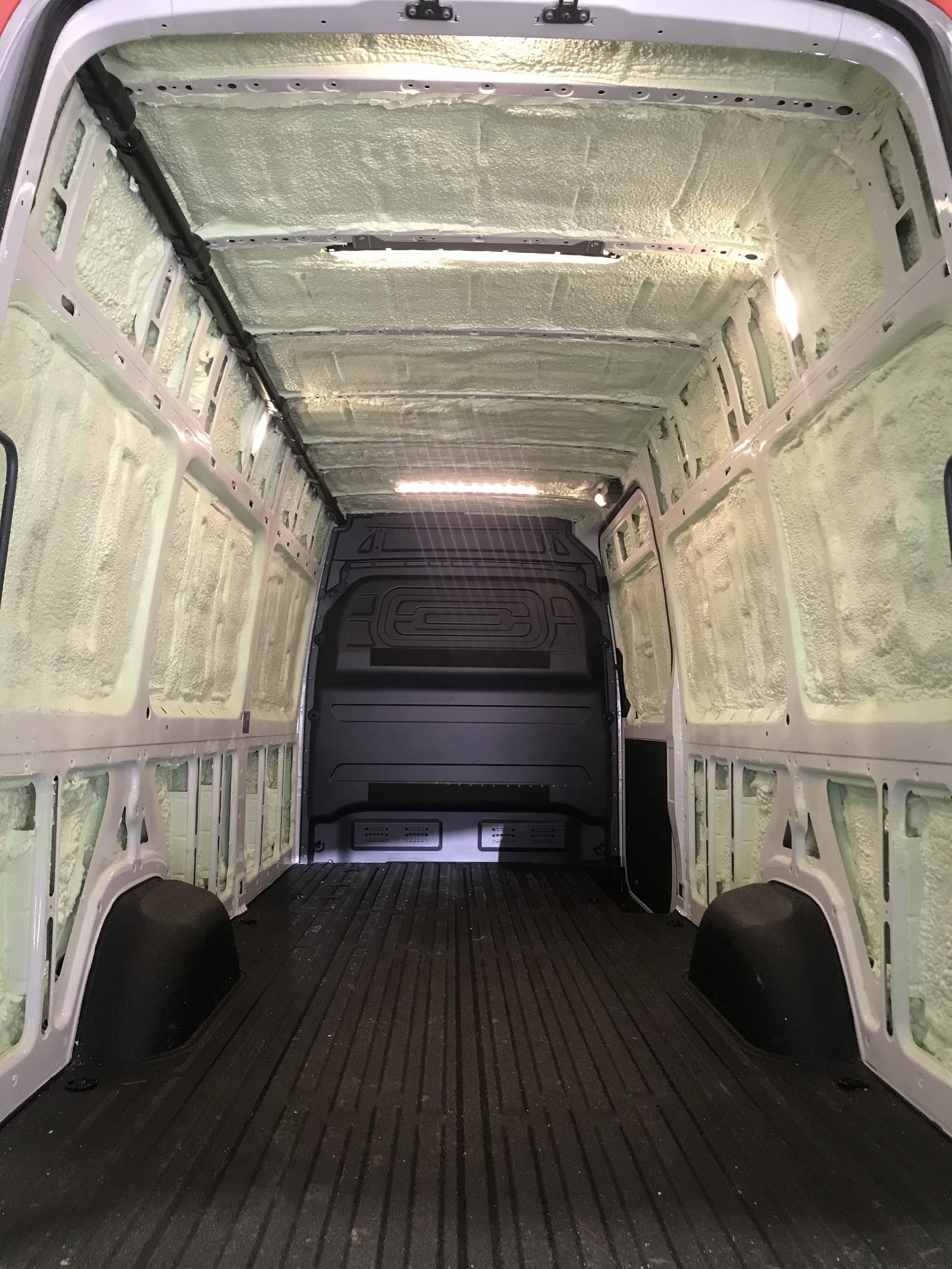
Vehicle Spray Foam Insulation Rimbey tends to be asked about a unit that is being kept going rather than replaced. This is a town with gas plants on one side and mixed farming on the other, and the fleet reflects it: a service deck with a shop-built cabinet on it, a hay hauler, an enclosed tandem that started life as a cargo box and has been rebuilt twice, a skidded shack from a lease that somebody bought at an auction and dragged home. The habit around here is to repair what you have, and a rebuild is the right moment to deal with the inside of the skin.
A rebuilt box is still a cold box
The trap in a unit that has been refurbished is that the new plywood and the fresh paint make the moisture problem invisible rather than absent. Somebody heats the box to work in it, moisture rises off a kettle and a heater and a pair of damp gloves, and it goes to whatever is coldest. That is the outer sheet, every time. The water forms on the back of it, soaks into the new plywood from above, and the floor that was replaced last spring is soft again by the second winter. The owner concludes the material was no good. The material was fine; it was being wetted from behind.
Why closed cell is the right call on a rebuild
If you are putting a unit back together, the inside face of the metal is accessible exactly once. Closed cell takes advantage of that. It is bonded rather than fastened, so no part of it can work loose on a gravel road. It delivers roughly R-6 per inch, which is enough that the wall build-up does not eat the interior. It is a vapour retarder and an air barrier in one application, which means the rebuild does not need a poly layer that somebody will later cut through to mount a bracket. And it stiffens the sheet, which on a tired old box is worth as much as the insulation value, because a tired box flexes and flexing is what reopens seams.
Vehicle spray foam insulation gets where a board cannot reach
Any box built or rebuilt in a shop has structure on the inside face: uprights, a hat channel or two, patch plates, weld beads, a rolled top edge. A rigid board can only sit on the high spots of that, and the shape of a repaired unit is more irregular than a factory one, so the gaps are bigger. Those gaps join into a single hollow, and air travelling through a hollow carries moisture to the coldest point and leaves it there. Sprayed material does not care about irregularity. It fills a patch plate pocket as readily as a factory channel, and it stays in contact with the metal across the lot.
Choosing a depth on a unit that is already heavy
An older deck or box usually carries more weight than it did new, because things have been added to it. So the depth question is about room first and mass second. Where the box is used as a workspace, the walls can afford less and the roof should get more, since the roof is where the condensation appears. Where a cabinet is bolted to a bulkhead, we keep the depth off the bulkhead and let the useful faces take it.
Getting an old surface ready for foam
A rebuilt or auction-yard unit arrives with layers on it. Rattle-can paint over mill scale, bitumen patch, tar, old contact adhesive, grease film, and rust in every seam that has stayed wet since it was built. All of that has to be cut back to sound metal and dried, because foam bonds to the first thing it reaches and a loose coating will peel and take the foam with it. We then agree what stays reachable with whoever maintains the unit: the lamp loom, the brake lines, the pin and hinge pockets, and the panels that have to come off to get at a repair. Those get planned around.
You get the contractor, not a referral
We look at the unit, we quote it, and our own installers spray it. The phrase in the search bar reads "Best Vehicle Spray Foam Insulation Rimbey", and the thing being checked is whether one person is answerable for the work. One of us is.
Vehicle Spray Foam Insulation Rimbey: Common Questions
Is a unit this old worth spending money on. Often it is, if the frame and the metal are sound. We would rather tell you the shell is finished than foam something that is on its way out, and plenty of the units we see in Rimbey have years left in them.
Our new floor went soft again. Why. Because it was being wetted from above by condensation on the roof sheet, not from below.
Can you do the sea can we use as a shop extension. Yes — shipping container spray foam insulation covers how a can is handled.
Also see spray foam insulation for the shop, barn and house, the provincial coverage at spray foam insulation Alberta, and our service areas.