
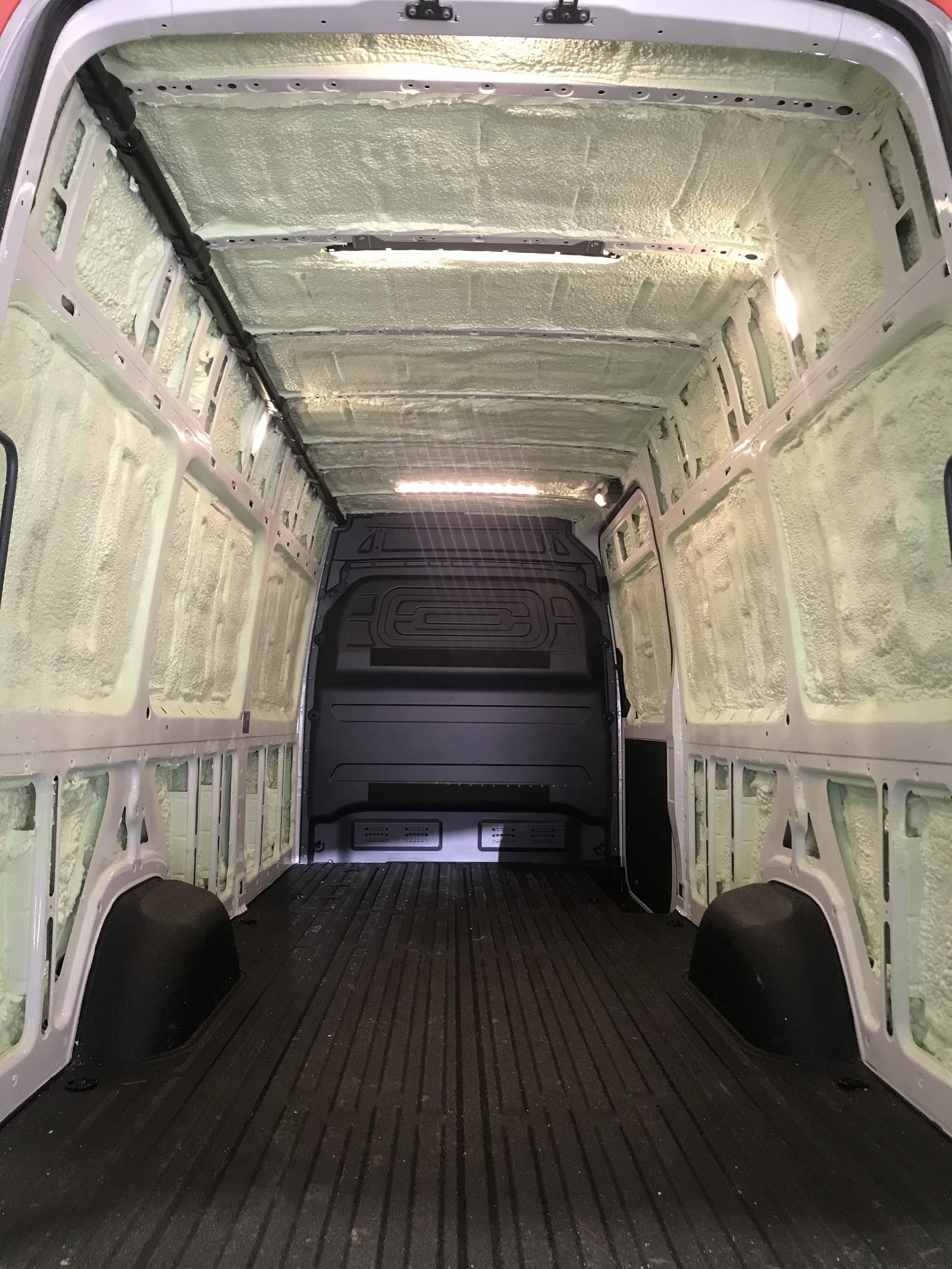
On most vehicles the people inside make the moisture. On a farm trailer the load does. That is the difference that makes Vehicle Spray Foam Insulation St. Paul a different conversation from a van conversation, and it is why the farmers who call us here are rarely asking about comfort at all. They are asking why the top of a load crusts, or why the inside of a tool trailer is wet when it has never been rained in.
This is a grain and equipment district. The trailers that matter are hoppers, enclosed cargo trailers that follow the combines, and deck trailers that haul machinery in off a wet field.
When the load is the thing making the water
Grain coming off a field carries moisture and it keeps giving it up in the trailer. That damp air rises through the load to the top of the box, and the top of the box is the coldest surface available because it is a single sheet of steel or aluminium with the night sky on the other side. The vapour condenses on the underside of the hopper roof, collects, and falls back onto the top of the load. That is what produces a crusted layer, and sometimes a patch that spoils, on grain that was fine when it was augered in. The mechanism has nothing to do with a leak in the tarp. Any enclosed box carrying a damp load will do it the moment the skin is colder than the air inside.
Grain trailer spray foam insulation and the crust at the top of the hopper
Closed cell applied to the inside of the roof sheet and over the roof bows takes the cold surface away. It is sprayed wet and expands into the bow, around the bolt line and across the radius at the top corner, which is where water used to track before falling, so the cold line disappears rather than being covered. At about R-6 per inch it earns its depth, and because it cures as its own air barrier and vapour retarder there is no membrane in a position where no membrane could survive. Open cell is a fine building material and absorbs sound well at about R-3.6 per inch, but it is permeable, and permeable insulation above a damp load is a sponge in the wrong place.
Vehicle spray foam insulation on a St. Paul farm yard
The enclosed trailer that follows the harvest is the other regular job. It carries tools, filters, belts, fittings and a welder, it gets opened and closed in all weather, and it sits cold overnight. Every time warm damp air gets into it and meets the skin, a film of water forms on everything metal inside. Nobody notices until a box of fittings is rusted together or a machine will not start. Treating the shell removes the surface that was doing the condensing, and because closed cell bonds to the panel it also stops the walls flexing on a field approach, which is the reason sprayed trailers rattle less.
Depth and weight on a trailer that is paid by the load
A hopper is a weight-sensitive machine. Every pound of foam is a pound less of product within the same rating, so this is one of the few places we deliberately keep the application lean and put it only where it works: the roof and the upper sides, which is where the condensation forms. There is no sense in loading up the lower walls of a grain box. On an enclosed cargo trailer the limit is usually interior width between the wheel wells and clear height at the door instead, so we measure those before deciding anything.
Prep, and what we leave alone
A farm trailer comes to us with dust, chaff, grease, old adhesive and a film of surface rust, and every bit of that has to be off before we spray, because foam bonds to the surface it lands on. The metal has to be dry and up to temperature, which means working under shelter rather than in a yard in deep cold. We mark out running lights, brake wiring to the axles, hopper gear and operating linkages, hydraulic lines, and any inspection cover that gets removed, and all of those stay reachable.
Vehicle Spray Foam Insulation St. Paul: Common Questions
Will this keep grain from crusting at the top. It removes the condensing surface that drips back onto the load, which is the cause of that crust. It is not a substitute for drying and managing the grain itself, and we would not claim otherwise.
Does it have to be the whole trailer. No. On a St. Paul hopper we usually recommend the roof and upper sides only, because that is where the water forms and because weight matters on a grain load.
My tool trailer gets opened dozens of times a day. Does insulation still help. It helps, because the problem is the cold panel rather than the open door. Take away the cold surface and the air coming in has nothing to condense on.
Related: agricultural spray foam insulation, shipping container spray foam insulation, cold storage spray foam insulation and the rest of our local spray foam insulation work. Across the province, Spray Foam Insulation Alberta and our spray foam insulation service areas. If you are weighing up bids after searching Best Vehicle Spray Foam Insulation St. Paul, ask each of them which surfaces they intend to spray and why those ones.