
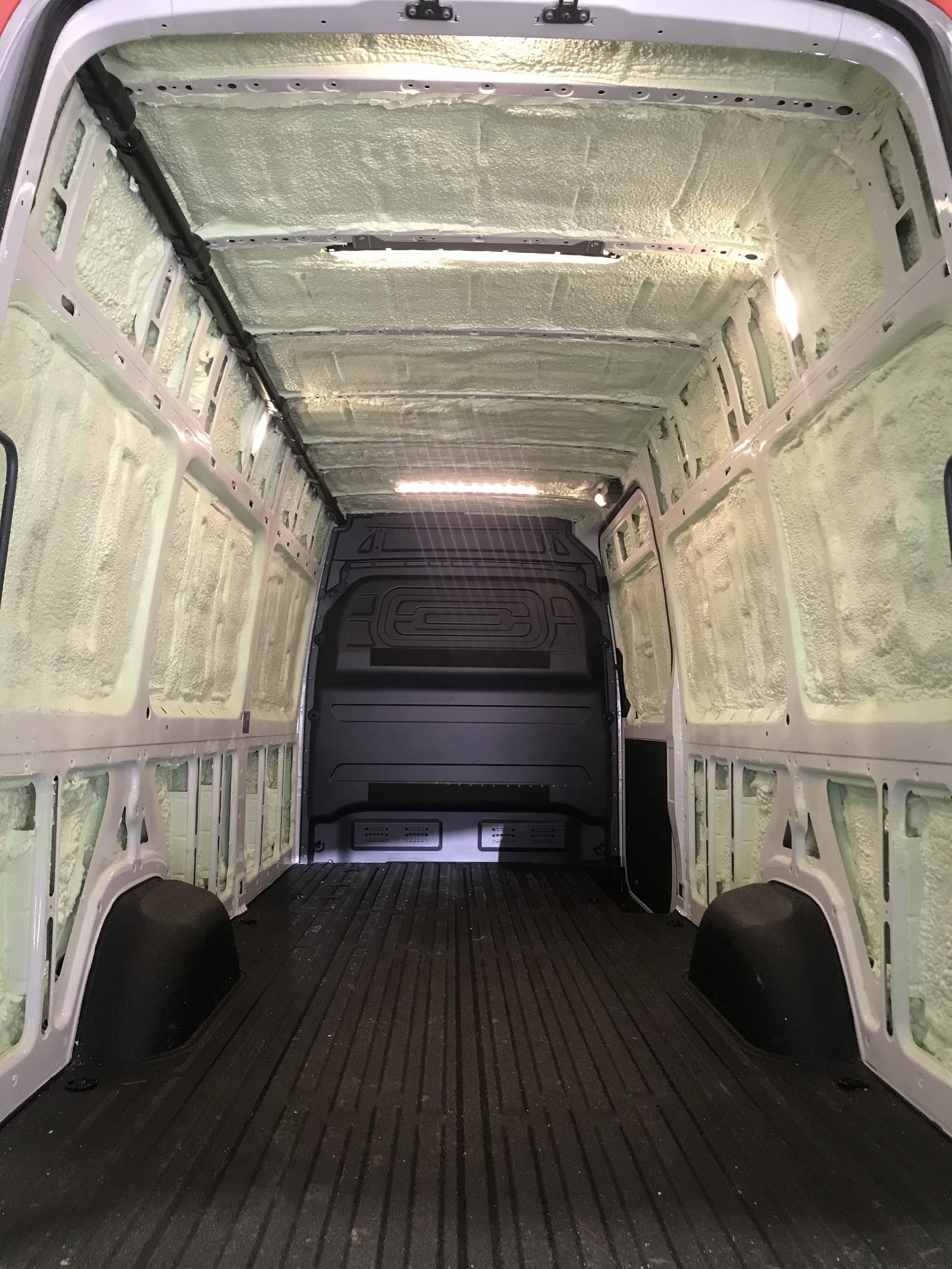
Vehicle Spray Foam Insulation Vermilion comes up around grain and cattle. East-central Alberta runs hopper trailers, liners, show units that haul 4-H stock to a county fair, enclosed tandems that take a bench and a compressor out to a quarter, and sea cans parked in a bin yard holding augers, belts and hardware. These are not city vehicles. They work in dust half the year and in hard cold the other half, and both ends of that are rough on a metal shell with warm air inside it.
Hot animals, cold aluminum and frost on the roof
Load a show unit with cattle on a January morning and the inside temperature climbs fast. Animals are radiators and they are also humidifiers; every breath adds water to a closed box. Outside, the top sheet is sitting in the wind with nothing to warm it. The moisture finds that sheet, and in deep cold it does not even bother forming droplets first — it frosts directly onto the metal and builds up through the haul. Then the unit gets parked in a shed, the frost releases all at once, and it comes down on the deck and the animals and whatever is stored in the front compartment.
Why we spray closed cell in a grain and livestock fleet
Dust is the quiet reason. Anything fastened over an air gap in a grain operation ends up with chaff and dust in the gap, and dust holds moisture. Closed cell fills the space instead of covering it, so nothing can accumulate behind it. On top of that it gives about R-6 per inch, which keeps the interior loss manageable; it is its own air barrier and vapour retarder, so the moist air never reaches the sheet; and it bonds hard enough that the panel becomes stiff, which stops the booming and flexing a long empty box does on a gravel grid road.
Vehicle spray foam insulation gets into the slot and board does not
A livestock deck has ventilation slots, formed uprights, a rolled roof edge, a wheel housing and a deck-to-wall flange. A hopper or a cargo box has ribs and seam angles. Rigid board can only rest on the raised faces of any of that, and the void left behind joins into one continuous space running the height of the wall. Air circulates in it, carries water to the coldest part and deposits it there, every cold night of the year, out of sight. Sprayed material goes into the slot edge, around the housing, over the rolled edge and down the flange, with no space behind it at all.
Setting depth against head room, stall width and load
Depth has to answer to what the unit carries. A show unit measures head room and stall width and cannot give much away. A cargo tandem measures what fits between the wheel tubs. A hopper has a different shape of problem again, because the roof and the upper sides are where the sweating happens and the cone does not need the same treatment. So we size it per surface, not per unit, and usually that means concentrating the depth overhead.
Clean, dry and bare before any foam is applied
Farm and grain units arrive with a long list of things that will stop foam sticking. Chaff and grain dust packed into every corner, manure and bedding in a stock deck, straw behind an upright, oil and grease films, calcium chloride off the highway, and rust where salts or urine have kept a seam wet. All of it is cleaned out and the metal dried back to sound steel, because foam adheres to the first layer it touches and dust is a release layer. We then agree the exclusions with the owner: the marker and clearance lamp wiring, the brake lines, the breakaway cable, the ramp and gate hinge pockets, the vent sliders, and any cover that gets removed for a repair.
One contractor, from the yard visit to the finish
We come to the yard, look at what you have, quote it, and our own installers apply the foam. "Best Vehicle Spray Foam Insulation Vermilion" is the phrase people put into a search bar, and the question behind it is normally just whether one outfit handles everything from the stock unit to the sea can.
Vehicle Spray Foam Insulation Vermilion: Common Questions
Frost builds up inside the roof of our stock unit. What stops it. Removing the cold surface. Once the sheet is covered, the animals' moisture has nowhere to freeze onto.
Can you do work at the farm instead of in town. Yes, and most of our Vermilion jobs happen on the owner's yard where the unit is parked.
Will foam in a sea can keep the hardware from rusting. It stops the damp swing that causes it. Shipping container spray foam insulation covers the walls, roof and doors.
See also spray foam insulation for the house, shop and barns, the provincial coverage at spray foam insulation Alberta, and our service areas.