
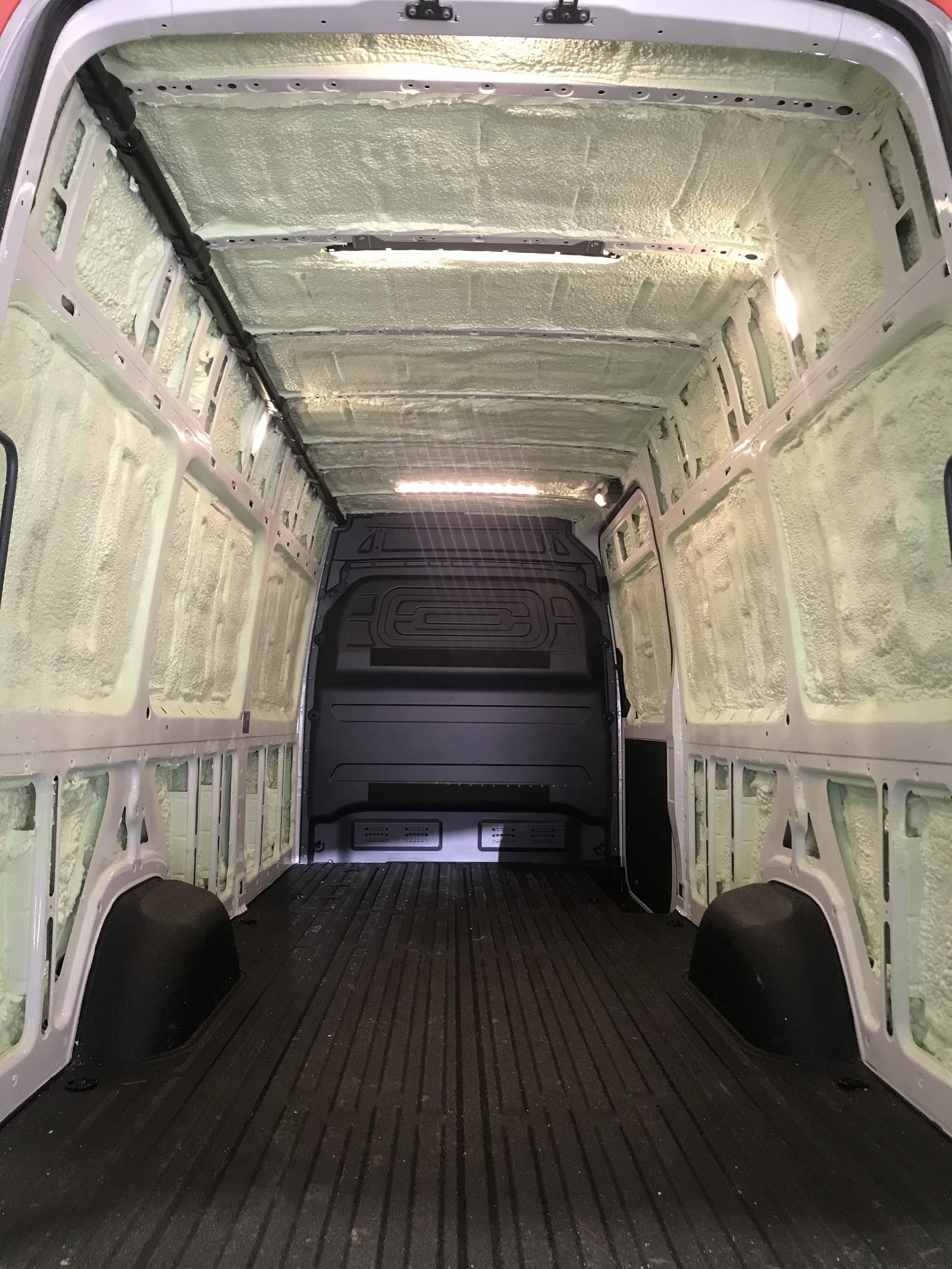
Two kinds of unit come to us for Vehicle Spray Foam Insulation Cold Lake, and they share a failure. One is the heavy-oil side: crew trucks with insulated boxes, field washroom units, pump sheds on skids, enclosed decks that carry hose and fittings up a lease road. The other is lake kit — sled decks, fish houses on runners, ice shacks with a burner in the corner. In each case the shell is sheet metal, somebody raises the temperature inside, and the sheet starts collecting water on its back face.
A burner, wet gear, and a metal roof
Heat a small enclosure on the ice with propane and you release a lot of water vapour into it before anybody even boils a kettle. Then add thawing slush off the boots, a wet parka over a chair, hands warming. All that moisture rises and goes looking for the coldest material available, and in a fish house the coldest material is the roof panel with the wind across it. It condenses, it beads, and then it drips back down on the gear and the floor. People call that a leak. It is not a leak; it is the air giving up its load on cold tin.
Vehicle spray foam insulation for a shell that gets heated hard
Closed cell suits anything portable and heated because it does the whole job in one layer. The number people want is about R-6 per inch, which is the figure that lets a thin application matter in a small cabin. More important in this application is that it is a vapour retarder and an air barrier by itself, so the moist air never gets through to the panel; without contact there is no condensing surface. It also grabs the metal firmly, and a bonded sheet behaves differently under load — less flexing on washboard, far less banging and drumming when the unit is being towed.
Why a sheet of board leaves you worse off
Field units are built light, which means stiffening ribs, pressed channels and corner radii everywhere. A flat board can only bear on the raised parts of that geometry. The volume behind the board is open and joined up, and air inside it convects — picking up warmth and moisture at the bottom of the wall, dropping both at the top where the steel is coldest. You end up with a dry-looking liner in front of a corroding panel. Foam does not span; it enters the channel, rolls over the radius and seals against the metal at every point.
How much thickness a portable unit can afford
Portable units have two limits. The first is room: a washroom trailer or an ice shack cannot lose much inside dimension before the layout stops working. The second is what the axle is rated to carry, since a skidded or towed unit is frequently loaded close to its limit already. We settle depth against those two facts, not against a catalogue figure, and in a small enclosure we often favour putting the depth overhead where the condensation actually forms.
Preparing a unit that has worked in the field
Field service units arrive greasy. Hydraulic weep, diesel film, fish slime, old adhesive from a liner, salt and calcium off the highway, scale where a floor edge has stayed wet. It all has to be degreased and the metal brought back to dry, sound steel, because foam attaches to the layer it touches and a film of oil is a release agent. Before we spray, we go round the unit and agree what remains serviceable: the heater feed, the tank fittings, the lighting loom, the hatches somebody has to open in deep cold with mitts on.
We own the job and we own the result
We assess the unit, we tell you what it comes to, and our own installers lay the foam. The search term is "Best Vehicle Spray Foam Insulation Cold Lake"; the practical question behind it is who shows up, and the answer is us.
Vehicle Spray Foam Insulation Cold Lake: Common Questions
Will this stop the ceiling dripping on us. Yes, if the dripping is condensation, which it almost always is in a heated portable. Cover the cold panel and the air has nowhere left to shed its moisture.
Do you spray units that go out to the lease. Regularly. Field and oilfield units are a large share of what we do around Cold Lake, and we schedule around turnaround so a unit is not away during a busy stretch.
Is a sea can worth doing for winter storage. It depends what is in it. Anything that suffers from damp usually is, and shipping container spray foam insulation explains how the walls and the roof get treated differently.
Further reading: spray foam insulation for homes and shops, the province-wide view at spray foam insulation Alberta, and our service areas.