
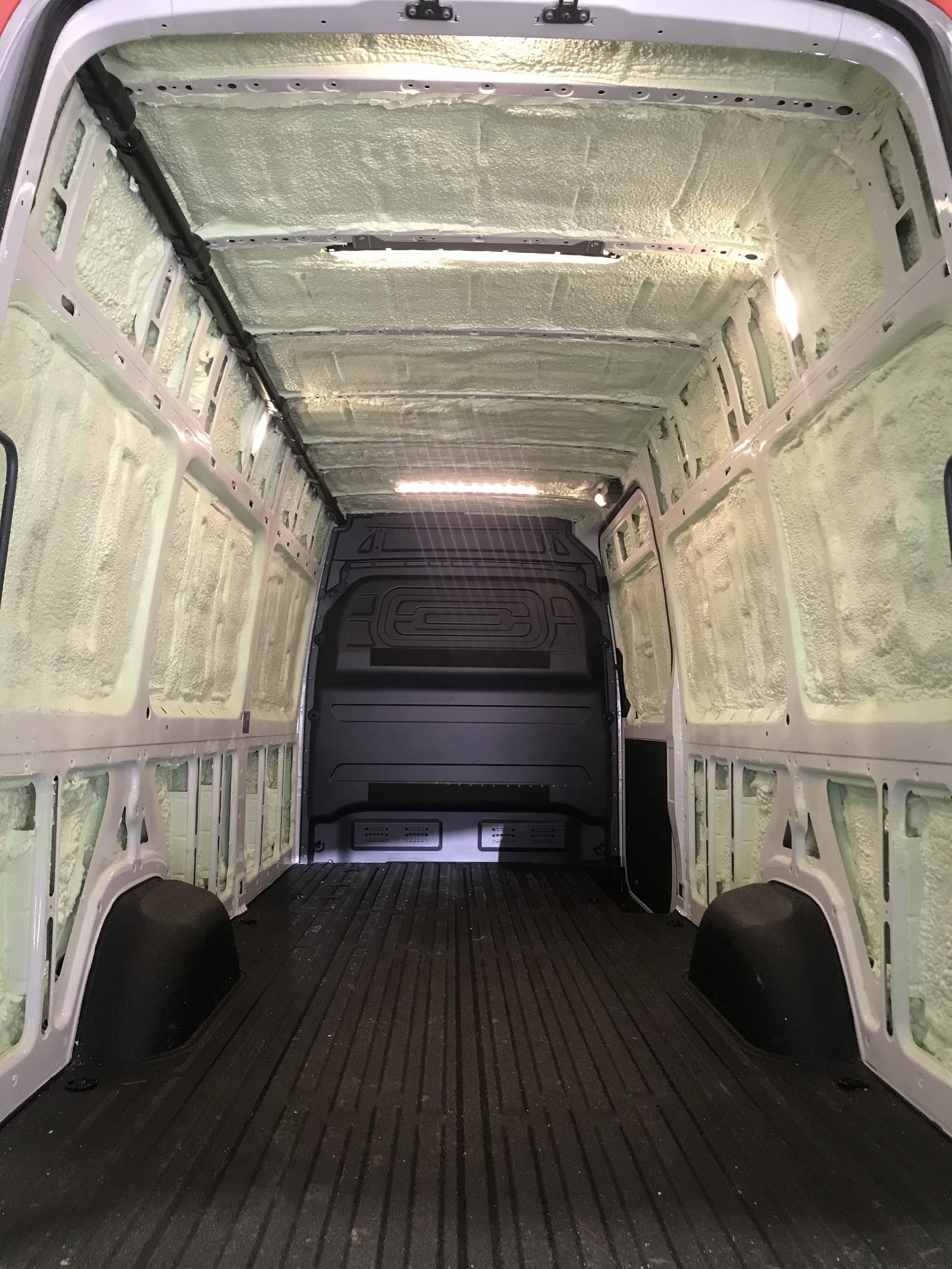
Occasionally we are asked to look at a trailer that has been foamed before and where the foam has come away from the wall in sheets, hanging off the skin with daylight behind it. Nobody picked the wrong product. Somebody sprayed onto a surface that would not hold it. Vehicle Spray Foam Insulation Ponoka is a prep job far more than it is a spraying job, and on the aluminium stock and horse equipment that moves through this town for the auction mart and the rodeo grounds, prep is most of the skill.
The underlying problem is still moisture. Animals and bedding put a lot of water into the air of an enclosed trailer, the skin is the coldest surface in there, and water forms on the metal and runs down inside the walls where nothing dries it.
The foam that let go in sheets
Closed cell grabs hard, but it grabs whatever is on the surface. Factory mill finish on aluminium carries a release film from manufacture. Steel out of a mill carries scale. Over a working life a trailer picks up wax, feed dust, manure residue, mat adhesive and a layer of powdery oxide. Spray onto any of that and the bond is between the foam and the contaminant, and the contaminant is holding on to nothing. It will stay up for a season or two, then a hard winter and a few hundred kilometres of washboard road will separate it, usually in one piece. Behind it the metal is exactly as cold as the day it was built.
Why adhesion decides whether vehicle spray foam insulation lasts
Our preparation for a trailer interior is mechanical and chemical, not cosmetic. Aluminium gets abraded to remove the mill finish, then cleaned. Steel gets loose scale and powdery rust taken off down to sound metal. Everything gets degreased and then has to be genuinely dry, not just not wet, because moisture on the panel at the moment of spraying ends up as a weak interface. Substrate temperature matters as well: foam applied to metal that is too cold will not cure or bond properly, so a trailer gets brought into shelter and allowed to come up to temperature rather than sprayed in a yard in January.
Once the surface is right, the material does what it is good at. Closed cell carries about R-6 per inch, which is efficient use of a shallow trailer wall; it cures as its own air barrier and vapour retarder, so there is nothing separate to lap and tape around a window or a vent; and it bonds into the panel and stiffens it, which quiets a trailer considerably. Open cell at about R-3.6 per inch is a good sound absorber but it is permeable and will keep water against metal, so it is not used here.
Horse trailer spray foam insulation around the nose and the dressing room
On horse and stock equipment the compartments that benefit are the enclosed ones: the dressing room and the tack area in the nose, the gooseneck, and the roof over a storage section where condensate drips onto saddles, blankets and feed. Live haul sections are built with slots and vents for a reason and we leave that air exchange alone. The gain in the nose is immediate because people sleep and change in there, which is to say they put moisture into it, and there is nothing in a factory dressing room wall that stops the framing conducting the outside temperature straight through.
What a Ponoka trailer hauls, and the dimension that sets depth
We decide thickness against the inside of the trailer rather than against a number. In a tack area it is usually saddle rack clearance and door swing; in a dressing room it is bunk length and the width to get past. Roof and upper walls take the most depth because the only loss there is head height. Weight is part of it too, since a gooseneck is often already working near its rating before anything is added.
Ribs, channels and the reason board was never an option
A trailer wall is a series of channels and hat sections, and the nose is a curve. Flat board can only span from one high point to the next, leaving an open channel behind every member with all of them joined together, so air still circulates against the skin and still condenses on it. Foam expands into the section and follows the curve, which closes the path instead of covering it.
Vehicle Spray Foam Insulation Ponoka: Common Questions
Previous foam fell off my trailer. Can it be redone. Usually, yes. We take the old material and the contamination it was bonded to right back off, prepare the metal properly, and start again. That is a common job for us in Ponoka.
Can you spray outdoors in winter. Not onto cold metal. The trailer needs shelter and time to warm through, otherwise the bond and the cure are both compromised.
Is aluminium harder to do than steel. Not harder, but less forgiving. The mill finish has to be removed. Anyone bidding after you search Best Vehicle Spray Foam Insulation Ponoka should be able to tell you exactly how they intend to prepare the surface.
Related: barn spray foam insulation, shipping container spray foam insulation and our local spray foam insulation services. Province-wide, Spray Foam Insulation Alberta and our spray foam insulation service areas.