
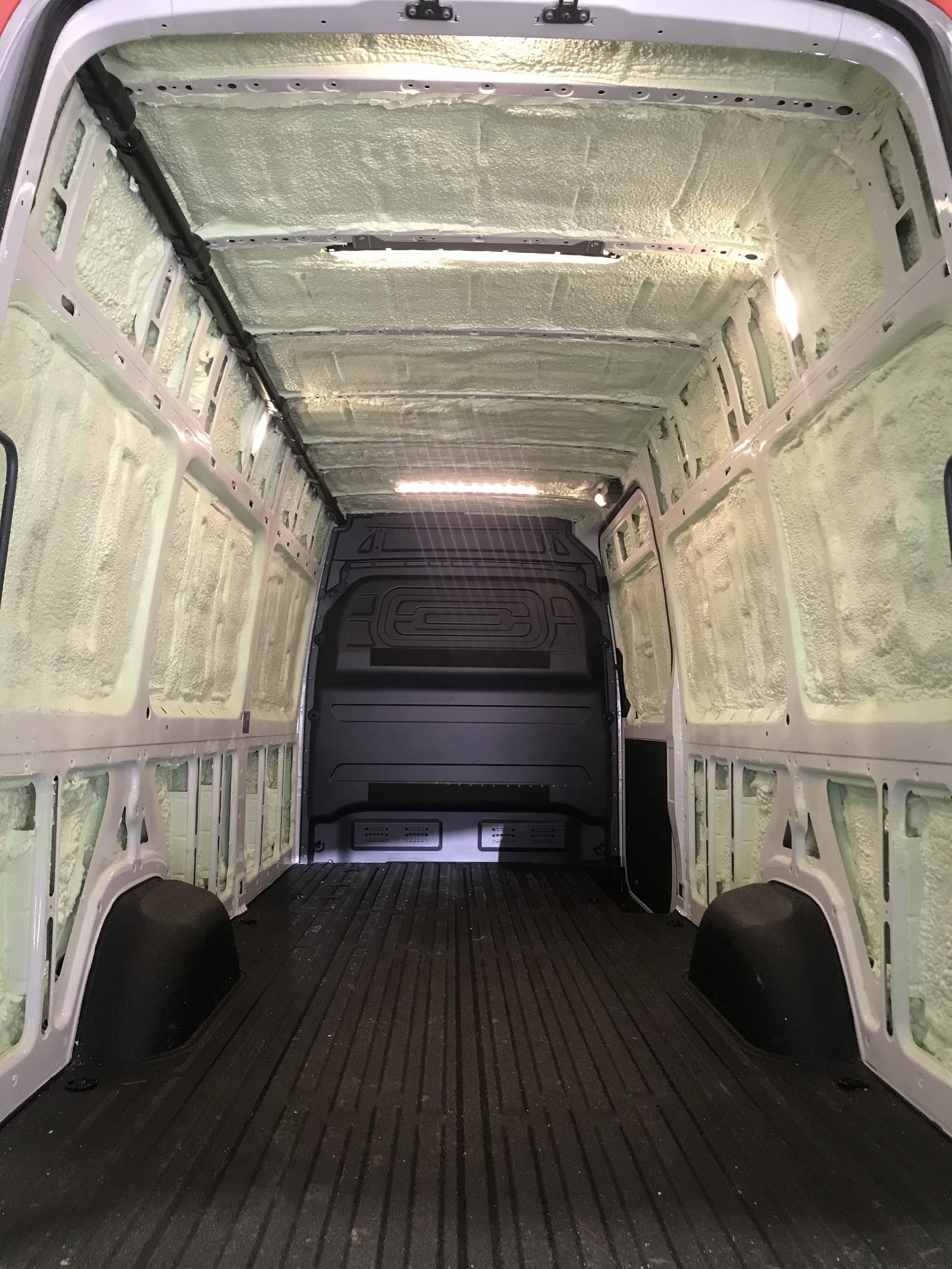
Vehicle Spray Foam Insulation St. Albert is mostly about units that live on a driveway. A compact motorhome squeezed in beside the garage, a mobile grooming or trades van that a household business runs out of, a tandem for the dirt bikes, a small fifth wheel that goes out to the mountains. None of these are fleet vehicles on a shift rotation. They sit for long stretches, get used in bursts, and the owner is usually the one who notices the wet ceiling because the owner is the one sleeping or working under it.
A unit used in bursts never gets a chance to dry
The pattern on a driveway unit is the problem. You heat it for a weekend, you fill the air with moisture from cooking, washing and breathing, and then you shut the door on it for three weeks. Whatever condensed on the panels while you were in there has no heat and no air movement to carry it away afterwards, so it stays. Next time you use the unit you add more. Over a winter that accumulates into a ceiling that feels clammy, cupboard backs that have gone dark, and a faint smell that will not air out in a day.
Why vehicle spray foam insulation on a motorhome means closed cell
Closed cell is what we put against the shell, and the case for it is cumulative. It provides about R-6 per inch, so a modest depth still changes how the unit holds heat on a cold night. It is at once an air barrier and a vapour retarder, so there is no separate membrane to fit around a window frame or a vent, which is where home-fitted barriers almost always fail. It bonds to the panel, so the long haul out to the foothills and back cannot shake it loose. And a bonded panel is a stiffer panel, which takes the tinny flexing noise out of a lightweight wall.
Board bridges a shaped wall and leaves a hidden hollow
Walk inside any recreational shell and feel the walls. There are formed uprights, a rolled transition at the ceiling, window surrounds that stand proud, a step over the wheel well. Rigid board makes contact on a handful of those raised faces and nowhere else, and the space it leaves behind joins up into a hollow that runs the height of the wall. Air moves through a hollow, and moving air brings water back to the coldest sheet over and over. The interior looks neat and the panel behind it gets wet in private. Spray takes the shape of the surround, follows the ceiling roll and seals against the sheet with nothing behind it.
Deciding depth when the layout is already fixed
Recreational units are laid out to the millimetre around standard furniture, so losing depth has visible consequences: a mattress that no longer fits the bunk, a slide that will not clear, an aisle too narrow to pass. We measure first and agree what each surface can surrender. Overhead usually has the most to give and also benefits the most, because the ceiling is where condensation shows up first. A working van is a different sum again, since the shelving along one wall sets the width you can give away.
Preparation on a unit somebody lives in
These units arrive with soft goods and residue in them. Carpet adhesive, double-sided mounting tape, old foil wrap, factory sound pads, and sometimes rust in the lower corners where water has been pooling for years. It all comes off and the sheet is dried, because foam grips the surface it touches and a tape residue is not a surface. Then we go through the shell with the owner and agree the untouchables: the loom to the lights and the fridge, the water lines, the propane routing, the roof vent opening, and any panel that gets lifted to service the heater or the pump. Those are left serviceable rather than entombed.
The person who quotes it is on the job
We come to the driveway, look at the unit, tell you what it will take, and our own installers spray it. The term people type is "Best Vehicle Spray Foam Insulation St. Albert", and what they really want is a straight answer about what will and will not fit.
Vehicle Spray Foam Insulation St. Albert: Common Questions
Can you work on the unit where it is parked. Often yes. A good share of our St. Albert work happens on the driveway or in the owner's garage, provided there is room to work around the unit.
Will it make the motorhome usable later in the year. It helps a great deal, because a shell that is not shedding its own moisture onto cold metal is far easier to heat and far more pleasant to sleep in.
What about the storage container at the back of the lot. We spray those too — shipping container spray foam insulation explains the approach.
More: spray foam insulation for the house and garage, the provincial picture at spray foam insulation Alberta, and our service areas.