
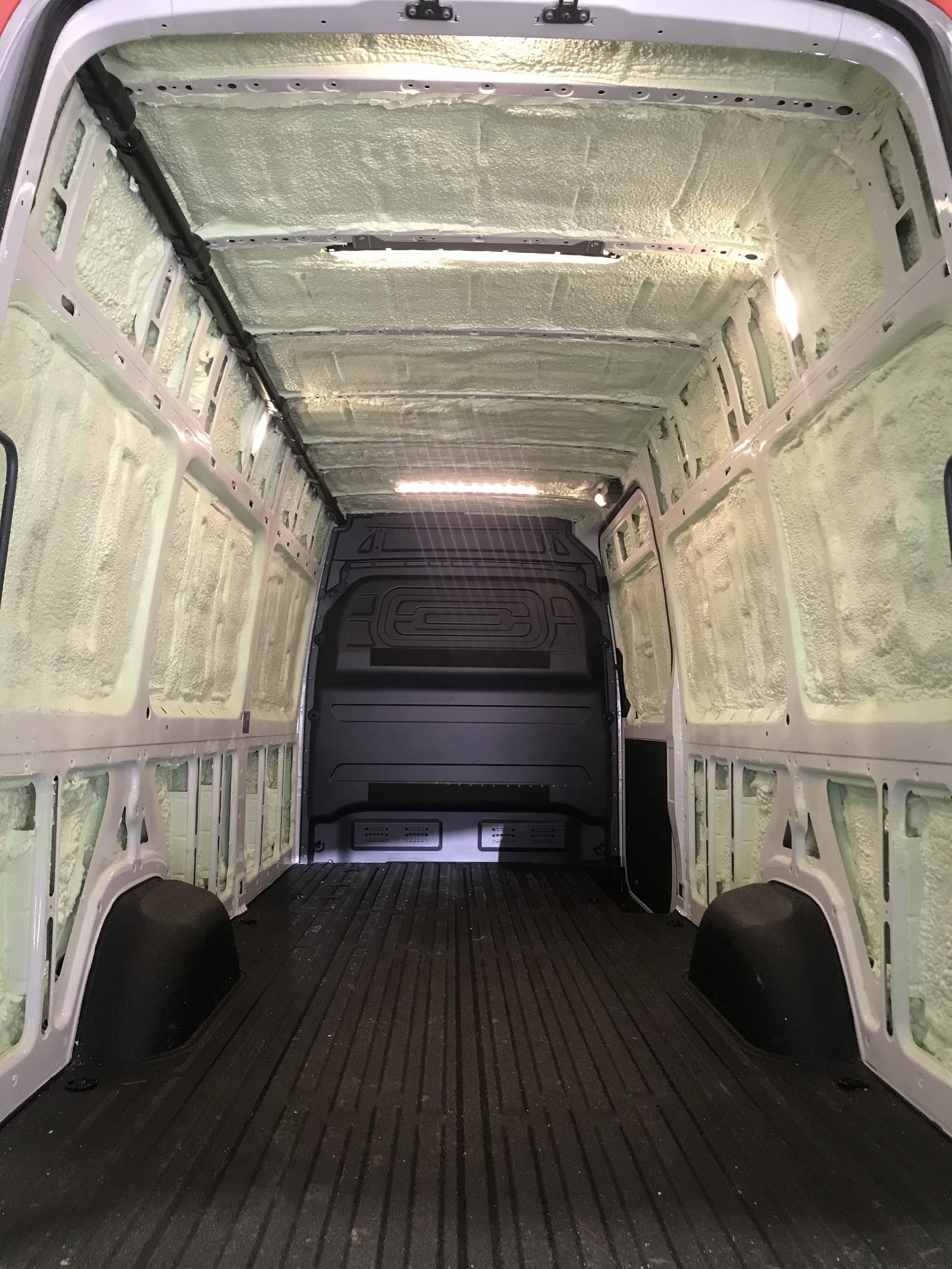
Drive the grid roads around Crossfield and there is a sea container parked at the back of nearly every shop yard and acreage. They start as dry storage, then somebody puts a bench in one, runs power out to it, hangs a heater, and it becomes a workshop. That is the point at which the owner discovers the thing containers are notorious for, and it is the reason Vehicle Spray Foam Insulation Crossfield gets asked about as often for containers as for trailers in this part of Rocky View.
The town sits between a farm district and the commuter corridor, so what we are asked to insulate here is a mix: containers, utility and stock-style trailers, and the occasional holiday trailer being made useful into the shoulder season.
Rain inside a container that has never leaked
A container is a steel box with a ribbed roof and no thermal break anywhere in it. Put a heater and a person inside and the air warms and takes on moisture from breathing, from a kettle, from wet boots, from a damp bag of something sitting on the floor. The roof is a single layer of weathering steel with the sky on the other side, so it is always the coldest surface in the box by a wide margin. The moisture goes straight to it, condenses on the underside, builds until the droplets are heavy, and then falls. Owners genuinely describe it as rain, and it lands on whatever is directly below. The hardwood floor takes the rest, because a container floor is absorbent and sits on cold cross members.
Shipping container spray foam insulation and the profile no board can follow
The inside of a container wall is a deep corrugation. A flat sheet of rigid board touches it only on the crests, and behind the board sits a continuous run of empty channels joined to each other top and bottom. That void is an air path and it runs the full height of the wall, so warm moist air circulates in it and delivers water to the coldest part of the steel exactly as it did before anybody insulated anything. Framing out to clear the corrugation costs you interior width and still leaves the void. Foam is applied wet and expands into every trough, over the crest, into the corner casting and across the roof rib in one unbroken skin, so there is no channel left and nothing connected.
Why vehicle spray foam insulation is a closed cell decision
Closed cell carries about R-6 per inch, which matters when the inside dimension is all you have. It cures as its own air barrier and vapour retarder, so the steel never reaches the dew point and no separate membrane has to be detailed around a door frame or a lifting lug. It bonds to the panel and takes the drumming out of a large flat wall. Open cell foam is a good material in a house and absorbs sound well at about R-3.6 per inch, but it is permeable, and permeable against cold steel just relocates the condensation.
Thickness against the space you lose
In a container the width is the thing you cannot get back. Benches, a vehicle door swing, a pallet turning: those decide depth before any R-value target does. We generally put the most depth on the roof, where it buys the most and costs only head height, and we trim what goes on the walls to whatever the working width can spare. On a trailer the same logic applies to the clear height at the ramp. Weight is also real, and on a tandem-axle trailer already near its rating the foam has to earn its mass.
What a Crossfield yard needs sorted before we arrive
Clean, dry, solid steel. Loose scale and surface rust off, old paint that has let go removed, grease and adhesive residue cleaned, and the box dry rather than merely not raining. We walk it with you and agree what stays reachable: conduit and junction boxes, door gear, vents, and any panel that will be unbolted later. If somebody searching Best Vehicle Spray Foam Insulation Crossfield only compares material and depth, they are comparing the easy half of the job.
Vehicle Spray Foam Insulation Crossfield: Common Questions
Will foam stop the roof dripping on my bench. Yes, because it removes the cold surface the water was forming on. Dripping in a Crossfield container is condensation, not a roof failure, and sealing the roof from outside does nothing for it.
Do I need to keep a vent if it is sealed up. Any space that is occupied or heated needs air exchange. Insulation handles the cold surface; ventilation handles the moisture you produce.
Can you do the floor too. We can treat the underside and the cross members, which is usually the better place to attack a floor that keeps coming up damp.
See also cold storage spray foam insulation, self storage spray foam insulation and the rest of our local spray foam insulation work. Further afield, Spray Foam Insulation Alberta and our spray foam insulation service areas.