
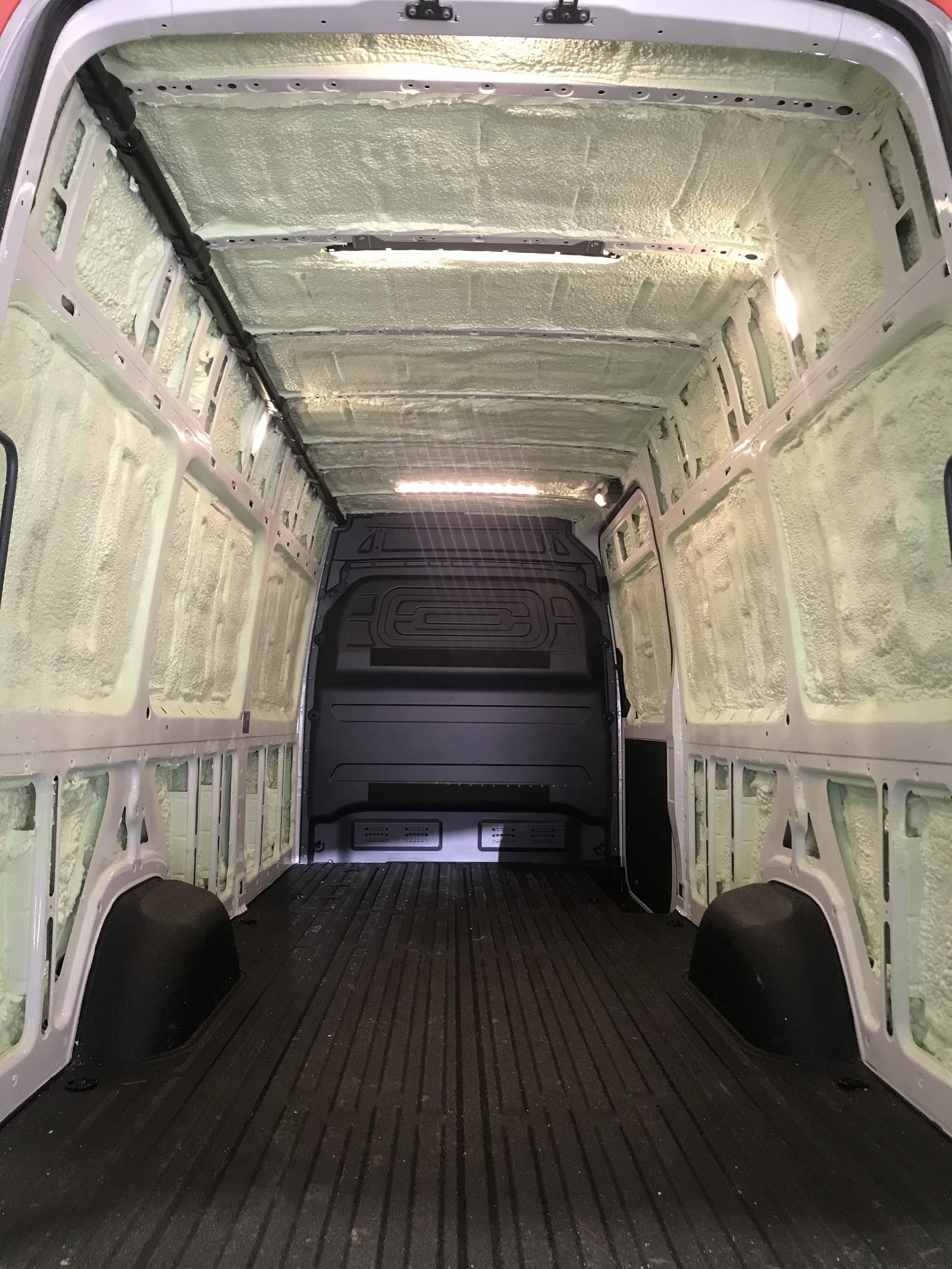
Vehicle Spray Foam Insulation Edmonton is fleet work more often than it is a one-off. The yards in Northwest Industrial, Winterburn, Davies, Coronet and Roper park dozens of cargo vans and box bodies on open gravel every night, and in January the dispatcher hears the same two things from drivers: the back of the unit is wet and the product nearest the doors came off the truck frozen. Both complaints come from the same piece of physics and neither is a mechanical fault.
Six in the morning in a yard off the Yellowhead
A unit that worked all day comes into the yard holding warm, damp air — breath, wet boots, melted snow off a hand cart, a hundred stops with the doors open. The engine stops, the steel shell gives its heat up to a clear sky, and within an hour the skin is the coldest thing for metres around. All that vapour leaves the air and arrives on the roof bows and the rear door frames as water. Overnight it freezes there. By the time the driver starts the route it is melting onto the load.
Fleet van spray foam insulation gets done a unit at a time
Nobody can hand over a whole fleet for a week, so the sequencing is the job. We take units in a rotation that dispatch sets, finish each one and hand it back before the next comes in, which is how an operator in Clover Bar or Kennedale gets through a fleet without losing a route. Closed cell at roughly R-6 per inch does the work: it is its own air barrier and its own vapour retarder, so once the shell is coated there is no interior air reaching cold steel anywhere in the body.
Where a box body ribs out and board cannot follow
A dry van body is built on bows and posts with a thin skin stretched between them, and a cargo van roof is a set of deep pressings. Rigid board can only land on the high points. It bridges every channel between them and leaves a connected cavity with bare metal at the back, which is precisely where the water you cannot see is forming. Sprayed foam goes down into the bow, around the post, over the wheel arch and up the radius at the roof line, so there is no cavity left to move air through and no uncoated metal to condense on.
Thickness against cube, pallet height and plated weight
On a commercial unit every inch is paid for twice — once in interior cube and once in payload. If the body is loaded to pallet height, depth on the ceiling is the first thing to come out of the specification. If the load is hand-stacked and light, there is room for more. Foam weighs something, and a unit already working near its plate has no appetite for a number chosen for its own sake. We set the depth against what the body carries and how long the doors stay open on a route.
What a working unit needs before the gun comes out
The shell has to be bare, clean and dry: lining, matting, decking and factory deadening out, surface rust taken back, old adhesive and tape removed. Loom for interior lighting, a liftgate or a beacon gets pulled and routed before anything is sprayed. Anything a technician will want to reach again — door hardware, junctions, serviceable panels — gets planned around rather than buried.
Who does the spraying
We are the contractor on vehicle spray foam insulation, not a referral service. We quote the job, schedule it and stand behind it, and our own installers carry it out. Fleet managers who search "Best Vehicle Spray Foam Insulation Edmonton" are usually trying to find one company that can take units in a rotation and keep to the dates, which is the part we treat as the work.
Vehicle Spray Foam Insulation Edmonton: Common Questions
Can you take more than one unit at a time. Yes, and across a large Edmonton fleet that is usually the sensible way to do it. The limit is how many trucks dispatch can release at once, not how many we can handle.
Will this keep product from freezing. Insulation holds a temperature, it does not make one. What it stops is the cold skin and the draught through a bridged cavity, which is what was freezing the pallets nearest the doors.
We only need the roof done. Is that worthwhile. Partly. The roof is where most of the condensation shows, but the rear frames and the upper corners are cold too, and leaving them bare leaves the water a place to keep forming.
Specific builds have their own pages: camper van spray foam insulation, trailer spray foam insulation and shipping container spray foam insulation. For buildings, see spray foam insulation, Spray Foam Insulation Alberta and our spray foam insulation service areas.